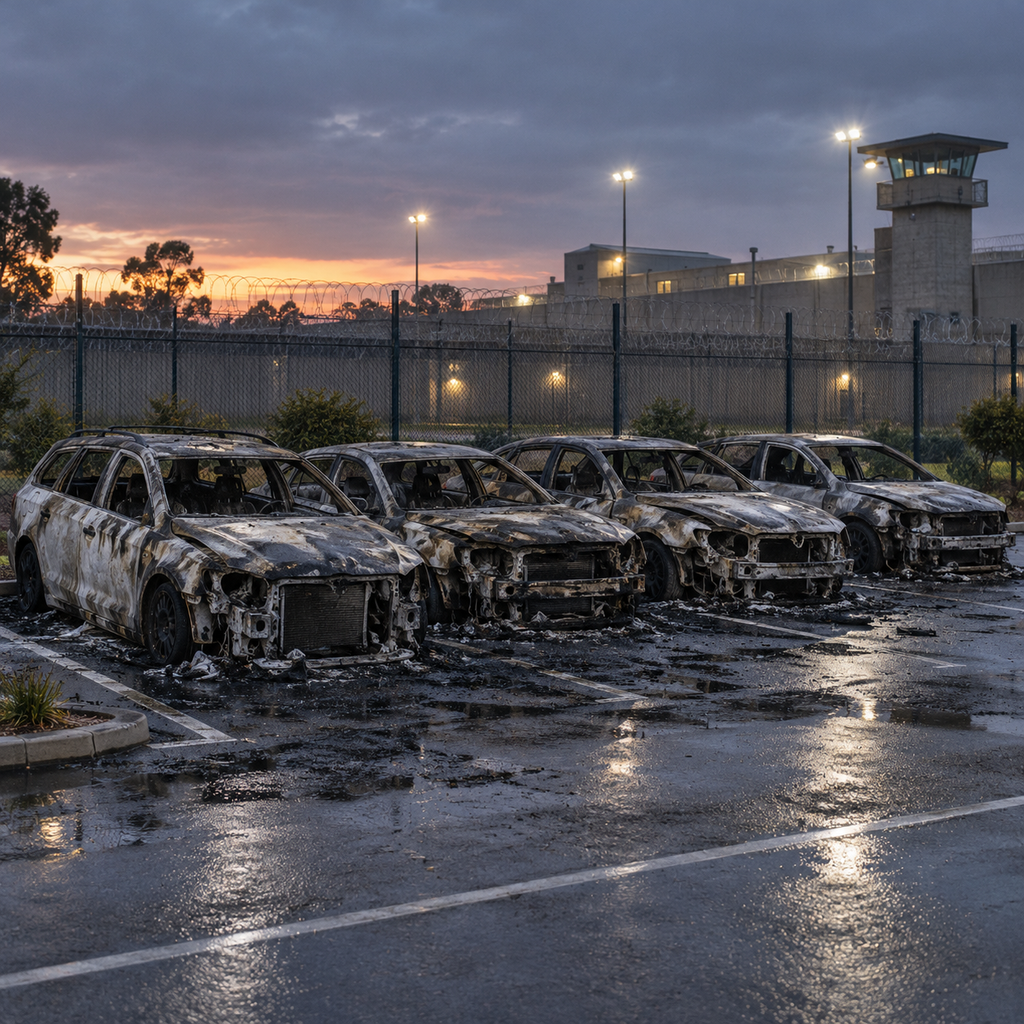
Four government vehicles were destroyed in a suspicious fire at Yatala Labour Prison in Adelaide’s north, intensifying concerns about the safety of correctional staff who use the facility’s car park. Police and firefighters were called to the site at Northfield after vehicles caught fire in the early hours. South Australia Police are treating the blaze as suspicious and are investigating how it began. The Public Service Association says workers had previously warned that security in the car park was inadequate and wants stronger protection. Those concerns are being aired while the police investigation is still active, so the fire’s cause and the identity of anyone responsible must not be presented as settled facts.
Emergency services attended the prison car park on Peter Brown Drive at about four in the morning. Police said two Mitsubishi station wagons and two Toyota sedans were completely destroyed. The damage involved government vehicles rather than a reported fire in the prison accommodation blocks. That distinction is important when describing the event: the account available does not support claims about prisoners escaping, cells catching fire or a prison-wide emergency. It does, however, raise a serious question about what happens when staff arrive for work and find vehicles destroyed in an area that is meant to support the daily operation of a correctional facility.
The police description is deliberately measured. Investigators are treating the fire as suspicious and have appealed for witnesses or relevant dashcam footage. A suspicious fire is not the same as a proven deliberate attack by an identified person. Although the Department for Correctional Services chief executive described the incident as an act of arson in comments to the ABC, that is his characterisation while police enquiries continue. The public has not been given a court finding, a charged offender or a verified motive. Keeping that distinction visible protects the integrity of the report while allowing readers to understand why staff and managers are concerned.
The Public Service Association says two workers arriving for duty encountered someone wearing a balaclava near the car park and that the person fled. This account has not been independently established as the identity of the person who started the fire. Police have not publicly linked a named suspect to the incident in the information reviewed. The union’s claim is nevertheless relevant because it helps explain the immediate reaction among members and the renewed demand for better security. It should be attributed to the union each time it is used, rather than written as a confirmed observation by police or an admission of responsibility.
Craig Bates, vice-president of the Public Service Association in South Australia, says workers have been raising concerns about the open nature of the parking area. The union says it wrote to the corrections department months earlier asking for improved protection. It wanted an extension of the perimeter fence and protective security officers on a round-the-clock basis. The union says those proposals were rejected. This is a contested part of the story because the department is responsible for balancing security arrangements and the operation of a large prison complex. The existence of an earlier request does not alone establish whether a particular prevention measure would have stopped the fire.
The union also points to earlier incidents affecting the car park. Mr Bates told ABC radio about an occasion when a stolen vehicle was driven through the area by masked people and later concerns were raised about a firearm. He referred to other instances of vehicle damage. Those are the union’s descriptions of previous events; the available account does not provide the full police record for each example. They add context to members’ concerns but should not be used to imply that all past incidents and the current suspicious fire were carried out by the same people or formed part of a coordinated campaign.
For workers, access to a car park can seem like a practical detail until questions arise about what happens before and after a shift. Correctional facilities often require staff to work at hours when ordinary surrounding activity is limited. The union’s argument is that parking areas used by prison staff need protection appropriate to the nature of the workplace. That is a position about risk and workplace safety, not proof of the precise circumstances of this fire. Police will need to establish what actually happened at the site, while the department and staff representatives may assess what changes are warranted even before any criminal investigation reaches a conclusion.
Department for Correctional Services chief executive David Brown acknowledged the seriousness of what happened and said the incident was the subject of an active police investigation. He said the department was looking at ways to enhance safety, including protection of the car park area. He did not rule out fencing or restricting access, while noting that Yatala is a large prison that has significant interaction with the public. Those statements show that the department is considering options, not that a particular scheme has already been approved, funded or installed. Announcing a review is different from confirming that workers will see an immediate change on the ground.
Mr Brown also said there was closed-circuit television material relating to the incident but declined to discuss its contents. That decision is consistent with the caution required around an active investigation. The existence of cameras does not automatically mean that every movement, vehicle or person was clearly recorded, and the footage has not been described in enough detail to identify an offender. Neither reporters nor readers can reliably reconstruct the event from a bare statement that CCTV exists. Any later police release may clarify what was captured, but speculation about images not publicly shown would go beyond the evidence.
There are several separate questions now facing authorities. The first is a criminal investigation into how the four vehicles were destroyed and whether anyone committed an offence. The second is an administrative review of security and whether present arrangements protect staff and government property adequately. The third is how decisions about requested changes were made before the incident. Answers to one question will not necessarily determine the others. Even if police identify a suspect, that would not alone decide the merits of fencing proposals; equally, a decision to build a fence would not establish that earlier managers were criminally or legally negligent.
The most immediate security debate centres on whether a vehicle parking area should be more tightly separated from public access. The union favours physical fencing and continuous protection, while management says it must consider the way the prison interfaces with the surrounding environment. Those positions could be assessed against available evidence of previous incidents, operational requirements and the likely effectiveness of proposed controls. No independent security assessment has been released in the source material reviewed. It would therefore be premature to declare that one proposal is obviously sufficient or that the department has been shown to have broken a specific duty.
Police have requested information from anyone who may have witnessed suspicious activity or recorded relevant footage. That appeal indicates investigators are still seeking to establish the circumstances, and it should not be recast as a search for a named, proven offender. Members of the public with relevant information can use the official Crime Stoppers reporting channel. It is particularly important not to circulate unverified photographs or online claims identifying people alleged to have been near the prison. Confusion between a possible witness, a person seen nearby and a suspect could harm the investigation and unfairly damage reputations.
The fact that four vehicles were written off is confirmed and consequential. Replacing them may involve insurance, fleet arrangements or operational decisions, but no verified replacement cost has been published in the inspected reporting. It would be misleading to attach a dramatic financial estimate without a departmental figure. Similarly, the fire’s effects on staff shifts, prisoner movements and daily prison services have not been quantified. Readers can appreciate that the loss of government vehicles is a serious incident without being told that other disruptions occurred unless authorities substantiate them.
Public debate about the prison should also avoid blaming prisoners as a group. The incident happened in a staff parking area, and the information released does not establish who caused the blaze or whether the offender had any connection with people incarcerated at Yatala. Claims about revenge, gangs or a targeted attack on officers remain speculative without evidence. The corrections environment can make dramatic explanations tempting, but the reporting standard is the same as for any other suspicious fire: identify the location and damage, attribute competing accounts, and wait for police findings before connecting an offence to individuals.
The union’s frustration is understandable as a stated response to repeated requests for stronger protection, and it deserves accurate reporting. At the same time, the department’s acknowledgement of the seriousness of the incident and its willingness to consider options are part of the record. A balanced article need not pretend those accounts are identical; it should make clear which facts are independently confirmed and which claims come from organisations with different responsibilities. This keeps the focus on the staff and safety questions rather than turning an unresolved fire into a contest of allegations presented as established wrongdoing.
Yatala Labour Prison now faces a practical period of review alongside a police investigation. Investigators must determine the fire’s origin and whether anyone is responsible; correctional managers must decide whether access and monitoring arrangements need to change. The available information supports reporting substantial vehicle damage, a suspicious blaze and long-running union demands for improved security. It does not support a claim that the culprit, motive or a preventable failure has already been established. Until authorities provide more detail, the most useful outcome for readers is a clear separation between what happened, what people say should have been done, and what still needs to be proved.






