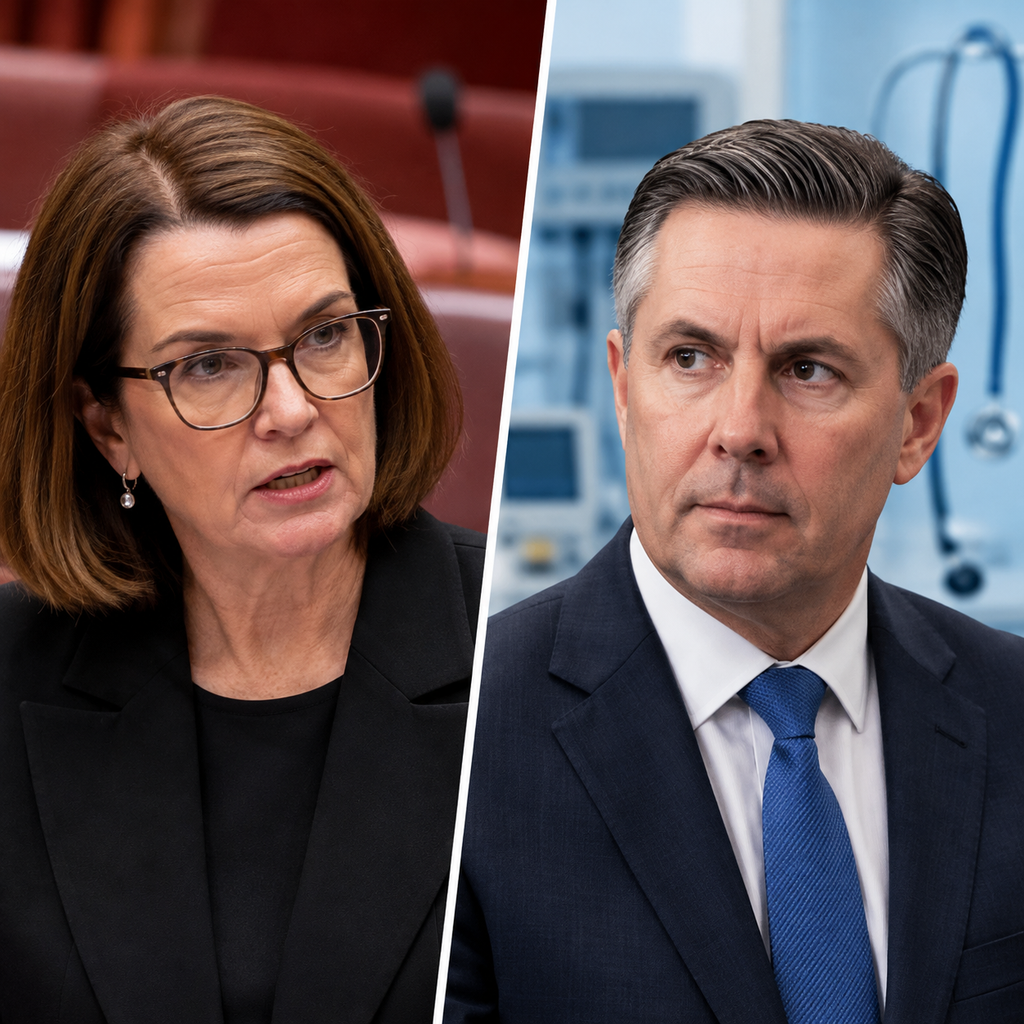
A dispute between opposition health spokesperson Anne Ruston and Health Minister Mark Butler has exposed a significant gap between two forecasts for older Australians expected to leave private health insurance under proposed rebate changes. Ruston accused Butler of misleading seniors, while the government argued that the numbers refer to different periods and must be considered alongside expected growth in overall membership. The disagreement is about a proposal, not a law already imposed on policyholders.
Health department modelling released under freedom of information processes forecast an initial decline in private cover among older Australians of about 44,000 people, with a cumulative reduction estimated at around 78,000 over a longer assessment period. Both numbers describe predicted responses to the policy, rather than verified counts of people who have cancelled their insurance. That distinction is essential for anyone trying to understand whether the proposal has already changed their bill.
Ruston argued that the government had routinely emphasised the smaller figure when defending the plan. “Either he didn’t read his own briefs, or he’s been deliberately misleading older Australians,” she said. That is an allegation about the minister’s knowledge and intentions, not a proven finding that Butler deliberately gave false information.
Butler’s response was that the smaller estimate reflected the department’s preferred measure over an initial assessment period and that the larger number covered a longer projection. He also pointed to modelling in which private health insurance membership was forecast to increase overall by roughly 360,000, even as the proposal was expected to cause some older people to drop their policies. A net increase in all members does not cancel the concern for the particular group affected.
The proposal would wind back the age-related premium rebate available to older private health insurance customers. The government expects savings of about $3 billion to support commitments in the aged-care system. Those figures describe the intended budget effect of a proposed reform; they are not a guarantee of savings or an assurance that Parliament will enact the policy unchanged.
For a retiree living on a fixed income, the most pressing issue may not be which politician handled a briefing correctly. It may be whether the cost of retaining a hospital policy rises beyond what a household budget can comfortably afford. When a rebate is reduced, the amount the customer must contribute can increase even if the insurer’s underlying premium remains unchanged. The precise effect would depend on the enacted policy and the person’s eligibility.
Private health insurance products differ significantly. Hospital cover and extras cover provide different benefits, and higher premiums do not necessarily correspond to services an individual expects to use. A person considering their options needs to understand the policy’s inclusions, exclusions, excess, waiting periods and any restrictions on treatment. Broad political forecasts cannot answer those individual questions.
The rebate framework is particularly important to older members because it has helped reduce the cost of maintaining cover. A policy adjustment affecting this group may lead some to choose a cheaper product, increase their excess or leave private cover altogether. The department’s projected cancellations attempt to estimate one part of that response, but modelling relies on assumptions rather than observing future decisions.
A forecast of 44,000 people and one of 78,000 people can both appear in the same analysis without being arithmetically contradictory. The key is whether they describe different time horizons or different definitions of the change. Comparing them as though both referred to the same point can mislead readers, while quoting only one without its context can leave out a material part of the policy discussion.
The department has acknowledged uncertainty inherent in using historical patterns to predict consumer behaviour. Future insurance premiums, wages, pensions, health needs and competing living costs can all influence a person’s choice. If economic circumstances differ from the model’s assumptions, actual outcomes may be higher or lower than projected. That is why forecasts should not be written as observed facts.
Butler has emphasised the overall projected growth of private insurance participation. That context matters when assessing the market’s aggregate direction, but it also has limits. A larger national membership figure can rise while a smaller demographic group experiences a decline because of a policy directed at that group. One measure does not erase the other.
Ruston’s argument centres on whether the government has been sufficiently candid with older Australians about the potential consequences. It is fair to scrutinise whether public statements clearly identified the full range of modelling. It is not fair to assert, without stronger evidence, that the minister intentionally deceived people. Accuracy requires separating questions about communication from conclusions about personal intent.
The proposal is also being debated against the needs of the aged-care system. Funding aged care is a significant public responsibility, covering services for people with increasing support needs. Redirecting expected savings from one subsidy to another can be defended as a choice about priorities, but it creates a legitimate question about how the benefits and costs fall across groups of older Australians.
The age-related private health rebate and public aged-care services are different parts of the system. One reduces an individual’s insurance bill; the other supports services delivered through aged-care arrangements. A policy may seek to shift funding from one to the other without ensuring that every person who loses a rebate will receive an equivalent direct benefit. The distributional effects should be explained rather than assumed.
A further concern raised in reporting is whether more cancellations could place pressure on public hospitals. If patients who would otherwise use private facilities choose public treatment instead, demand may shift between sectors. The scale of any change depends on the medical services involved, the behaviour of affected members and public hospital capacity. It should not be presumed that every person leaving insurance will need a public hospital bed.
State and territory governments have an interest in such forecasts because they oversee much of the public hospital system. An increase in demand can affect waiting lists and service planning, though the eventual impact depends on circumstances that are difficult to model perfectly. Policymakers should assess those system-wide consequences alongside the direct savings expected from reducing a federal rebate.
For households, the insurance decision involves more than the premium alone. A lower-cost product may expose a member to higher out-of-pocket expenses or narrower hospital choices. On the other hand, someone who rarely uses extras benefits may decide that a different mix of cover makes more financial sense. These possibilities explain why members’ responses can vary; they do not support a universal recommendation to cancel or retain insurance.
Older Australians may also be weighing insurance against housing, utilities, food and transport. Inflation in essential expenses can make a premium increase more significant than it appears in isolation. A policy justified at the level of the federal budget can therefore affect household decisions in ways that are not fully visible through a national membership forecast.
The business dimension is significant as well. Private insurers plan around the age and health profile of members, expected claims and the number of people maintaining cover. Changes that disproportionately affect older members can influence how insurers estimate future costs. But it would be premature to assert that the proposal has already produced particular premium changes without verified insurer decisions.
The government argues that adjustments to the rebate make the allocation of subsidies fairer. Critics question whether this approach risks disproportionately affecting people who depend on the subsidy to maintain insurance. Neither proposition can be evaluated properly without discussing who receives the subsidy, the intended beneficiaries of redirected funds and the projected number of people who may leave cover.
Parliamentary debate also matters because the reform faces legislative scrutiny. Proposals can be amended, delayed or rejected. Consumers reading about projected consequences should not confuse an announced intention with an operative rule. Any change to eligibility, effective dates or premium arrangements would need to be confirmed through legislation and official guidance before individual costs can be calculated reliably.
A useful government explanation would set out both cancellation projections prominently, identify their distinct horizons, disclose major assumptions and describe how officials estimated the overall membership increase. It would also explain how the proposed savings would reach aged care and whether additional hospital demand was considered. Those details would permit voters to assess trade-offs without relying on political accusations alone.
Opposition scrutiny should follow the same standard. Quoting the larger estimate is legitimate, especially if the smaller figure dominated public discussion, but a full account must note the different periods and the uncertainty surrounding both forecasts. Presenting the larger estimate as a verified mass cancellation would repeat the sort of oversimplification the criticism seeks to challenge.
For a pensioner, the most useful next information would be any official change to their rebate entitlement, the insurer’s notice of their actual premium and the details of the product they hold. Until policy settings become law and insurers communicate the consequences, modelling should be treated as context rather than a substitute for a personal quote.
The dispute has focused attention on an important issue: how governments describe policies whose budget benefits are concentrated in one place while costs may be borne by a specific group of households. A technically correct short-horizon number can still leave an incomplete impression if a longer-horizon estimate is not explained. Equally, a longer projection should not be used to imply that the government has concealed an observed outcome.
Ruston and Butler disagree over how the proposed rebate change should be presented and justified. The substantive questions are whether older Australians can keep affordable cover, how redirected funds would support aged care and what public hospitals might experience if some members leave. Those are financial and health-system questions that deserve clearer evidence than a fight about which forecast makes the stronger headline.