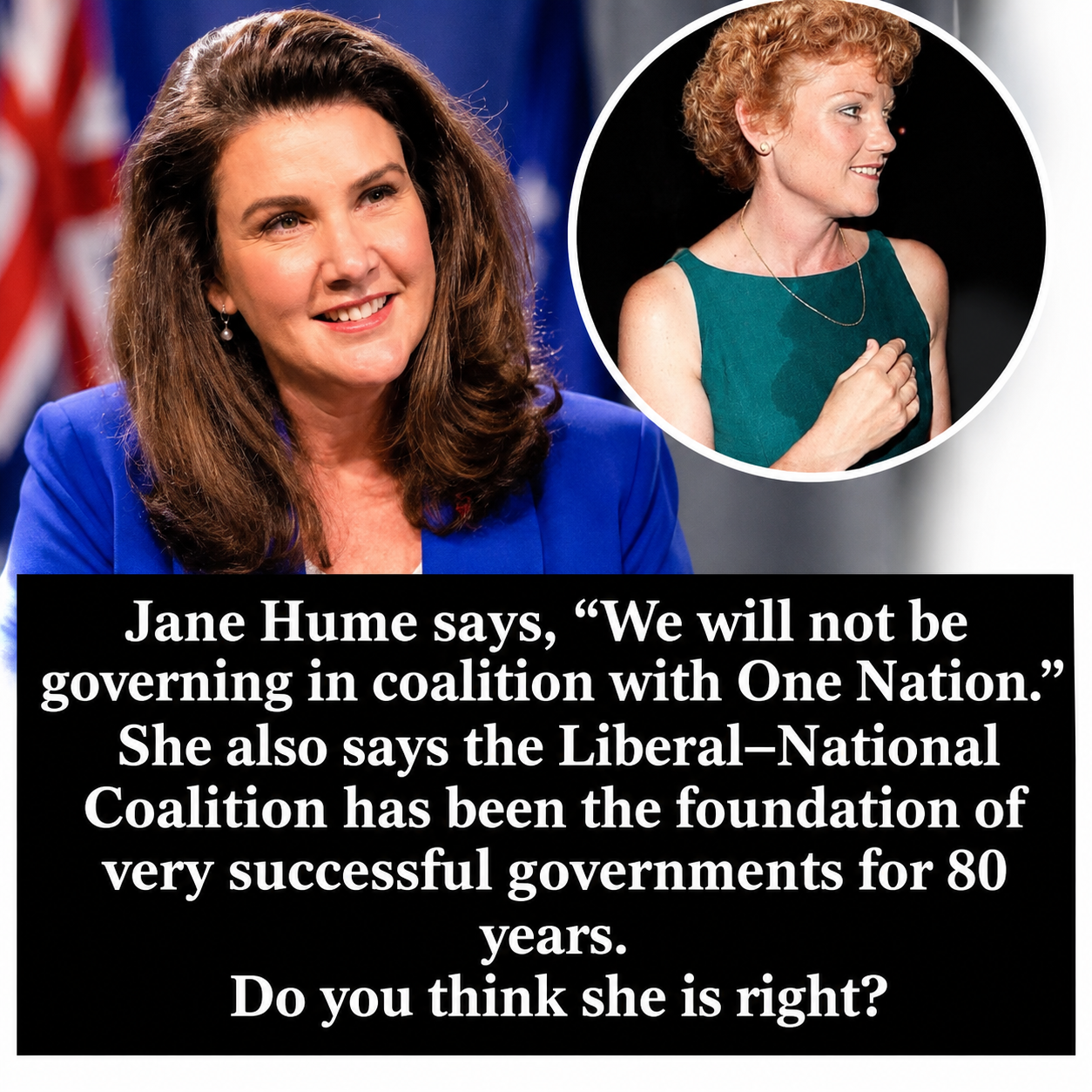
Liberal deputy leader Jane Hume has emphatically rejected suggestions that the Liberal Party could enter a formal governing arrangement with Pauline Hanson’s One Nation, insisting the Coalition has “no plans” and “no intention” of forming a coalition with the minor party regardless of recent political speculation.
Speaking after renewed questions about possible post-election scenarios, Senator Hume reaffirmed that the Liberal Party remains committed to its long-standing partnership with the National Party and is focused on securing government in its own right rather than relying on One Nation.
“No, we will not,” Hume said when asked whether the Liberals would consider a formal coalition with Pauline Hanson’s party.
She described the Liberal–National Coalition as a political partnership that has successfully governed Australia for around 80 years and said that relationship would remain the Opposition’s priority.
Her comments were widely interpreted as an attempt to shut down growing speculation triggered by fellow Liberal senator Andrew Bragg, who had earlier suggested politics sometimes requires pragmatism if election numbers leave no party able to govern alone.
Appearing on the Today program, Bragg said the Coalition would naturally speak with parties willing to work constructively if parliamentary arithmetic required it, remarks that many observers interpreted as leaving the door open to potential cooperation with One Nation in a hung parliament.
Asked directly about Bragg’s comments, Hume declined to engage with hypothetical post-election scenarios.
Instead, she stressed that the next federal election remained many months away and said the Coalition’s objective was to win a governing majority rather than depend on negotiations with minor parties or independents.
“Our focus is on winning government,” she said, dismissing discussion of minority-government arrangements as premature.
The differing public comments have highlighted the complex political environment confronting Australia’s centre-right opposition.
While One Nation has recorded stronger polling in recent years and has sought to broaden its electoral appeal, Liberal leaders have continued to reject any suggestion of a formal governing alliance with Pauline Hanson’s party.
The issue has nevertheless attracted attention because Australia’s increasingly fragmented political landscape has made minority governments and crossbench negotiations more plausible than in previous decades.
Australia’s Coalition is itself a long-established formal partnership between the Liberal Party and the National Party.
The arrangement dates back more than eight decades and has produced numerous federal governments, including those led by Robert Menzies, Malcolm Fraser, John Howard, Tony Abbott, Malcolm Turnbull and Scott Morrison.
Following internal disagreements after the 2025 federal election, the Liberals and Nationals briefly separated before re-establishing their Coalition agreement in 2026, reinforcing the importance both parties continue to place on the partnership.
Hume’s remarks therefore underline that, despite political pressure from smaller conservative parties, Liberal leadership continues to view the Nationals as its only formal coalition partner.
That position has also been reflected in previous public comments made by senior Liberal figures during debates over One Nation’s rising support.
The renewed discussion comes as Pauline Hanson seeks to position One Nation as an increasingly influential force in Australian politics.
The party has recently strengthened its organisational structure, appointing former Morrison government adviser Chris Taylor as Senator Hanson’s chief of staff while promoting long-time strategist James Ashby to Party Director, where he will oversee national campaign operations and candidate recruitment.
Those changes have been presented by One Nation as part of preparations for a busy election cycle that includes several state contests and the next federal election.
Opinion polling has also contributed to speculation.
Recent surveys have suggested One Nation remains capable of attracting a significant share of the conservative vote, prompting continued discussion about how preferences and parliamentary numbers could influence the formation of Australia’s next government.
However, opinion polls do not determine parliamentary outcomes, and Australia’s preferential voting system means final seat numbers depend on the distribution of preferences as well as primary votes.
Political analysts note there is an important distinction between a formal coalition agreement and cooperation on individual pieces of legislation.
Australian minority governments have historically negotiated support from crossbench MPs and smaller parties on a case-by-case basis without creating formal coalition arrangements.
Such agreements vary considerably and often depend on the specific composition of Parliament following an election.
Hume’s comments addressed the question of a formal coalition rather than every possible parliamentary negotiation that might occur after an election.
For One Nation, speculation about potential cooperation with the Coalition reflects the party’s broader ambition to expand its influence over national policy.
Senator Hanson has repeatedly argued that One Nation’s growing electoral support demonstrates increasing public dissatisfaction with Australia’s major parties and has said her party is prepared to pursue policies it believes address immigration, cost-of-living pressures, energy security and government spending.
At the same time, Hanson has indicated that while she is open to constructive parliamentary cooperation where policies align, One Nation remains an independent political party with its own priorities rather than an extension of the Coalition.
The debate also illustrates the broader strategic challenge facing the Liberal Party.
On one hand, the Opposition is attempting to attract conservative voters who may be considering One Nation or other minor parties.
On the other, Liberal leaders continue to emphasise that the party seeks to govern from the political centre-right through its established partnership with the Nationals rather than through formal alliances with populist minor parties.
That balancing act has become increasingly significant as Australia’s political landscape becomes more fragmented and competition for conservative votes intensifies.
For now, Jane Hume has sought to remove any ambiguity.
Despite speculation generated by differing comments from within Liberal ranks, she insists the Coalition has no intention of governing in formal partnership with Pauline Hanson’s One Nation and remains focused on securing an outright election victory alongside the National Party.