Prime Minister Anthony Albanese’s flagship pledge to help solve Australia’s housing crisis by delivering 1.2 million new homes is facing growing scrutiny after fresh Australian Bureau of Statistics (ABS) data showed the country has fallen well behind the pace required to meet the ambitious five-year target.
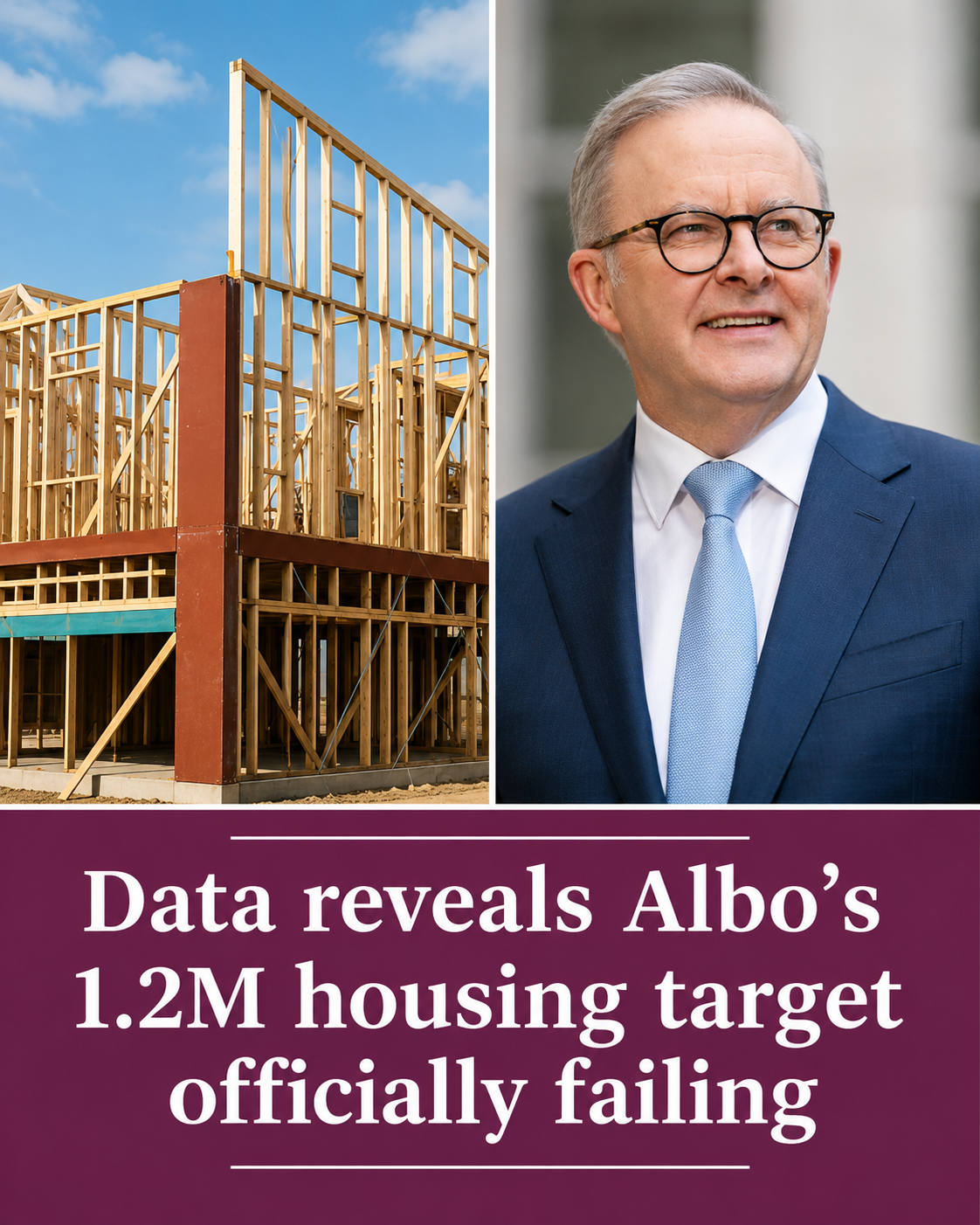
According to the latest ABS building approvals figures for June 2026, Australia has approved 393,426 new dwellings since the National Housing Accord commenced, leaving the nation more than 100,000 approvals short of where it needed to be after two years of the program. To remain on schedule, around 500,000 homes would already have required approval by this point.
The figures represent a significant challenge for one of the Albanese government’s signature domestic policy commitments. The National Housing Accord aims to deliver 1.2 million well-located homes across Australia over five years through cooperation between the Commonwealth, states, territories, local governments, institutional investors and the building industry.
While there has been some encouraging movement in recent months, industry leaders say the improvement is not yet sufficient to recover lost ground.
ABS data shows approvals increased from 188,777 dwellings during the 12 months to June 2025 to 204,649 during the year ending June 2026, marking the strongest annual approval level since 2021. Apartment approvals were a major contributor to the increase, while detached house approvals remained relatively steady for six consecutive months.
Despite that improvement, experts caution that approvals alone do not guarantee homes will actually be completed. Construction delays, labour shortages, financing constraints and higher building costs mean many approved projects can take years to reach completion, while some never proceed at all.
Industry analysis suggests Australia would likely need to approve at least 250,000 homes annually—well above current levels—to ensure enough dwellings ultimately reach completion and satisfy the government’s overall target.
Master Builders Australia says the challenge extends well beyond planning approvals.
The organisation argues that the construction industry continues to face persistent pressures including elevated material costs, reduced productivity, shortages of skilled tradespeople and increasingly complex planning and regulatory processes. Those constraints have combined to slow the delivery of new housing despite strong demand across much of the country.
Housing affordability remains one of Australia’s most pressing economic and political issues.
Rapid population growth during recent years, combined with years of insufficient housing supply, has contributed to rising property prices and rental costs in many metropolitan and regional markets. Vacancy rates have remained historically low across several capital cities, placing further pressure on renters while making home ownership increasingly difficult for first-home buyers.
The Albanese government introduced the National Housing Accord as the centrepiece of its long-term strategy to expand housing supply. The broader package also includes initiatives such as the Housing Australia Future Fund, support for social and affordable housing projects, incentives for first-home buyers and cooperation with state governments to accelerate residential development.
However, achieving the Accord’s headline target depends not only on federal funding but also on planning approvals, infrastructure investment, state and local government cooperation, workforce availability and private sector confidence.
Economists note that recent approval numbers have at least returned to a level broadly consistent with current population growth. Nevertheless, they stress this does not erase the shortfall accumulated during the first two years of the Accord, meaning Australia must now sustain significantly stronger building activity for an extended period if the original deadline is to remain achievable.
Some analysts also warn that policy settings introduced in the latest federal budget could affect future approvals.
Industry representatives have expressed concern that changes affecting investment structures, including restrictions on certain borrowing arrangements for self-managed superannuation funds, could reduce investment in residential property development and rental housing. While opinions differ over the long-term effects, some developers believe those policy changes may begin appearing in approval data over coming months.
Another major challenge is the rising cost of construction.
Master Builders Australia estimates that building a new home now costs around 50 per cent more than before the COVID-19 pandemic, reflecting higher labour expenses, more expensive building materials and ongoing supply-chain disruptions. These increases have placed pressure on both builders and prospective homebuyers while reducing project feasibility for some developments.
The Productivity Commission has likewise identified planning regulation and development approval processes as significant barriers to increasing housing supply. In an interim report, the Commission argued that complex land-use rules and lengthy approval pathways have become a substantial constraint on new residential construction, particularly in high-demand urban areas.
Several economists argue that improving supply will require coordinated reform across every level of government rather than relying solely on Commonwealth initiatives.
Planning systems are largely controlled by state and local governments, meaning rezoning decisions, infrastructure provision and development approvals all play critical roles in determining how quickly additional housing can be delivered. Industry groups have repeatedly called for streamlined planning processes alongside continued investment in roads, utilities and transport to unlock new housing developments.
Although the latest ABS figures demonstrate that building approvals are moving in a more positive direction, the National Housing Accord remains well behind its intended trajectory.
Some independent assessments now suggest the original target may ultimately be achieved later than planned rather than within the five-year timeframe ending in mid-2029. Estimates published by the National Housing Supply and Affordability Council indicate the milestone could slip into 2030 unless construction activity accelerates significantly.
For the Albanese government, the numbers present both encouragement and political pressure.
The rise in annual approvals indicates momentum has improved compared with a year earlier, offering evidence that housing activity is recovering after a prolonged slowdown. Yet the cumulative shortfall highlights the scale of the challenge still facing policymakers as affordability remains a dominant concern for households across Australia.
Whether the government can ultimately fulfil its promise of 1.2 million new homes will depend on sustaining higher approval rates, converting approvals into completed dwellings more efficiently, reducing construction bottlenecks and maintaining investment confidence throughout the remainder of the Accord period. As Australia’s housing shortage continues to affect buyers and renters alike, future ABS releases are likely to be watched closely as a key measure of whether the nation’s most ambitious housing program can still return to schedule.