For years, political debate surrounding social media has focused largely on voters.
Algorithms have frequently been blamed for reinforcing existing beliefs, encouraging political polarisation and helping smaller parties build loyal online communities.
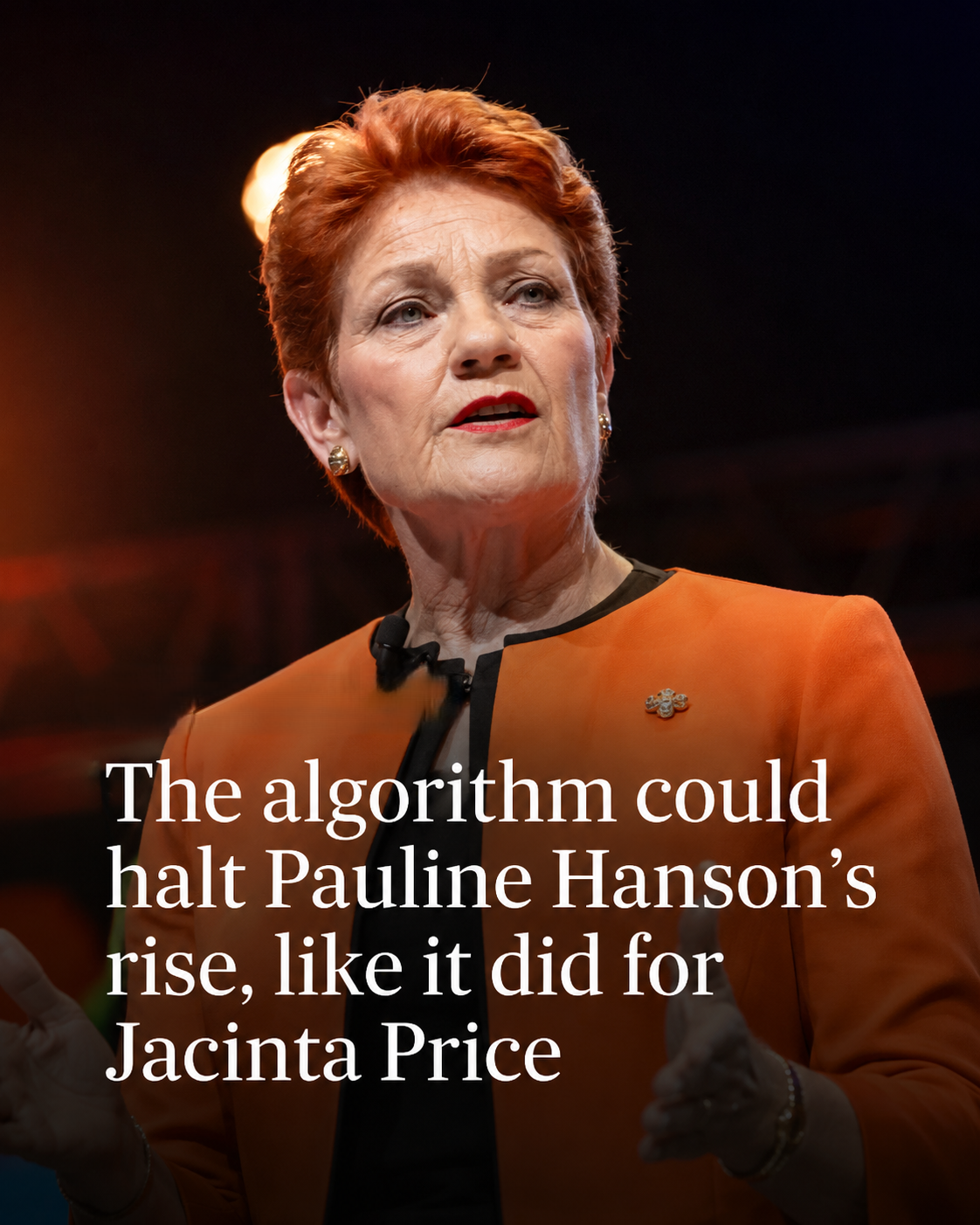
Now, a new political analysis argues the greater consequence may not be what algorithms are doing to voters—but what they are doing to politicians themselves.
According to the commentary, social media feeds can create a distorted picture of public opinion, encouraging political leaders to mistake their most enthusiastic online supporters for the broader electorate they ultimately need to win.
The analysis focuses particularly on Pauline Hanson’s One Nation, a party that has significantly expanded its online presence while also enjoying rising support in national opinion polls.
Recent surveys have placed One Nation among Australia’s strongest-performing minor parties, fuelling speculation about whether it could secure additional seats at the next federal election.
However, the article argues that electoral momentum alone does not guarantee long-term political success if online engagement begins shaping strategy more than real-world voter behaviour.
The central argument is relatively simple.
Social media algorithms are designed to maximise user engagement rather than accurately reflect public opinion.
Because highly engaged supporters are more likely to like, comment, share and interact with political content, politicians can gradually come to believe those voices represent mainstream public sentiment even when they may reflect only a particularly active segment of the electorate.
In other words, the algorithm rewards intensity—not necessarily popularity.
For a party such as One Nation, whose supporters often display exceptionally high engagement across social media platforms, that dynamic may create a powerful feedback loop.
Messages that receive the strongest online response can encourage politicians to emphasise increasingly uncompromising positions because those posts generate greater visibility, stronger engagement and wider distribution through platform recommendation systems.
The risk, according to the analysis, is that political success on a social media feed does not always translate into electoral success at the ballot box.
The commentary argues that politicians can gradually begin performing for the audience they see online rather than the much broader and often less vocal group of Australians who ultimately decide elections.
Most voters do not spend every day commenting on political posts or engaging in online debates.
Many consume relatively little political content and may hold more moderate or mixed views than the highly active communities that dominate algorithm-driven platforms.
As a result, a political message that performs exceptionally well online may resonate with only a limited portion of the wider electorate.
The article points to Jacinta Nampijinpa Price as an example of how strong online popularity can create expectations that are difficult to reproduce across the broader voting population.
It argues that algorithm-driven enthusiasm can sometimes encourage politicians to overestimate the electoral appeal of messages that primarily energise existing supporters rather than attracting undecided voters. That comparison represents the author’s interpretation rather than an established conclusion.
The broader phenomenon has attracted increasing attention from political scientists internationally.
Researchers have noted that recommendation algorithms generally prioritise content that generates strong emotional responses because such material tends to increase user engagement.
That does not necessarily mean platforms deliberately promote any particular political ideology, but it can reward messages that provoke stronger reactions than more measured political discussion.
Consequently, politicians may receive continuous reinforcement for the kinds of messages that perform well online, regardless of whether they broaden electoral support.
For One Nation, this presents both opportunities and risks.
The party has built one of Australia’s most recognisable social media operations, allowing Pauline Hanson and other candidates to communicate directly with supporters without relying exclusively on traditional media.
Direct communication enables parties to shape their own narratives, respond rapidly to political developments and mobilise supporters efficiently.
At the same time, critics argue heavy reliance on algorithm-driven platforms may encourage parties to focus disproportionately on issues that generate online engagement rather than those most important to undecided voters.
Political campaigns increasingly operate across two very different environments.
One is the digital world, where success is often measured through views, likes, shares and comments.
The other is the physical electorate, where elections are decided by millions of Australians whose political priorities may differ substantially from the conversations dominating social media.
Experienced campaign strategists frequently warn against confusing the two.
High engagement can indicate strong enthusiasm among existing supporters, but it does not automatically demonstrate broader electoral appeal.
Winning elections generally requires persuading voters outside a party’s established base rather than simply energising those already committed.
That distinction lies at the heart of the article’s argument.
Rather than claiming algorithms are harming One Nation directly, the commentary suggests they may gradually encourage strategic decisions that limit the party’s ability to expand beyond its existing support base.
The analysis also reflects a broader shift in thinking about social media’s political influence.
Early research often focused on how algorithms shaped voters’ attitudes.
Increasingly, however, analysts are exploring whether politicians themselves are becoming influenced by the same recommendation systems that determine which posts receive the greatest visibility.
Because political leaders consume their own social media feeds, they may encounter highly personalised streams of supportive comments and content that reinforce existing assumptions about public opinion.
That personalised environment can differ markedly from nationally representative polling or direct conversations with voters in marginal electorates.
Supporters of One Nation would likely dispute the article’s conclusions.
They could argue the party’s recent electoral gains reflect genuine shifts in public opinion rather than algorithmic distortion, pointing to rising support in multiple opinion polls and growing concern among Australians about issues such as cost of living, immigration, energy policy and crime.
From that perspective, strong social media engagement simply reflects authentic voter sentiment rather than creating an illusion of popularity.
Political analysts generally agree that online engagement represents only one element of modern campaigning.
Candidate quality, local issues, preference flows, campaign organisation, media coverage and broader economic conditions continue to play significant roles in determining election outcomes.
Social media has become an increasingly influential campaign tool, but it has not replaced the fundamentals of electoral politics.
The debate therefore extends beyond One Nation alone.
Every major Australian political party now invests heavily in digital campaigning, online advertising and social media communication.
If algorithms genuinely shape politicians’ perceptions of public opinion, the phenomenon could affect governments, oppositions, independents and minor parties alike.
Ultimately, the article offers a caution rather than a prediction.
Its central claim is not that Pauline Hanson or One Nation will inevitably lose support because of social media, but that successful digital campaigning can create strategic blind spots if online enthusiasm is mistaken for nationwide electoral consensus.
Whether that theory proves correct will become clearer at the next federal election.
Until then, the discussion highlights an increasingly important question for modern democracies: in an era dominated by personalised algorithms, are politicians still hearing the electorate—or simply hearing the loudest voices in their own feeds?






