Australia’s extraordinary success in the swimming pool at the 2026 Commonwealth Games will be rewarded with more than A$1.27 million in privately funded bonuses after mining billionaire Gina Rinehart and Hancock Prospecting confirmed cash payments for every Australian swimmer and para swimmer who won a medal in Glasgow.
The reward scheme recognises one of the most successful Commonwealth Games swimming campaigns in Australian history and continues Rinehart’s long-standing financial backing of elite Australian swimming.
Under the program, athletes who reached the podium will receive individual bonus payments based on the colour of each medal they earned, with money expected to arrive in competitors’ bank accounts within two weeks of the Games concluding. 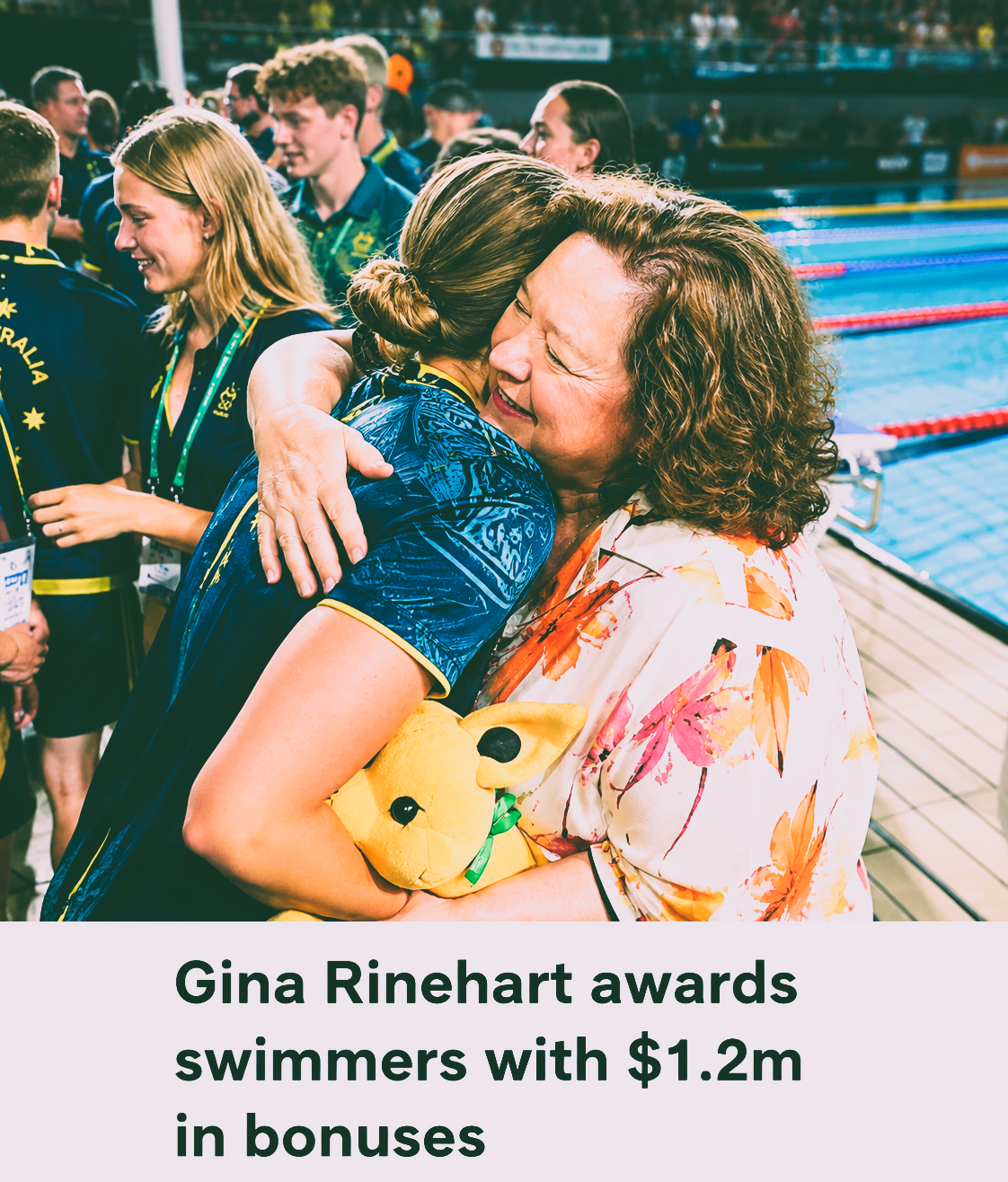
A record-breaking campaign rewarded
Australia dominated the swimming competition in Glasgow, finishing with an extraordinary medal haul.
The Dolphins captured:
- 37 gold medals
- 21 silver medals
- 23 bronze medals
The results represented one of the strongest Commonwealth Games performances ever produced by Australian swimmers and para swimmers, reinforcing Australia’s status as one of the world’s leading swimming nations.
Following the completion of competition, Hancock Prospecting confirmed that medal bonuses would total A$1,272,500.
How much each athlete will receive
The bonus structure rewards athletes according to both the medal won and whether the event was individual or relay.
Individual medal payments are:
- A$20,000 for every individual gold medal.
- A$15,000 for every individual silver medal.
- A$10,000 for every individual bronze medal.
Relay athletes will also receive payments for each medal earned:
- A$5,000 per swimmer for relay gold.
- A$3,750 per swimmer for relay silver.
- Separate relay bronze payments were also included under the announced bonus structure.
Because bonuses are paid for every medal won, athletes competing across multiple events stand to receive substantial rewards reflecting the breadth of their achievements.
Major rewards for Australia’s biggest stars
Several Australian swimmers produced remarkable medal hauls during the Games.
Among them was Meg Harris, whose performances across both relay and individual events saw her collect six gold medals.
Under the announced bonus schedule, Harris is expected to receive approximately A$60,000.
Other multi-medal winners are also expected to receive significant bonus payments, recognising both individual excellence and Australia’s remarkable relay success throughout the championships.
Payments arriving quickly
Unlike many sporting incentives that are distributed months after major competitions, Hancock Prospecting confirmed athletes will not have to wait long.
Bonus payments are scheduled to be transferred within two weeks of the Commonwealth Games closing ceremony.
For many swimmers, particularly younger athletes who balance training with work or study, the payments represent meaningful financial support as they prepare for future international competition.
Swimming remains one of Australia’s most successful Olympic sports, yet prize money available outside major commercial events is often relatively modest compared with professional sports such as football, cricket or tennis.
Rinehart: A gesture of appreciation
Announcing the bonuses, Gina Rinehart said the payments were intended as recognition rather than simply financial incentives.
“I’m pleased to be able once again to provide financial rewards to our medal winners in the sports where I’m Patron,” she said.
“It’s a way of saying thank you and showing appreciation for their dedication and achievements, the pride they make Australians feel, right across our country, and for being the inspiring young ambassadors that they truly are.”
Her comments reflect a philosophy she has frequently expressed over many years—that elite athletes deserve stronger financial recognition for representing Australia internationally.
A decade of support for Australian swimming
Rinehart’s involvement with Australian swimming extends well beyond the Commonwealth Games.
Through Hancock Prospecting and the Georgina Hope Foundation, she has provided substantial financial support to Swimming Australia and numerous individual athletes for more than a decade.
Her investment has helped fund high-performance programs, athlete development, training opportunities and international competition.
Many current Australian champions progressed through programs supported by Hancock Prospecting during earlier stages of their careers.
Swimming officials have regularly acknowledged that private investment has played an important role in maintaining Australia’s position among the world’s leading swimming nations.
Why these bonuses matter
Elite swimming requires years of intensive training, extensive travel and considerable personal sacrifice.
Although Olympic and Commonwealth champions receive widespread public recognition, financial rewards are often significantly lower than those available in professional team sports.
Many swimmers continue balancing training with university studies or part-time employment throughout their careers.
For those athletes, privately funded bonuses can provide valuable financial security while allowing greater focus on preparation for future international competitions.
Several senior swimmers have previously noted that such incentives can help extend careers by easing financial pressures during Olympic cycles.
Preparing for Los Angeles 2028
The Glasgow Commonwealth Games also serve as an important stepping stone towards the 2028 Olympic Games in Los Angeles.
Historically, many of Australia’s Olympic champions first established themselves through success at Commonwealth level.
Rinehart has repeatedly pointed to that pathway when explaining her support for swimming, arguing that rewarding excellence today helps strengthen Australia’s future Olympic prospects.
The record medal haul achieved in Glasgow provides further optimism that Australia will remain among the world’s strongest swimming nations over the coming Olympic cycle.
A broader conversation about athlete funding
The announcement has also renewed discussion about how elite athletes are funded in Australia.
While governments invest heavily through the Australian Institute of Sport and national sporting organisations, private patrons have increasingly become important contributors to high-performance programs.
Supporters argue philanthropic investment complements public funding by giving athletes additional opportunities and financial security.
Others note that reliance on private benefactors highlights the ongoing financial challenges faced by athletes competing in sports that generate relatively limited commercial revenue.
The debate reflects broader questions about how Australia should support elite sport while ensuring sustainable pathways for future generations of competitors.
Recognition beyond the podium
Although the bonuses focus on medal winners, the announcement also shines a spotlight on the broader effort behind Australia’s success.
Behind every podium finish are years of coaching, family support, sports science, medical care and institutional investment.
For many athletes, the financial reward represents not only recognition of a single performance but acknowledgement of the dedication required to compete at the highest international level.
With more than A$1.27 million now set to be distributed among Australia’s medal-winning swimmers and para swimmers, Hancock Prospecting’s latest initiative continues one of the country’s most significant private sporting partnerships. As the athletes begin turning their attention towards world championships and the Los Angeles Olympics, the bonuses provide both immediate recognition and practical support for the next stage of Australia’s pursuit of international swimming success.






