Former Victorian Premier Daniel Andrews has issued one of his rarest public political statements since leaving office, paying warm tribute to his successor Jacinta Allan while throwing his full support behind newly elected Premier Ben Carroll as Labor prepares for a fiercely contested state election.
The statement came only hours after Carroll used his first appearance as Premier to deliberately distance himself from the two Labor leaders who came before him, repeatedly telling Victorians:
“Let me make one thing very clear: I am not Daniel Andrews. I am not Jacinta Allan.”
The declaration immediately became the defining political message of Carroll’s first day in office, signalling Labor’s determination to present a fresh image after more than a decade in government while acknowledging growing voter frustration over the state’s economic challenges, rising debt, crime and cost-of-living pressures. 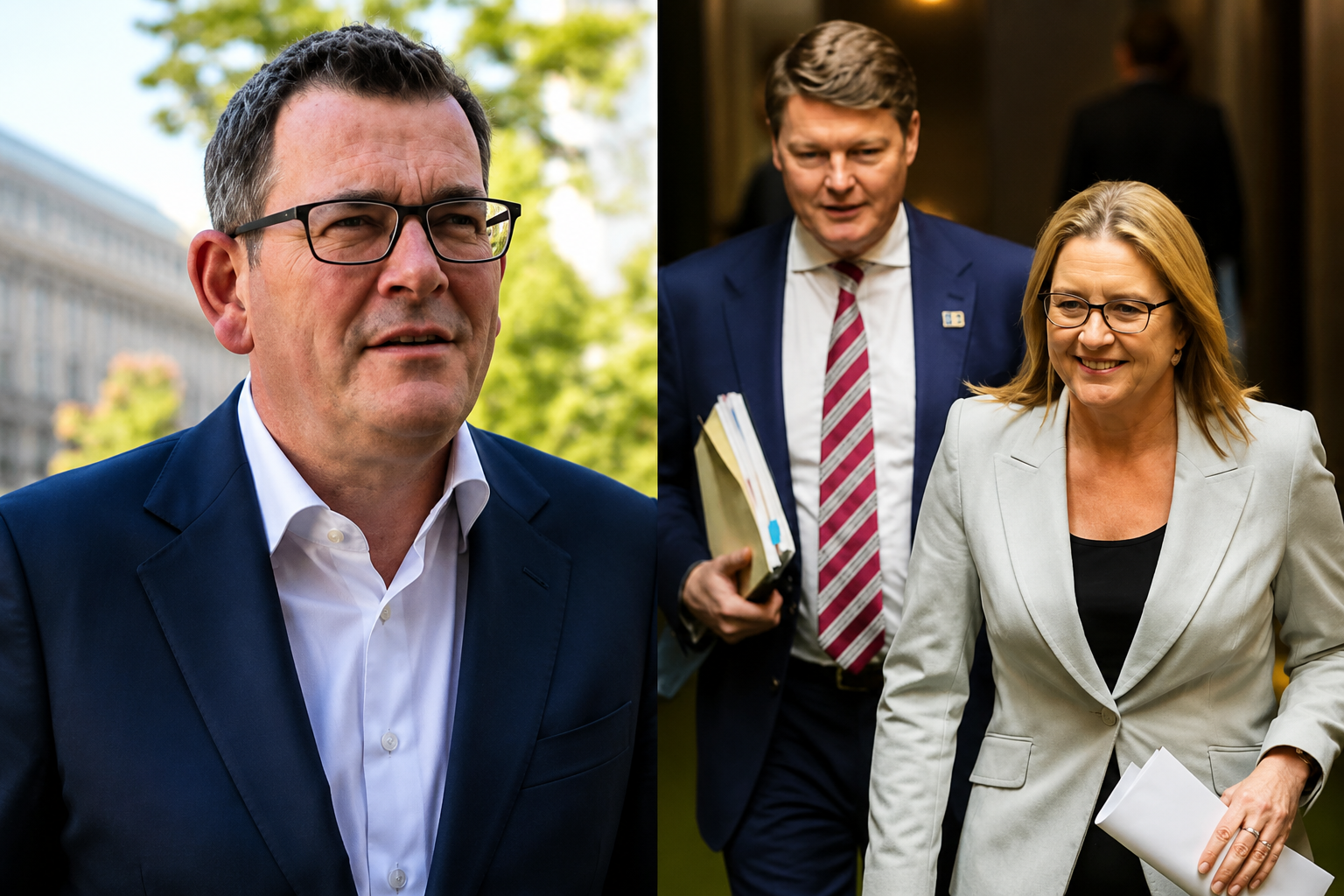
Rather than responding defensively to Carroll’s attempt to separate himself from previous governments, Andrews adopted a conciliatory tone, using the opportunity to honour Jacinta Allan’s long political career and publicly endorse Labor’s new leader.
His intervention marked the first substantial public comment Andrews has made on Victorian politics since Labor’s dramatic leadership spill removed Allan as Premier and elevated Carroll to the state’s highest office only months before the November election.
“A champion” of the Labor movement
In his statement, Andrews reflected on first meeting Jacinta Allan more than a quarter of a century ago, long before either would become Premier.
He described how both began their political journeys as young Labor campaigners determined to win what was then considered an unwinnable electorate.
“I first met Jacinta Allan when I was the most junior official at ALP head office and she was the youngest candidate in a seemingly unwinnable Liberal stronghold in Bendigo.”
“Together, we worked to win that seat and for the next 25 years, to elect Labor governments and deliver a Labor agenda for working people.”
Andrews went on to describe Allan as a “champion”, praising both her political resilience and her commitment to public service throughout a career spanning more than two decades.
The tribute carries particular significance because Allan had long been regarded as Andrews’ chosen successor.
When Andrews unexpectedly announced his resignation in September 2023 after almost nine years as Premier, Allan assumed the leadership largely unopposed following years serving as his deputy and one of Labor’s most senior ministers.
Her premiership, however, proved considerably shorter than many expected.
After less than three years leading Victoria, mounting internal dissatisfaction within the parliamentary Labor Party culminated in her resignation this week, clearing the way for Ben Carroll to become Victoria’s 50th Premier.
Backing Ben Carroll despite the fresh start message
Although Carroll deliberately sought to present himself as different from both Andrews and Allan, the former premier made clear he fully supported the transition.
Rather than viewing Carroll’s remarks as a rejection of his legacy, Andrews expressed confidence the new leader could successfully guide Labor into the upcoming election.
He described Carroll as an energetic campaigner capable of connecting with Victorian voters during what he acknowledged would be a difficult political contest.
“The stakes are high,” Andrews said, urging Labor supporters to unite behind the new Premier as the party prepares to defend government after more than twelve years in office.
That endorsement provides Carroll with the public backing of Labor’s most electorally successful Victorian leader in modern history, even as the new Premier attempts to project a distinct leadership style.
Why Carroll said “I am not Daniel Andrews”
Carroll’s repeated declaration that he is “not Daniel Andrews” was widely interpreted as an acknowledgement that Labor believes many Victorians are looking for change without necessarily changing governments.
Political analysts say the message attempts to strike a delicate balance.
On one hand, Labor remains proud of many achievements delivered under Andrews, including major transport infrastructure projects, expanded hospital investment, education reforms, renewable energy initiatives and the removal of level crossings across Melbourne.
On the other hand, the party also recognises that the Andrews era remains deeply polarising.
Critics continue to associate that period with Victoria’s lengthy COVID-19 lockdowns, rapidly increasing state debt, the cancellation of the 2026 Commonwealth Games, integrity controversies and ongoing concerns surrounding crime and housing affordability.
By distancing himself personally from Andrews and Allan, Carroll hopes to convince undecided voters that Labor can renew itself without abandoning its broader governing philosophy.
A changing Labor government
Carroll has wasted little time attempting to demonstrate that his administration intends to move in a different direction.
Within hours of becoming Premier, he announced legislation to abolish group voting tickets in Victoria’s Legislative Council and confirmed plans for a wide-ranging Royal Commission into alleged corruption and misconduct across the state’s construction industry.
He also pledged stronger integrity measures, including expanded powers for Victoria’s Independent Broad-based Anti-corruption Commission (IBAC), while promising a renewed focus on economic management and restoring public confidence.
Those announcements were widely interpreted as an effort to demonstrate decisive leadership from the outset while signalling that Labor was prepared to examine issues that had become politically contentious during previous administrations.
Labor’s biggest challenge in years
Despite Andrews’ endorsement, Labor faces one of its most competitive electoral environments since first winning government in 2014.
Opinion polling has suggested support for the government has weakened following years of economic pressure, rising public debt and increasing concern about community safety.
The Liberal Party hopes to capitalise on voter dissatisfaction, while One Nation and other minor parties are also seeking to increase their parliamentary representation amid broader fragmentation of Victoria’s political landscape.
Carroll’s challenge therefore extends beyond simply replacing Allan as Premier.
He must persuade voters that Labor has genuinely refreshed its leadership while also defending the record of governments in which he himself served as a senior minister under both Andrews and Allan.
Opposition parties argue that replacing the Premier does not erase more than a decade of Labor policy decisions.
Government ministers counter that leadership naturally shapes priorities, management style and policy implementation, making Carroll’s administration distinct despite continuity within the party.
The enduring influence of Daniel Andrews
Although Andrews left Parliament nearly three years ago, his influence continues to shape Victorian politics.
As the state’s longest-serving Labor Premier, he transformed both the Labor Party and Victoria’s policy agenda through landmark infrastructure investments, education reforms and renewable energy programs.
Supporters credit him with modernising the state and delivering significant long-term projects, while critics argue his governments left Victoria with unprecedented debt and deep political divisions.
That legacy explains why Carroll felt compelled to declare he was “not Daniel Andrews” on his first day as Premier—and why Andrews’ endorsement immediately became a major political story.
His public support may reassure Labor members concerned about party unity after Allan’s resignation, but it also inevitably reminds voters of the very political era Carroll is attempting to move beyond.
The coming election is therefore likely to revolve around a central question: can Labor successfully convince Victorians that changing the Premier represents meaningful renewal, or will voters conclude that a new leader cannot separate himself from the record of a government that has held office for more than twelve years?
For Andrews, the answer is clear.
His statement leaves little doubt that he believes Jacinta Allan’s contribution deserves recognition, Ben Carroll is capable of leading Labor forward and the party remains competitive despite one of the most dramatic leadership changes in Victorian political history.
Whether Victorian voters reach the same conclusion will become clear when they head to the polls in November. Until then, Andrews’ rare intervention ensures his political legacy remains firmly intertwined with Labor’s attempt to write its next chapter under a new Premier.






