One Nation leader Pauline Hanson has defended her recent European trip after parliamentary disclosure records confirmed that mining billionaire Gina Rinehart paid for several components of the overseas visit, including flights around Italy and tickets to a prestigious Dolce & Gabbana fashion event.
Speaking publicly after returning to Australia, Hanson insisted that Australian taxpayers had not funded any part of the holiday, stressing that the travel arrangements complied with parliamentary disclosure requirements and that she personally covered a significant portion of the expenses.
“It didn’t cost the taxpayer one cent for my trip overseas. Not one cent,” Hanson said while responding to questions about the luxury getaway. 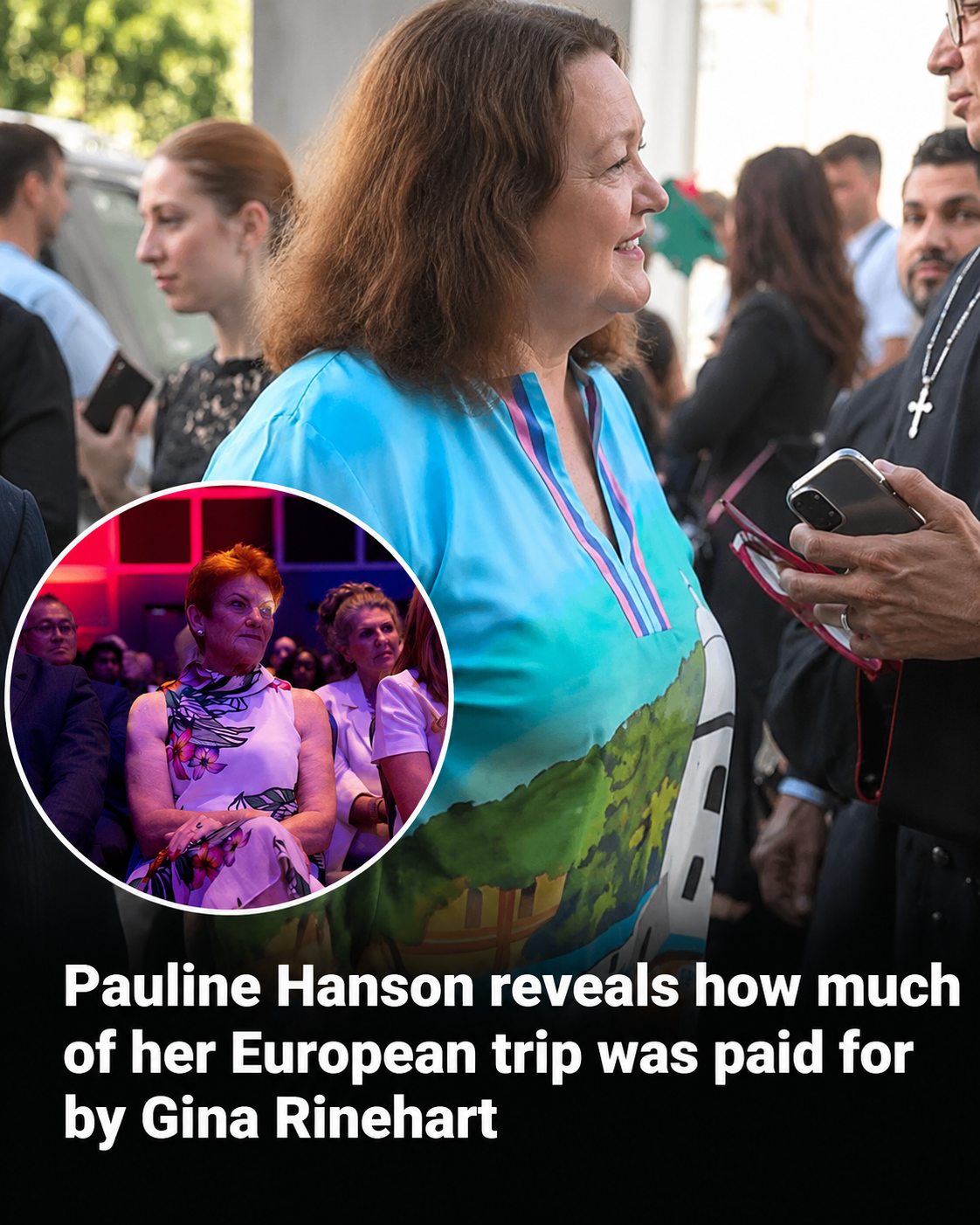
The controversy emerged after Senator Hanson’s updated Register of Senators’ Interests revealed that Gina Rinehart funded flights from London to Sicily via Rome, together with the return journey, and also covered Hanson’s attendance at an exclusive Dolce & Gabbana fashion show held on the Italian island.
The disclosures followed widespread media attention after Hanson and Rinehart were photographed together at the luxury Grand Hotel San Pietro in Taormina, Sicily, and later attended high-profile Dolce & Gabbana Alta Moda events that attracted international celebrities, business leaders and fashion figures.
While the images prompted questions about who financed the overseas visit, Hanson’s disclosure clarifies that the billionaire mining executive paid for only part of the trip.
According to the register, Hanson personally met the costs of her accommodation, meals and daily living expenses throughout the visit between 11 and 16 July.
Those costs were not paid by Rinehart, nor were they funded by the Australian taxpayer, according to the senator’s declaration.
One aspect that remains unclear is how Hanson’s flights between Australia and London were funded.
The updated parliamentary declaration records only the flights between London, Rome and Sicily because those were provided as gifts by Rinehart.
If Hanson personally paid for the Australia-to-London flights, parliamentary rules would not require those tickets to appear on the Register of Interests.
ABC News reported that Hanson’s office has been asked to clarify how those long-haul flights were financed, but that information was not included in the public disclosure.
The episode has once again placed Hanson’s relationship with Gina Rinehart under political scrutiny.
Over recent years, the One Nation leader and Australia’s richest woman have developed an increasingly visible friendship, appearing together at political events, conservative conferences and business functions both within Australia and overseas.
Rinehart, executive chair of Hancock Prospecting, has become one of the country’s most influential business figures and has publicly advocated for lower taxes, reduced regulation, expanded mining investment and policies designed to strengthen Australia’s economic competitiveness.
Hanson has frequently expressed admiration for Rinehart, describing her as someone who has made an enormous contribution to Australia’s economy through investment, employment and resource development.
Following criticism of the Sicily trip, Hanson again defended the mining magnate, rejecting suggestions that Rinehart’s wealth diminished the challenges she faced while building Hancock Prospecting into one of Australia’s largest private companies.
“She had to borrow everything and was flat out in the very start to pay the bills. She’s built up that company,” Hanson said.
Hanson’s remarks echoed previous comments in which she praised Rinehart’s business achievements and argued that successful entrepreneurs should not be criticised simply because of their wealth.
The Sicily disclosure is not the first time gifts from Rinehart have attracted public attention.
Earlier this year, Hanson declared receiving a Cirrus G7 aircraft donated by Rinehart to assist One Nation’s election campaigning. That gift, together with other previously disclosed flights and hospitality, intensified debate about the relationship between political leaders and wealthy private benefactors.
Australian parliamentary rules require senators and members of parliament to disclose gifts, sponsored travel and hospitality above prescribed thresholds through publicly available registers of interests. The objective is to provide transparency regarding benefits that could reasonably be perceived as creating conflicts of interest.
The disclosure system does not prohibit politicians from accepting gifts or sponsored travel. Instead, it requires those benefits to be declared so that voters can assess the relationships for themselves.
Supporters of Hanson argue that the system worked exactly as intended in this case because the travel was formally disclosed within parliamentary requirements and there is no suggestion taxpayers funded the overseas visit.
Critics, however, contend that repeated high-value gifts from influential individuals inevitably raise broader questions about political access, influence and public confidence, even where all disclosure obligations have been met.
The debate reflects a wider issue that extends well beyond One Nation.
Politicians from Australia’s major parties have regularly faced scrutiny over sponsored travel, hospitality, fundraising events and relationships with business leaders, unions and industry groups. Transparency advocates have long argued that disclosure registers are an essential safeguard, while others have called for tighter restrictions on the acceptance of expensive gifts altogether.
Hanson rejects suggestions that her political positions are influenced by gifts or personal friendships.
She maintains that her policy positions on mining, taxation, immigration, energy and economic management have remained consistent for many years, long before her relationship with Rinehart became widely known.
The senator also emphasised that the overseas trip occurred during Parliament’s winter recess and therefore did not involve publicly funded parliamentary travel.
That distinction has become central to her defence against criticism, with Hanson repeatedly stressing that Australians did not bear any financial burden for the European visit.
Her statement that the trip “didn’t cost the taxpayer one cent” has become the defining response to questions surrounding the disclosure.
The renewed attention arrives during an already busy political period for the One Nation leader.
In recent weeks Hanson has outlined an ambitious first-100-days agenda should One Nation ever form government, announced candidates for almost every Victorian electorate ahead of the state election and confirmed she intends to seek special leave to appeal her Section 18C case to the High Court.
Against that backdrop, the European trip has become another highly visible chapter in Hanson’s political profile.
Whether viewed as a legitimate private friendship disclosed in accordance with parliamentary rules or as an example of the close relationship between wealthy business figures and elected representatives, the Sicily visit has again highlighted the importance of transparency in Australian public life.
For Hanson, the message remains unchanged. She argues every relevant gift was declared, taxpayers paid nothing toward her holiday and voters should judge her political positions on their merits rather than on who paid for flights between London and Sicily. As debate continues over political donations, sponsored travel and influence in Canberra, her relationship with Gina Rinehart is likely to remain under close public scrutiny in the lead-up to future elections.






