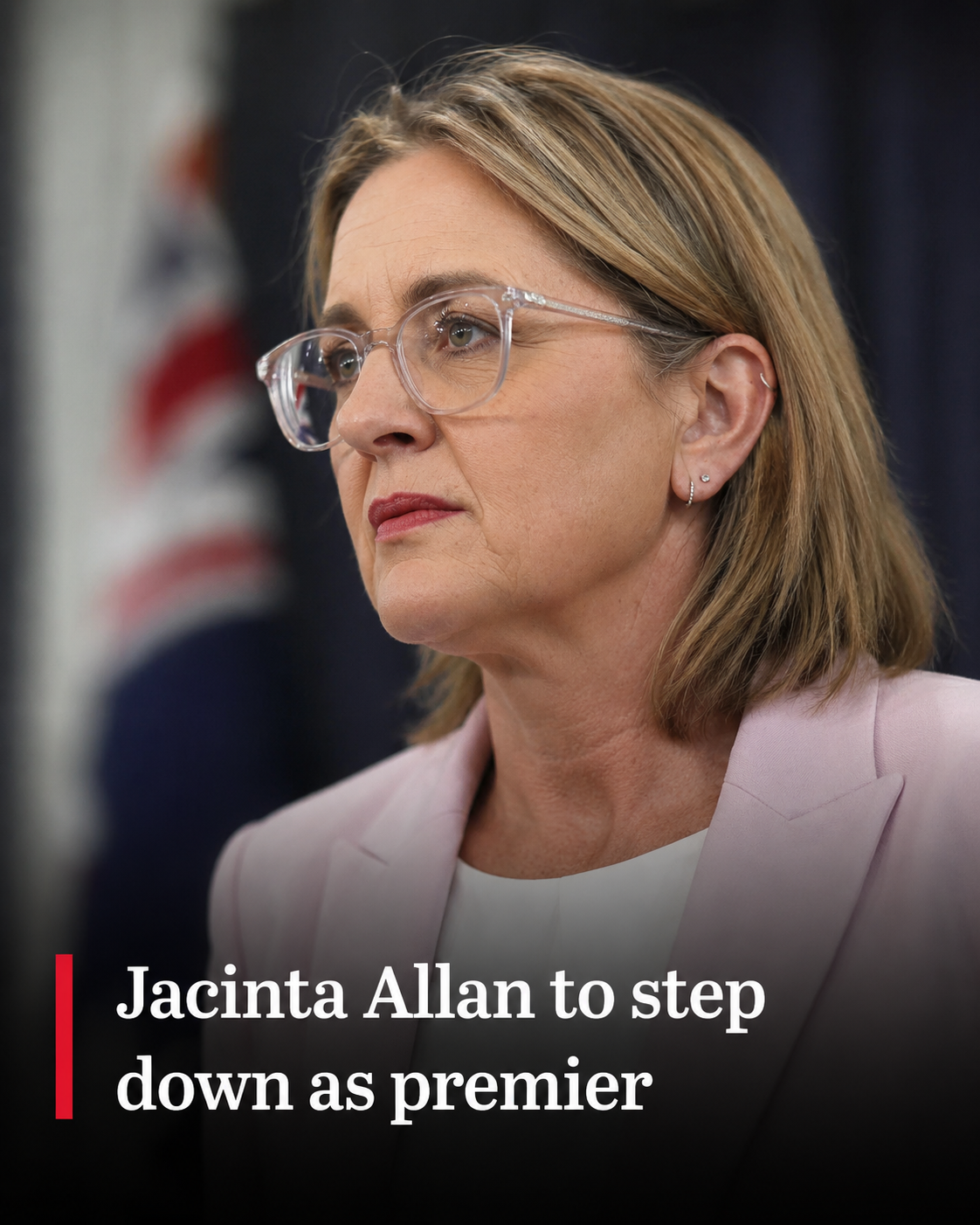
Victoria has entered a new political era after Jacinta Allan resigned as premier, bringing an abrupt end to months of speculation over her political future and paving the way for Ben Carroll to become the state’s 50th premier.
The leadership transition unfolded after Allan’s authority within the Victorian Labor Party steadily weakened in the face of declining opinion polls, growing dissatisfaction among Labor MPs and mounting controversy surrounding the government’s handling of allegations of corruption within the construction sector. By the time she announced her resignation, senior figures from multiple factions had concluded that a change of leadership offered Labor its best chance of remaining competitive at the state election later this year.
Allan fought back tears while announcing that she would step aside, insisting she still believed Labor could have won the coming election under her leadership.
However, she said a prolonged internal leadership contest would divert valuable time and energy away from governing and campaigning.
Her decision came only hours after senior ministers and influential caucus members informed her that she no longer held the confidence of the parliamentary party.
Although Ben Carroll quickly emerged as the overwhelming favourite to succeed her, the leadership contest briefly descended into confusion.
Attorney-General Sonya Kilkenny unexpectedly entered the race, triggering a tense caucus meeting during which MPs were reportedly heard arguing behind closed doors.
Her challenge ultimately lasted only a short time before she withdrew, clearing the path for Carroll to be elected unanimously as leader of Victorian Labor.
One of the more unusual moments of the day involved Transport Infrastructure Minister Gabrielle Williams.
As part of the procedural arrangements required to complete the leadership transition, Williams briefly became interim leader of the Victorian Labor Party for several minutes before Carroll formally assumed the leadership.
She was then elected deputy leader and became Deputy Premier in the new ministry.
Carroll wasted little time attempting to distinguish himself from the governments of Daniel Andrews and Jacinta Allan.
At his first press conference after being sworn in, he declared:
“I am not Daniel Andrews. I am not Jacinta Allan.”
He argued that Victoria required a different style of leadership and said his government would place integrity, accountability and transparency at the centre of its agenda.
His first major announcement was one of the most significant policy reversals by a Victorian Labor premier in recent years.
Carroll confirmed that his government would establish a Royal Commission into alleged corruption within Victoria’s construction sector.
The inquiry will examine claims involving organised crime, governance failures and alleged misconduct linked to parts of the state’s multibillion-dollar infrastructure program.
Previous Labor governments had repeatedly resisted calls for such an inquiry despite sustained pressure from the Coalition, crossbench MPs and sections of the business community.
Alongside the Royal Commission, Carroll announced two additional integrity measures.
He will appoint a special prosecutor to work in parallel with the commission and pursue any criminal matters arising from its investigations.
His government also intends to strengthen the powers of Victoria’s Independent Broad-based Anti-corruption Commission (IBAC), including expanding its ability to investigate the movement of public funds through major government projects.
Those announcements were widely interpreted as an attempt to reassure voters that Labor had listened to public concerns after months of damaging headlines involving the construction industry and the CFMEU controversy.
The allegations became particularly politically sensitive because Jacinta Allan had previously overseen transport and infrastructure portfolios during the period when many of Victoria’s largest projects were underway.
Opposition parties repeatedly argued that a Royal Commission was necessary to restore confidence in public spending and procurement processes.
For Carroll, however, the challenge extends well beyond announcing new investigations.
Despite presenting himself as a fresh leader, he served as Deputy Premier under Allan and held senior ministerial positions throughout much of the Andrews era.
Opposition Leader Jess Wilson and Coalition MPs have argued that replacing the premier does not erase Labor’s record after more than a decade in office.
They contend Carroll must demonstrate through actions—not simply rhetoric—that his government represents genuine change.
Supporters of the new premier argue the opposite.
They point to Carroll’s willingness to embrace policies that had previously been rejected, including the Royal Commission, as evidence that the government is prepared to change direction in response to community concerns.
Within Labor, many MPs hope the leadership transition will allow the party to refocus attention on cost-of-living relief, economic management, housing affordability and public safety before the election campaign intensifies.
Political analysts note that leadership changes only months before an election are inherently risky.
On one hand, a new leader can provide an opportunity to reset public perceptions and introduce a different governing style.
On the other, voters may question whether a change of leader truly represents a change of government, particularly when many senior ministers remain in cabinet and have collectively overseen policy for years.
Carroll has acknowledged that challenge, arguing Victorians should judge his administration on what it does over the coming months rather than on assumptions about previous governments.
The resignation also marks the end of Jacinta Allan’s premiership after less than three years in office.
She became Victoria’s premier in September 2023 following Daniel Andrews’ surprise resignation and was only the second woman to hold the position in the state’s history.
During her tenure, her government continued major infrastructure projects and planning reforms but also faced persistent criticism over rising state debt, cost-of-living pressures and allegations involving the construction sector.
The timing of the leadership transition reflects Labor’s growing concern about the approaching election.
With only months remaining before Victorians return to the polls, Carroll has limited time to establish his own identity as premier while convincing voters that Labor can offer both stability and renewal.
His decision to place integrity reform at the forefront of his premiership suggests the government recognises that restoring public confidence will be central to its electoral strategy.
Whether those reforms prove sufficient to reverse Labor’s political fortunes remains uncertain.
The Coalition is expected to continue arguing that Carroll was an integral member of the Andrews-Allan governments and therefore shares responsibility for the issues now confronting Victoria.
Labor, meanwhile, hopes that a new premier combined with a stronger emphasis on accountability, transparency and institutional reform will persuade voters that the party is capable of charting a different course.
As Parliament resumes under new leadership, attention will quickly shift from the drama of the leadership spill to the substance of Carroll’s government.
The promised Royal Commission, expanded anti-corruption powers and broader agenda for economic management and public confidence are now set to become defining issues in Victoria’s political debate as the state moves towards one of its most consequential elections in recent years.






