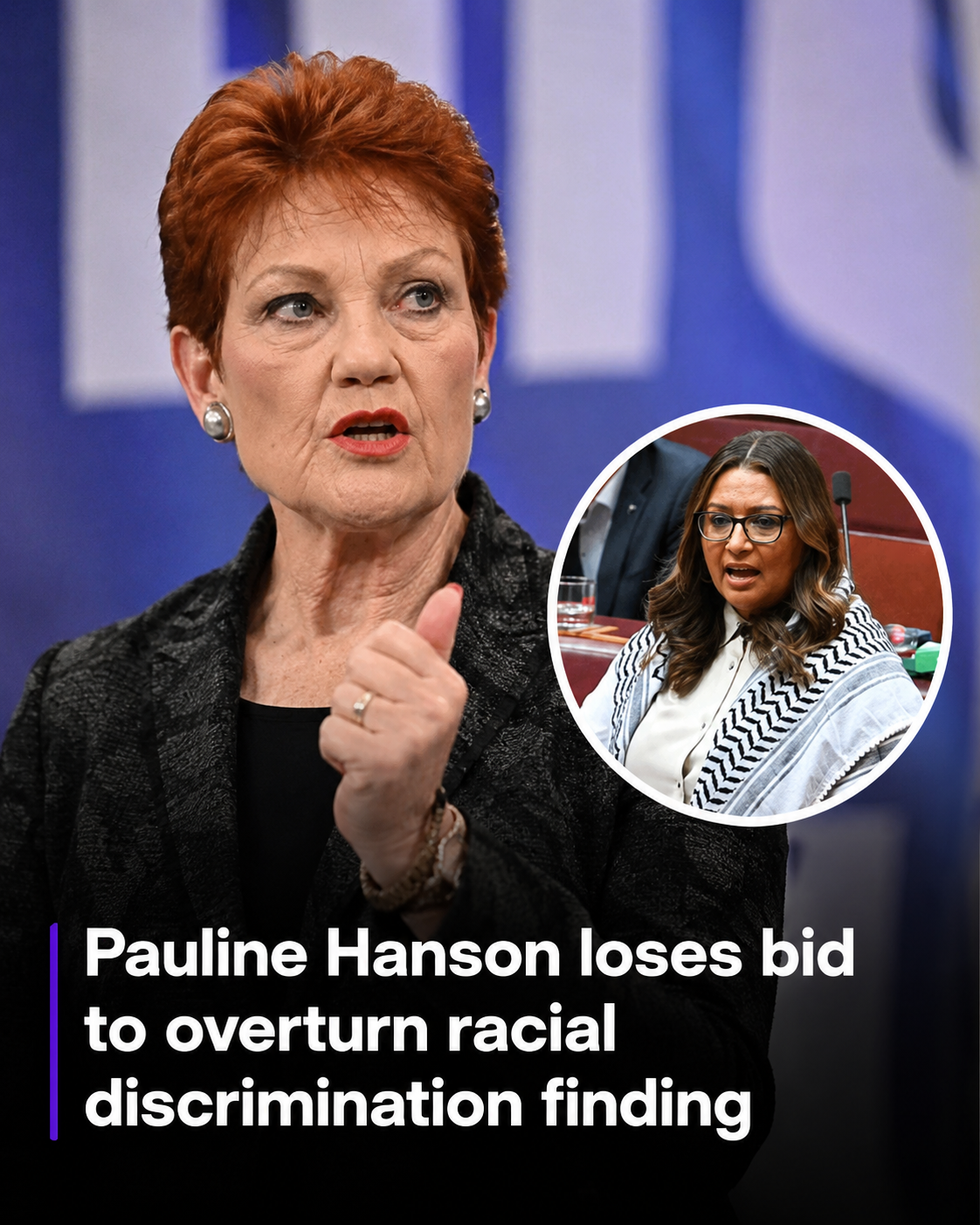
One Nation leader Pauline Hanson has vowed to continue fighting for what she describes as free political speech after the Full Federal Court unanimously dismissed her appeal against a landmark racial discrimination ruling involving Greens deputy leader Mehreen Faruqi.
The decision leaves intact a 2024 Federal Court judgment that found Hanson unlawfully racially discriminated against Senator Faruqi by telling her to “pack your bags and p*** off back to Pakistan” in a social media post following the death of Queen Elizabeth II in September 2022.
Handing down its decision, the Full Court rejected every ground of appeal advanced by Hanson and upheld the earlier finding that the post breached Section 18C of the Racial Discrimination Act 1975.
The three-judge bench also rejected Hanson’s constitutional argument that Section 18C imposed an unlawful burden on the implied freedom of political communication protected by the Australian Constitution.
The case arose after Senator Faruqi responded publicly to the death of Queen Elizabeth II.
While offering condolences to those mourning the monarch, Faruqi wrote that she could not personally mourn “the leader of a racist empire built on stolen lives, land and wealth of colonised peoples”.
Her comments generated widespread political debate, prompting Hanson to publish a strongly worded response on social media directing the Greens senator to return to Pakistan.
In his original 2024 judgment, Justice Angus Stewart concluded that Hanson’s language constituted a “strong form of racism” and was “seriously offensive”.
He found the remarks relied upon a well-known racist trope that suggested Australians from migrant backgrounds could never truly belong in the country regardless of their citizenship, public office or years of residence.
The judge also concluded the comments reduced Faruqi to the status of a second-class citizen and were capable of encouraging similar discriminatory conduct by others.
During the appeal hearing, Hanson’s legal team argued that while the language may have been offensive or unpleasant, it did not amount to unlawful racial discrimination.
Counsel also argued the legislation should not be interpreted in a way that restricted robust political debate or prevented politicians from expressing controversial opinions about public issues.
The Full Federal Court rejected those submissions, finding that none of the grounds advanced by Hanson had been established.
Following the judgment, Hanson expressed disappointment and warned that Australia was becoming a place where ordinary people increasingly feared expressing their opinions.
She argued that freedom of political discussion was being constrained by anti-discrimination laws and confirmed that her legal team would examine the judgment before deciding whether to seek special leave to appeal to the High Court of Australia.
“My legal team and I will now closely review the decision in the coming days, with a view to commencing an appeal in the High Court of Australia,” Hanson said.
Senator Faruqi welcomed the outcome, describing it as an important victory extending beyond her own case.
Speaking outside court, she said the judgment sent a clear message that racist abuse directed at Australians because of their ethnicity or background would not be protected simply because it occurred in a political context.
She also repeated her long-held view that “hate speech is not free speech”, arguing the decision would provide reassurance to many Australians from culturally diverse communities.
The ruling has attracted significant legal interest because it clarifies how Australia’s racial discrimination laws interact with political communication.
Section 18C makes it unlawful, in certain public circumstances, to do an act that is reasonably likely to offend, insult, humiliate or intimidate another person because of their race, colour, or national or ethnic origin.
The provision has remained politically contentious for many years, with critics arguing it can inhibit free expression while supporters contend it provides essential protection against racial vilification.
Successive federal governments have debated possible amendments to Section 18C.
Previous proposals to narrow or repeal the provision have ultimately failed to secure parliamentary support, leaving the legislation substantially unchanged since earlier reform efforts were defeated.
The latest judgment therefore represents one of the most significant appellate decisions interpreting the scope of the law in recent years.
Legal experts note that the High Court does not automatically hear appeals from the Full Federal Court.
Before any appeal proceeds, Hanson would first need to obtain special leave, a process under which the High Court accepts only a relatively small number of matters involving questions of broad legal significance or important principles requiring clarification.
Whether such leave would ultimately be granted remains uncertain.
The litigation has also become part of a wider political debate about civility and language in Australian public life.
Supporters of Hanson argue elected representatives should enjoy broad freedom to express political opinions without fear of legal consequences.
Supporters of Faruqi respond that political disagreement does not justify language targeting a person’s race or ethnic background and that anti-discrimination protections remain essential within a multicultural democracy.
The decision arrives at a politically significant time, with debates over immigration, multiculturalism, identity and free speech continuing to feature prominently in national politics.
As leader of One Nation, Hanson has long campaigned on stricter immigration policies and has frequently argued that Australians should be able to speak openly about issues involving national identity and social cohesion.
Faruqi, meanwhile, has consistently advocated for stronger protections against racism and discrimination while calling for greater recognition of Australia’s multicultural society.
Although the legal proceedings centred on a single social media post, the broader implications extend well beyond the two senators.
The judgment reinforces that political speech, while strongly protected in Australia’s democratic system, is not unlimited where Parliament has enacted laws prohibiting racial discrimination.
At the same time, Hanson’s intention to consider a High Court appeal means the debate over the balance between free speech and anti-discrimination protections may not yet be over.
If special leave is sought, the High Court will first determine whether the legal questions raised warrant further examination.
Until then, the Full Federal Court’s decision stands as one of the most significant judicial statements on the operation of Section 18C and the limits of political expression in modern Australia.






