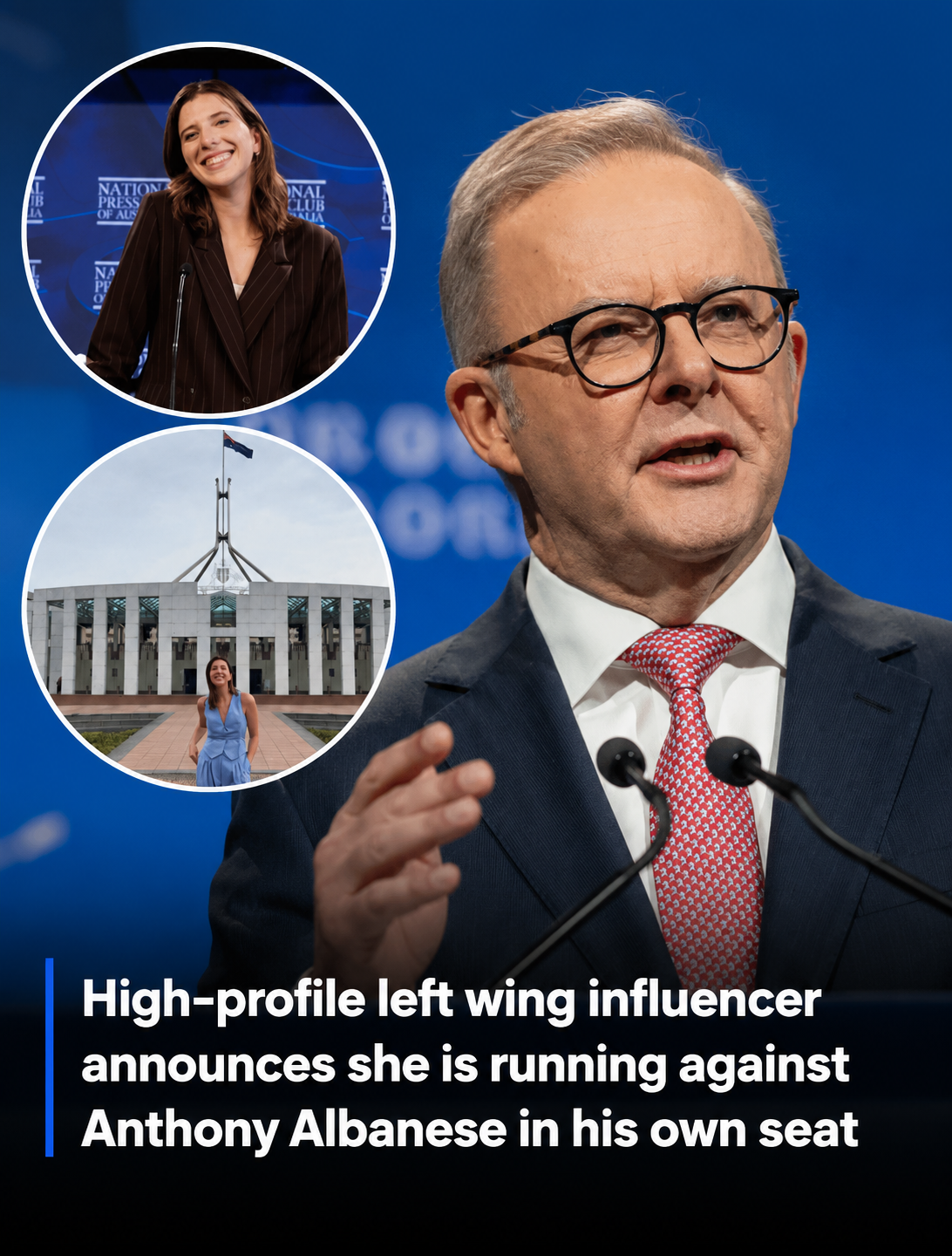
Independent media founder Hannah Ferguson has announced she will challenge Prime Minister Anthony Albanese in his long-held Sydney electorate of Grayndler, setting up one of the highest-profile independent campaigns ahead of Australia’s next federal election.
Ferguson, the 28-year-old founder and chief executive of progressive digital publication Cheek Media, confirmed she will contest the inner-west Sydney seat as an independent candidate after several weeks of speculation about her political ambitions.
The announcement places her directly against one of Australia’s most established political figures in an electorate Labor has dominated for generations.
Explaining her decision, Ferguson said she believed residents deserved stronger representation and wanted to build her campaign through direct engagement with local voters rather than traditional party politics.
“I believe we deserve better representation,” she wrote while announcing her candidacy.
“I’m not here to play politics. That is just another reason Australians are fed up with the political party machinery.”
She added that she intended to continue hosting community events, listening to residents and developing policy positions based on local feedback rather than party platforms.
Before confirming her lower-house campaign, Ferguson had publicly explored contesting a Senate position.
However, she said conversations with people living throughout Sydney’s Inner West convinced her that many residents wanted an independent candidate prepared to directly challenge the sitting Prime Minister in Grayndler.
She described the decision as one that emerged from months of discussions rather than a publicity exercise.
“The question became whether there was an appetite for an independent in Grayndler,” she told Women’s Agenda, explaining that the campaign was shaped by community conversations rather than personal ambition.
Grayndler has long been regarded as one of Labor’s safest federal electorates.
Anthony Albanese has represented the seat since 1996, having first entered Parliament at the age of 33.
The electorate itself has been held continuously by the Australian Labor Party since it was created in 1949, making it one of the party’s traditional heartland seats.
At the 2025 federal election, Albanese comfortably retained Grayndler with approximately 66 per cent of the two-party-preferred vote, underlining the significant electoral challenge facing any opponent.
Despite those numbers, Ferguson believes there is growing dissatisfaction with Australia’s major political parties.
Her campaign centres on the argument that many voters, particularly younger Australians, feel increasingly disconnected from traditional party structures and want representatives who are more directly accountable to local communities.
She has criticised what she describes as excessive influence from vested interests within Australian politics and has argued that independent MPs can provide stronger scrutiny of government regardless of which party holds power.
Ferguson has become one of the more recognisable progressive media figures in Australia through Cheek Media, a digital publication she founded while studying law.
The platform has developed a substantial following among younger audiences by combining news reporting, political commentary and social media engagement.
Its editorial focus has generally supported progressive causes including climate action, integrity reforms, gender equality and political transparency.
That public profile has given Ferguson an audience unusual for a first-time political candidate, although she has acknowledged that challenging a sitting Prime Minister carries significant personal and professional risks.
To avoid potential conflicts of interest, Ferguson has indicated she intends to step back from her operational role at Cheek Media while campaigning.
She says separating journalism from electoral politics is necessary to preserve the publication’s independence and ensure the campaign remains transparent.
The decision reflects broader debates about the relationship between digital media personalities and electoral politics, particularly as social media platforms become increasingly influential in Australian political campaigns.
Political observers note that defeating a sitting Prime Minister in Grayndler would require an extraordinary electoral swing.
Albanese has represented the electorate for nearly three decades and has built a strong local profile through successive elections.
The Prime Minister’s long-standing connection to Sydney’s Inner West remains one of Labor’s most durable electoral advantages.
Nevertheless, analysts also point out that independent candidates have become increasingly competitive across Australia over the past decade, particularly in electorates where voters seek alternatives to traditional party politics.
The rise of community independents—often referred to as “teal independents” in some electorates—has transformed Australia’s political landscape since the 2022 federal election.
Although Ferguson has not positioned herself within the Climate 200-backed teal movement, her campaign similarly emphasises local representation, political accountability and community engagement over party discipline.
Whether that approach can succeed in a seat as strongly Labor as Grayndler remains uncertain.
Unlike several teal-held electorates that were previously represented by Liberal MPs, Grayndler has consistently recorded substantial Labor majorities for decades.
That historical voting pattern presents a much steeper challenge for any independent campaign.
Even so, Ferguson argues that electoral success should not be measured solely by whether a seat changes hands.
She says campaigns can also influence political debate by encouraging greater discussion of local concerns and holding elected representatives publicly accountable.
Her community meetings have already focused on issues including housing affordability, cost-of-living pressures, climate policy, gambling reform and government transparency—topics that she says repeatedly emerge in conversations with residents.
The campaign is also likely to attract national attention because of Albanese’s position as Prime Minister.
Although prime ministers are frequently challenged by opposition candidates and minor parties, contests involving prominent public figures or well-known independents often receive disproportionate media coverage regardless of the eventual electoral outcome.
That visibility could help Ferguson raise her national profile while also increasing scrutiny of Albanese’s performance within his own electorate.
For Labor, however, Grayndler remains one of the party’s safest seats.
Albanese has repeatedly secured commanding victories there across multiple elections, and the electorate’s demographic profile has traditionally aligned closely with Labor’s political base.
No major political analyst currently considers Grayndler among the most likely seats to change hands at the next election.
Nevertheless, Ferguson’s candidacy reflects broader changes occurring across Australian politics.
Digital media personalities, community activists and politically engaged independents are increasingly seeking elected office, challenging the long-standing dominance of Australia’s major parties.
Whether or not Ferguson succeeds in unseating the Prime Minister, her decision ensures that one of the country’s safest Labor electorates will attract unusual national attention during the campaign.
As Australia moves towards the next federal election, the contest in Grayndler is likely to become more than simply a battle between an incumbent Prime Minister and a first-time candidate.
It will also serve as a test of whether independent, community-driven campaigns can gain traction even in the safest parliamentary seats—or whether the strength of long-established political loyalties will once again prevail.






