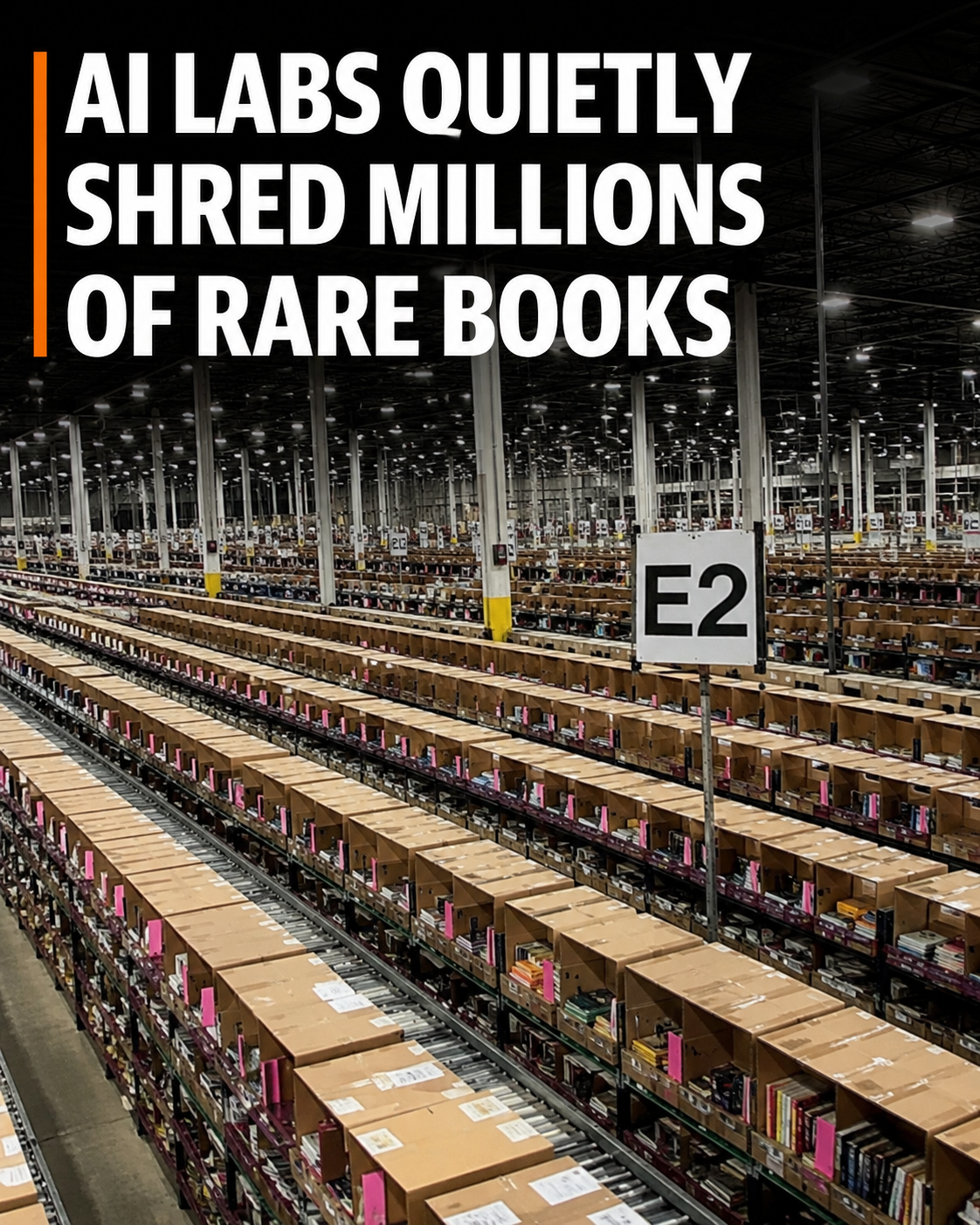
For decades, rare books have been collected, restored and preserved as cultural artefacts intended to outlive generations of readers. Today, however, many of those same books are finding themselves at the centre of a very different race—one driven not by historians or collectors, but by artificial intelligence companies searching for ever-larger sources of high-quality training data.
Across North America and Europe, booksellers have reported an extraordinary surge in demand for obscure, out-of-print and specialist books. According to multiple reports, some of those purchases are linked to companies acting on behalf of AI laboratories that are buying physical books in bulk, removing their bindings, scanning every page at industrial speed and then pulping the original copies once the digitisation process is complete.
The practice has become known within the industry as destructive scanning.
Unlike traditional archival digitisation, where books are carefully photographed or scanned without damaging the original volume, destructive scanning involves slicing the spine from a book so that every page can pass rapidly through high-speed commercial scanners. Once digitised, the paper is commonly recycled or discarded.
Supporters argue that the process is significantly faster and cheaper than non-destructive methods, making it practical for digitising millions of volumes.
Critics, however, warn that the technique risks permanently eliminating physical copies of books that may never again be printed.
The issue has intensified because large language models require enormous quantities of human-written material.
Early generations of AI systems relied heavily on publicly available internet content, news articles, code repositories and licensed publishing datasets.
As AI-generated material increasingly fills the internet, companies have begun searching for older books published before the recent explosion of generative AI, believing they provide cleaner and more reliable training data free from AI-written contamination.
One second-hand bookseller told technology publication 404 Media that his business changed almost overnight.
Instead of selling around twenty books each week, he suddenly found himself dispatching hundreds of obscure titles every week, including foreign-language works and specialist publications that had previously attracted little interest.
“It benefits me financially,” the bookseller said, explaining that the sales had cleared long-unsold inventory.
At the same time, he admitted feeling uncomfortable about the final destination of many books.
“I don’t like the end-use, and I don’t like that uncommon books are being pulped.”
Similar stories have emerged across Europe.
Booksellers in the Netherlands, Germany, Spain and Switzerland have reported receiving unusually large purchase requests covering thousands of titles identified by ISBN rather than by subject or collecting interest.
The requested books frequently include highly specialised technical manuals, folklore collections, scientific publications and long out-of-print academic works—titles that would ordinarily attract only niche demand.
Many dealers believe the purchases are intended for AI training rather than private collections or resale because of the extraordinary breadth and scale of the requests.
One company openly marketing this type of service is ISBNdb, which advertises its ability to source hundreds of thousands—and potentially millions—of physical books for AI developers.
The company argues that older printed books represent some of the highest-quality training data available because they were produced before the emergence of large language models and therefore are not influenced by AI-generated writing.
Its website describes physical books as repositories of valuable information that can be transformed into digital knowledge for AI systems.
The legal environment surrounding these practices has also evolved.
In the United States, Anthropic—the developer of Claude—recently secured an important court victory after a federal judge concluded that converting purchased physical books into digital copies through one-for-one scanning could qualify as transformative use under American fair use law.
The decision formed part of broader copyright litigation involving the company’s AI training practices and has been widely interpreted as an important legal precedent in the United States.
That ruling does not automatically apply in Australia, where copyright law differs significantly from the American fair use framework.
The Australian book industry is therefore watching developments closely.
Dawn Albinger, president of the Australian and New Zealand Association of Antiquarian Booksellers (ANZAAB), said members were aware of similar purchasing activity overseas but had not yet confirmed comparable operations within Australia.
She suggested Australia’s geographic distance and higher shipping costs may currently make local books less attractive for overseas AI buyers.
Even so, she described the issue as one the industry is monitoring carefully because of the potential loss of rare and historically significant printed material.
ANZAAB argues that books possess value extending well beyond the information printed on their pages.
Rare editions often contain unique bindings, handwritten annotations, publication histories and physical characteristics that cannot be replicated through digital scanning alone.
For collectors, historians and archivists, destroying an original volume may therefore represent the permanent loss of an important cultural object, even if its textual content survives digitally.
The debate has also reached Australia’s political agenda.
Earlier this month, Prime Minister Anthony Albanese announced the establishment of a national Office for AI as part of a broader strategy governing artificial intelligence.
While outlining the initiative, the Prime Minister stressed that Australian creative works should remain protected.
“Australian writers, musicians, artists and journalists must retain ownership and control of their work,” he said when discussing future AI regulation.
Those comments have been welcomed by many in Australia’s publishing and bookselling sectors, although questions remain about exactly how future regulation would apply to physical books purchased and digitised by overseas companies.
Unlike digital copyright disputes, where copying can occur instantly across borders, the acquisition and destruction of physical books presents a more complex challenge involving international trade, ownership rights and preservation responsibilities.
The controversy reflects a broader tension emerging throughout the AI industry.
Developers require increasingly large and diverse datasets to improve language models, yet many of the highest-quality sources remain protected by copyright or exist only in physical form.
At the same time, authors, publishers and cultural institutions argue that intellectual property rights and historical preservation should not be sacrificed simply because AI systems require additional training material.
Technology companies respond that purchasing books through legitimate commercial channels differs fundamentally from downloading pirated digital libraries.
They argue that when a company legally buys a physical copy, scanning it for internal computational purposes can, depending on jurisdiction, be consistent with existing copyright law.
Opponents counter that legality does not necessarily resolve the ethical questions raised when rare physical books disappear forever.
Beyond copyright, archivists also worry about long-term preservation.
Many older books have never been digitised by libraries because of limited funding, fragile condition or low public demand.
If the remaining copies are purchased and destroyed before archival institutions can preserve them, scholars fear future generations may lose access to original editions containing historically significant material.
The debate is especially relevant for books published in smaller languages or by specialist academic presses.
Unlike bestselling novels that exist in millions of copies, some technical manuals, regional histories and foreign-language publications survive only in very small numbers.
Destroying even a handful of surviving copies may therefore have disproportionate cultural consequences.
The discussion also illustrates how the rapid growth of generative AI is creating unexpected pressure on industries far removed from computer science.
Booksellers who previously struggled to sell obscure inventory are suddenly experiencing unprecedented demand.
Libraries are reassessing digitisation priorities.
Governments are examining copyright law.
Publishers are reconsidering licensing strategies.
Meanwhile, AI developers continue searching for ever-larger collections of reliable human-written material capable of improving the performance of future models.
For readers, the controversy serves as a reminder that the AI revolution extends beyond software and algorithms.
It is now reshaping the physical world as well—changing the value of forgotten books, transforming second-hand book markets and forcing difficult conversations about how society should balance technological progress with the preservation of cultural heritage.
Whether governments ultimately introduce new legal protections or the industry develops less destructive digitisation methods remains uncertain.
What is already clear is that the competition to acquire high-quality training data has expanded far beyond the internet, reaching the shelves of second-hand bookshops, antiquarian dealers and private collections around the world. As artificial intelligence continues to evolve, the future of countless rare printed works may increasingly depend on how that balance between innovation and preservation is ultimately resolved.






