Political commentator, podcaster and Cheek Media co-founder Hannah Ferguson has formally announced she will contest Prime Minister Anthony Albanese’s long-held Sydney electorate of Grayndler as an independent, arguing the community deserves stronger local representation and a political system that is more accountable to voters than vested interests.
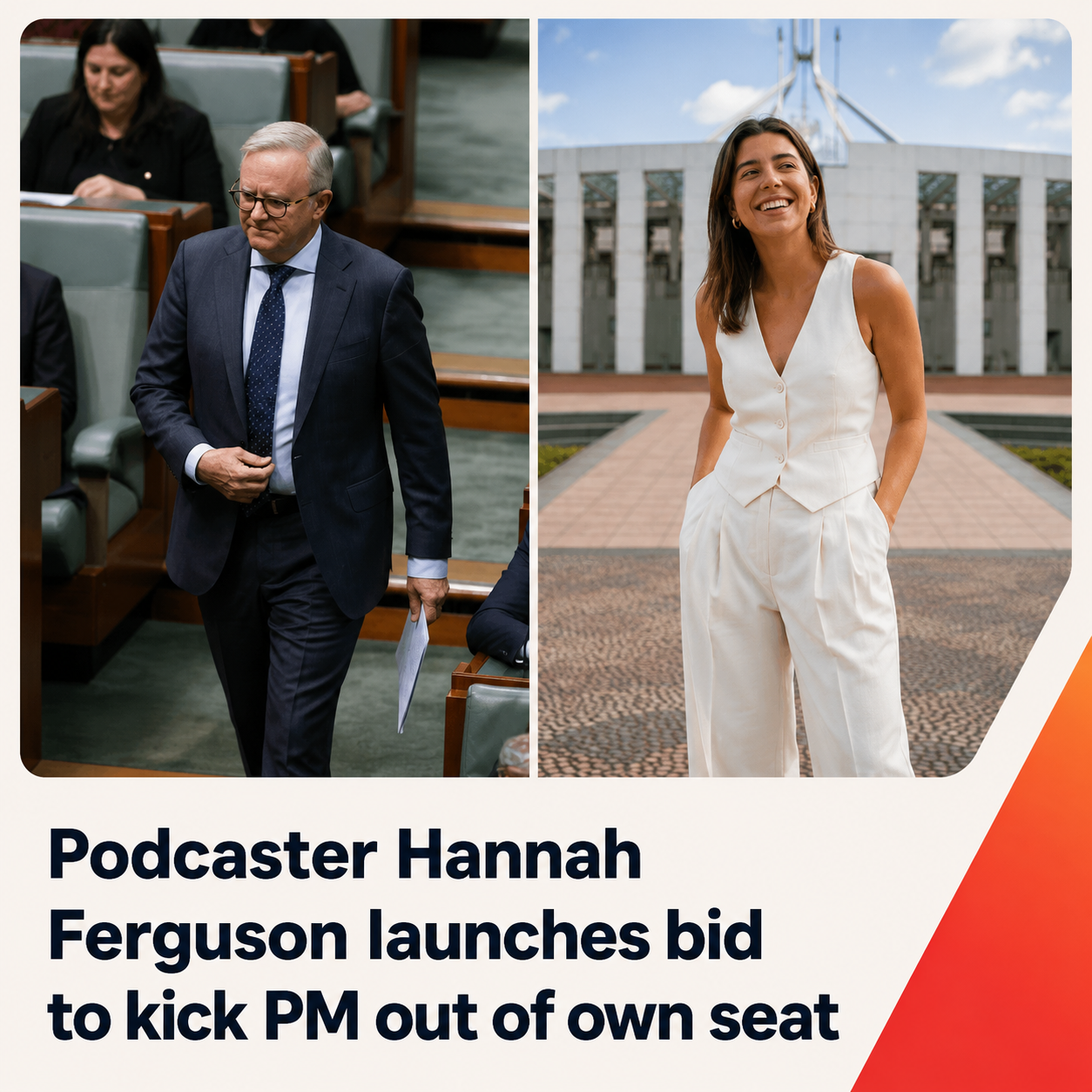
The announcement confirms days of speculation that the 28-year-old media executive would enter federal politics by targeting one of Australia’s safest Labor seats. Rather than pursuing a Senate campaign as she had previously planned, Ferguson says months of discussions with local residents convinced her that challenging for Grayndler would allow her to have a greater impact on issues affecting her own community.
Grayndler, covering much of Sydney’s inner west, has been represented by Anthony Albanese since 1996, making it one of Labor’s most established strongholds. Albanese was elected to the seat before Ferguson was born and has retained it through every election since, eventually becoming Prime Minister in 2022 and leading Labor to an expanded parliamentary majority at the 2025 federal election.
In a video announcing her campaign, Ferguson said she believes Australia’s political institutions are no longer delivering for ordinary voters.
“The political system is broken,” she said.
She argued that both major parties have become too closely aligned with powerful interests rather than the communities that elect them, claiming many voters she has spoken with feel increasingly frustrated despite Labor’s commanding position in Parliament.
“The major parties are answering to vested interests, not the communities they have been elected to serve,” Ferguson said, adding that she regularly hears disappointment from constituents who expected more from the current government.
Ferguson pointed to Labor’s current parliamentary dominance, noting the government holds a substantial House of Representatives majority. In her view, that level of political strength has not translated into the reforms many voters expected on issues such as transparency, housing affordability, gambling advertising and climate policy.
Speaking during a television interview following her announcement, Ferguson said she does not feel represented by her local federal member despite living in the electorate.
She argued Grayndler is an electorate with strongly progressive values and believes many residents want a representative willing to challenge both major political parties rather than operate within the traditional party system.
Among the issues she highlighted were concerns about political donations, the influence of the gambling and fossil fuel industries and what she described as insufficient transparency from government decision-making.
She also criticised what she sees as growing public distrust in Australia’s political institutions, arguing that independent candidates have become increasingly attractive because they are not bound by party discipline.
“I believe we deserve better representation,” Ferguson wrote in her campaign announcement.
“I’m not here to play politics,” she said, adding that Australians have become frustrated with the machinery of the major parties.
Although Ferguson has built a significant following through social media commentary and the success of Cheek Media, she acknowledged that contesting a federal election represents a major personal and professional commitment.
She said she intends to gradually step away from the business she co-founded six years ago in order to campaign full-time before the next election.
Ferguson also stressed that her decision to enter politics was not made lightly.
She originally announced plans last year to seek election to the Senate, but after months of conversations with residents across Sydney’s inner west, she concluded that Grayndler offered the greatest opportunity to advocate directly for the local community.
According to Ferguson, many of those conversations centred on whether one of Australia’s safest Labor seats should face stronger electoral competition.
She believes independent representation has become an increasingly important feature of Australian politics as voters seek alternatives to the traditional two-party system.
The rise of community-backed independents over recent federal elections has demonstrated that even long-held seats can become competitive when local campaigns resonate with voters on issues such as integrity, planning, housing and environmental policy.
However, Grayndler presents one of the most difficult electoral challenges in the country.
Anthony Albanese has represented the electorate continuously for nearly three decades and remains one of Labor’s highest-profile political figures.
At the 2025 federal election he comfortably retained the seat with a decisive two-party-preferred margin, reinforcing Grayndler’s reputation as one of Labor’s safest electorates.
Political analysts note that defeating a sitting Prime Minister in his own electorate would be an extraordinary achievement requiring a dramatic swing in voter sentiment.
Nevertheless, Ferguson’s candidacy is likely to attract national attention because it combines the profile of a well-known media personality with a direct challenge to Australia’s most senior elected official.
Her campaign also arrives at a time when independent candidates continue to play an increasingly influential role in Australian politics.
Since the 2022 federal election, the crossbench has expanded significantly, with community independents proving capable of winning formerly safe seats from both Labor and the Coalition.
Many of those campaigns have focused on local engagement, political transparency and reducing the influence of major-party structures—messages that closely resemble Ferguson’s early campaign themes.
Whether that approach can succeed in Grayndler remains uncertain.
Unlike several electorates won by independents in recent years, Grayndler has traditionally delivered strong support for Labor, and Albanese enjoys both the advantages of incumbency and the national profile that comes with serving as Prime Minister.
The next federal election is due by 2028, meaning Ferguson has an extended period to build a grassroots campaign, recruit volunteers and develop policy positions while introducing herself to voters beyond her existing online audience.
She has indicated that community consultation will remain central to her campaign, promising to continue holding local events, meeting residents and refining her platform based on issues raised by constituents rather than party directives.
For Labor, Ferguson’s announcement does not immediately threaten Grayndler’s status as a safe seat, but it adds another high-profile contest to what is expected to be an increasingly competitive national political environment over the next two years.
For Ferguson, the campaign represents an opportunity to test whether growing public appetite for independent politics can extend into one of Labor’s most recognisable electorates.
While the final result remains years away, her decision to take on the Prime Minister in his own backyard ensures Grayndler will attract far greater national attention than is normally expected for a seat long considered one of Labor’s safest strongholds.






