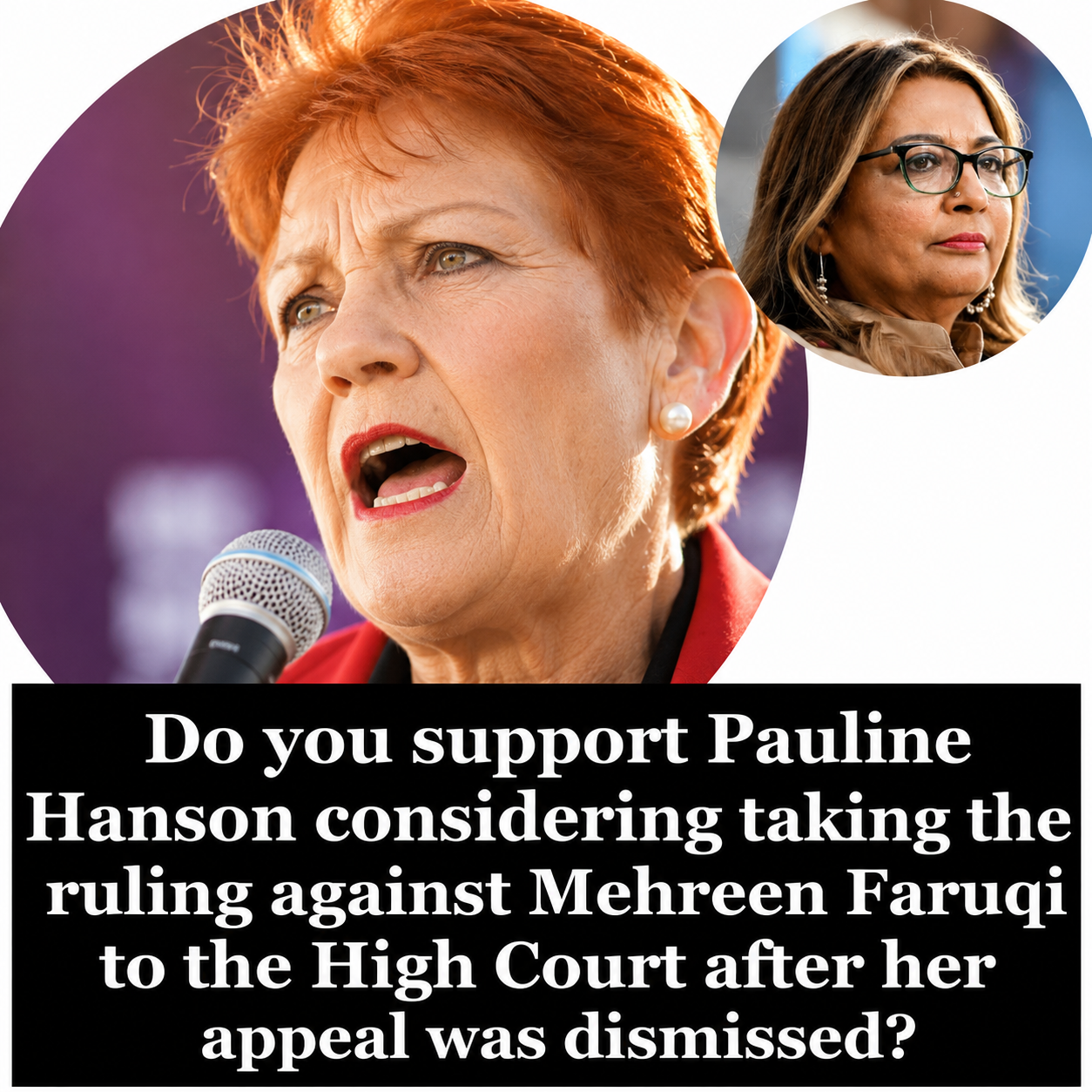
One Nation leader Pauline Hanson is considering taking one of Australia’s most closely watched political legal battles to the High Court after the Full Federal Court unanimously rejected her appeal against a ruling that found she unlawfully racially discriminated against Greens Deputy Leader Mehreen Faruqi.
The decision marks another significant chapter in a case that has evolved far beyond a dispute between two senators, becoming a national debate about where Australia should draw the line between freedom of political expression and protections against racial discrimination.
The Full Federal Court dismissed all seven grounds of Hanson’s appeal, affirming a 2024 judgment that found her September 2022 social media post telling Senator Faruqi to “pack your bags and piss off back to Pakistan” breached Section 18C of the Racial Discrimination Act.
The dispute began shortly after Queen Elizabeth II died in September 2022.
Senator Faruqi posted that she could not mourn “the leader of a racist empire”, prompting a strong response from Hanson, who criticised Faruqi’s comments before telling the Pakistan-born senator to leave Australia and return to Pakistan.
Faruqi subsequently launched legal proceedings, arguing the post constituted unlawful racial discrimination and caused broader harm to migrant communities and Australians of colour.
After lengthy proceedings, Federal Court Justice Angus Stewart ruled in November 2024 that Hanson’s comments amounted to an “angry personal attack” that was “seriously offensive” and represented a strong form of racism directed not only at Faruqi but also at broader racial groups.
Hanson appealed that judgment, arguing the decision imposed unreasonable limits on political communication.
Her legal team submitted that the comments, while robust and offensive to some readers, formed part of legitimate political debate rather than unlawful racial discrimination.
Counsel argued the remarks were directed at Faruqi’s political opinions and conduct rather than her race, and therefore should receive protection under Australia’s implied constitutional freedom of political communication.
The Full Federal Court rejected those arguments.
In a unanimous judgment delivered by Justices Melissa Perry, Geoffrey Kennett and Elizabeth Bennett, the court concluded the original decision contained no legal error and confirmed that criticism of political views does not shield statements that unlawfully discriminate on racial grounds.
The court also reaffirmed that comments directed at an individual because of their race can have wider consequences for others sharing the same racial or ethnic background.
According to the judgment, the phrase used by Hanson relied upon a long-recognised racist trope that implies Australians from migrant backgrounds remain outsiders regardless of their citizenship or public service.
The judges agreed the comments were reasonably likely to offend, insult, humiliate or intimidate not only Senator Faruqi but also members of broader minority communities.
Following the decision, Hanson said she was disappointed by the outcome and indicated her legal team would carefully examine the judgment before deciding whether to seek special leave to appeal to the High Court of Australia.
She argued the ruling reflected a broader trend in which Australians increasingly fear expressing controversial opinions because of legal consequences.
“Public debate is being silenced,” Hanson said, maintaining the case concerns freedom of political discussion rather than personal hostility toward Senator Faruqi.
She argued Australians should remain free to express strongly held opinions, even where others find those opinions offensive or distressing.
For Hanson, the legal battle has become about much more than one social media post.
Throughout the proceedings she has consistently argued that Section 18C of the Racial Discrimination Act imposes excessive restrictions on free expression and should be substantially amended or repealed.
She has previously described herself as defending the right of ordinary Australians to speak openly about political issues without fear of litigation.
Supporters of her position argue robust political debate inevitably includes language that many people may find offensive and warn against expanding legal restrictions on political speech.
Critics respond that freedom of expression does not extend to racial vilification prohibited by Australian law.
Senator Faruqi welcomed the appeal decision, describing it as an important affirmation that Australia’s anti-discrimination laws continue protecting minority communities.
Outside court she declared that “justice has prevailed” and argued the judgment represented a victory for every Australian who has experienced racial abuse.
She also rejected Hanson’s free speech arguments, stating that “hate speech is not free speech.”
Faruqi confirmed she intends to seek legal costs from Hanson and challenged the One Nation leader to continue the litigation if she chooses.
“Bring it on,” she said when asked about the possibility of a High Court appeal.
The litigation has drawn widespread attention because it raises significant constitutional and legal questions extending beyond the personal dispute between two parliamentarians.
Australia does not have a comprehensive constitutional bill of rights guaranteeing unrestricted freedom of speech.
Instead, courts recognise a limited implied freedom of political communication derived from the Constitution.
That freedom operates primarily as a limitation on legislative power rather than creating an unrestricted personal right to say anything without legal consequence.
The Federal Court concluded that Australia’s racial discrimination laws remain compatible with that constitutional principle in this case.
The controversy also arrives during an especially active period in Hanson’s political career.
Recent weeks have seen renewed debate surrounding her comments on immigration, domestic violence and multiculturalism, together with criticism over meetings she held in Britain with anti-Islam activist Tommy Robinson.
Each controversy has reinforced Hanson’s position as one of Australia’s most polarising political figures while simultaneously maintaining strong support among many One Nation voters who view her as willing to challenge political orthodoxy.
Opinion polling has fluctuated during the same period, with some surveys indicating One Nation remains significantly stronger than at previous elections despite short-term movements in primary vote support.
The long-running political rivalry between Hanson and Faruqi also predates the current litigation.
The senators have repeatedly clashed over immigration policy, multiculturalism, Islam, Australia’s constitutional arrangements and religious freedom.
Faruqi was among the strongest critics of Hanson’s previous burqa protest inside the Senate chamber, describing it as racist and Islamophobic.
Hanson, meanwhile, has consistently defended her actions as legitimate political protest directed at public policy rather than religion itself.
Their fundamentally different political philosophies have repeatedly produced some of the Australian Parliament’s most contentious exchanges.
If Hanson ultimately seeks special leave to appeal, the High Court would first need to decide whether the case raises issues of sufficient legal importance to justify hearing the matter.
The High Court accepts only a relatively small proportion of applications each year, particularly where an applicant seeks to overturn a unanimous decision of the Full Federal Court.
Should special leave be granted, the resulting judgment could become one of Australia’s leading authorities on the relationship between political communication and anti-discrimination law.
If leave is refused, the Federal Court’s unanimous decision will remain the final determination of the case.
Regardless of whether further proceedings occur, the Hanson–Faruqi dispute has already become one of the country’s most significant legal tests involving political speech in recent years.
For supporters of Hanson, the litigation represents a broader contest over freedom of expression and the ability of politicians to speak candidly on controversial issues.
For Faruqi and those supporting the judgment, it confirms that political disagreement does not excuse unlawful racial discrimination and that Australia’s legal protections against racial vilification remain enforceable even in heated political debate.
As Hanson weighs her next legal move, the case continues to shape national discussion about where democratic debate ends and unlawful racial discrimination begins—a question that may yet find its final answer in Australia’s highest court.






