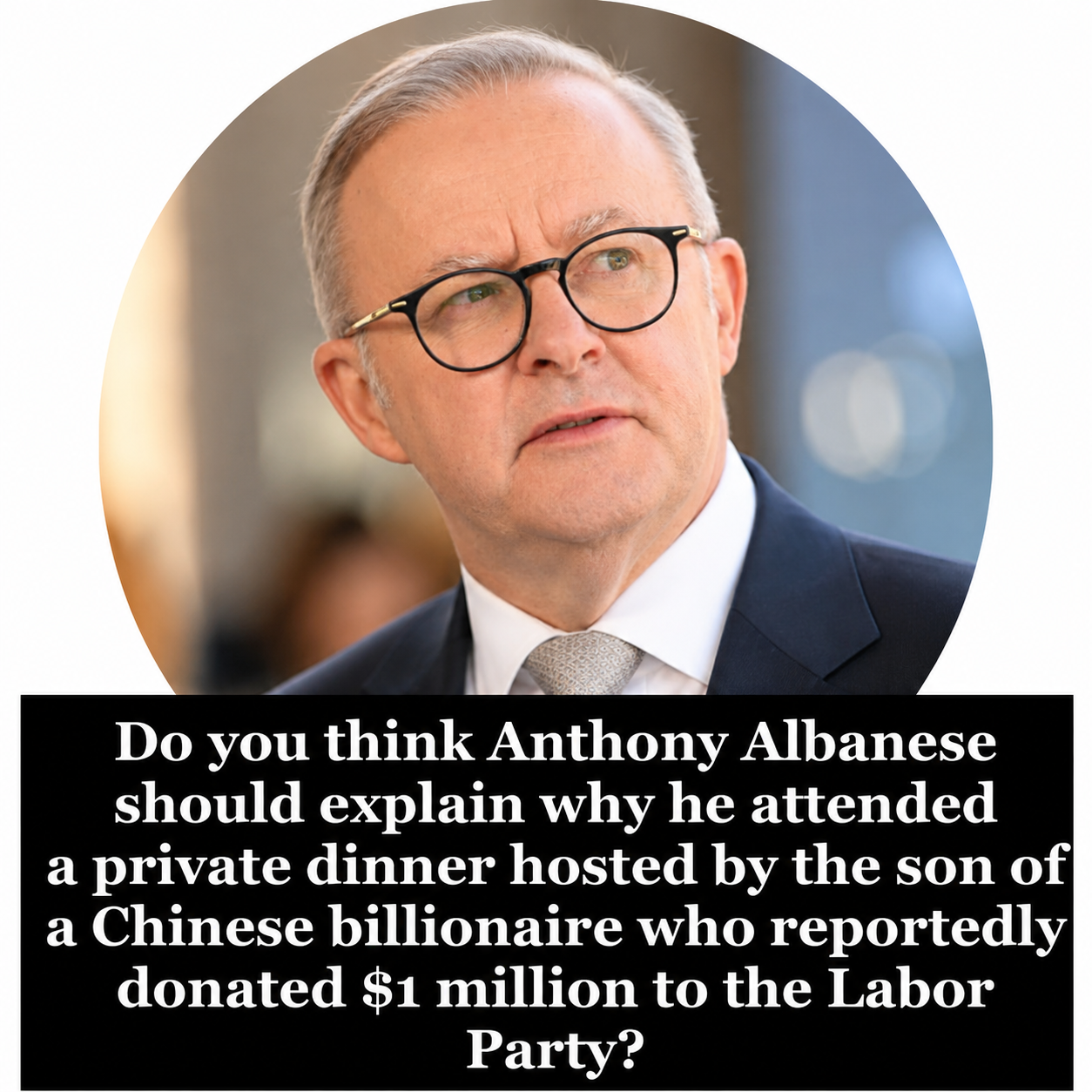
Prime Minister Anthony Albanese has come under renewed political scrutiny after attending an exclusive private dinner at Sydney’s prestigious Point Piper waterfront estate owned by Felix Lee, the son of Chinese-born property developer Phillip Dong Fang Lee, with the event sparking debate over political fundraising, transparency and perceived double standards.
The dinner was attended by a small group of senior business and political figures, including Commonwealth Bank chief executive Matt Comyn, former Victorian Premier Daniel Andrews, former ASIC chairman James Shipton and former Future Fund chairman David Murray.
Media reports suggested the event was organised by Felix Lee and linked to a significant political donation for the Australian Labor Party, with some early reports claiming a contribution of around A$1 million had been discussed. However, Labor sources later disputed that figure, saying the dinner raised substantially less and that suggestions of a A$1 million donation were inaccurate.
The Prime Minister’s attendance has generated criticism from opposition politicians and renewed debate about the relationship between major political parties and wealthy donors.
Critics questioned whether the optics of attending a private dinner hosted by a businessman whose family has previously attracted regulatory attention were appropriate for Australia’s Prime Minister.
Government representatives, however, stressed that attendance at fundraising events is a routine part of political life for leaders of both major parties and that all reportable donations must ultimately be disclosed under Australia’s political finance laws.
According to media reports, Felix Lee has been building his own business profile through the Lee Family Office while distancing himself professionally from controversies that have previously surrounded his father.
Phillip Dong Fang Lee became well known during public inquiries into Star Entertainment after evidence emerged that he had gambled more than A$2 billion at Sydney’s Star Casino over approximately fifteen years.
Separately, the Australian Taxation Office obtained freezing orders in 2021 over assets connected with Phillip Lee and associated companies during proceedings relating to an alleged tax liability of approximately A$272 million. Court proceedings were ultimately resolved through settlement, and the allegations were not determined at trial.
Felix Lee has also previously attracted regulatory attention through an investment in digital banking venture In1Bank.
Reports indicated the Australian Prudential Regulation Authority examined aspects of the investment and source-of-funds due diligence before the banking venture later surrendered its banking licence.
No allegation of wrongdoing has been made against Felix Lee in relation to the fundraising dinner itself.
Questions intensified after reports suggested the Prime Minister’s attendance may have been connected with an anticipated major political donation.
While some reports initially referred to a possible A$1 million contribution, subsequent reporting quoted Labor sources as saying the dinner instead operated more like a traditional fundraising function, with guests contributing attendance fees and the total proceeds likely being closer to A$100,000 rather than A$1 million.
Neither the Prime Minister’s Office nor the Labor Party has publicly confirmed the precise amount associated with the event.
A spokesperson for Mr Albanese said the Prime Minister does not comment on private dinners and reiterated that political donations are matters for the Labor Party and will be disclosed through the Australian Electoral Commission under normal reporting requirements.
When questioned publicly about the dinner, Mr Albanese declined to discuss the specific gathering.
Instead, he said he attends many private functions as Prime Minister and maintained that political fundraising occurs across the Australian political system.
He also indicated he was not personally familiar with historical matters involving Phillip Lee when asked by journalists.
The issue quickly became politically charged after One Nation leader Pauline Hanson accused Labor of applying different standards depending on which political party receives support from wealthy Australians.
Hanson recently defended her own relationship with mining billionaire Gina Rinehart after criticism surrounding flights provided on Rinehart’s private aircraft.
She argued that all relevant support had been properly declared and suggested critics had subjected her to greater scrutiny than they were willing to apply to Labor’s relationships with prominent business figures.
Coalition politicians also seized on the controversy.
Nationals senator Matt Canavan argued the Prime Minister should explain the circumstances surrounding the dinner and called on Labor to reject any donation if questions remained about the event’s appropriateness.
Liberal figures similarly questioned whether adequate due diligence had been undertaken before the Prime Minister attended the gathering.
Government ministers defended Mr Albanese’s actions.
Social Services Minister Tanya Plibersek said Australian political parties routinely hold fundraising functions and argued transparency is ensured through Australia’s political donation disclosure regime.
Other ministers similarly noted that political leaders from both Labor and the Coalition regularly attend fundraising events organised by supporters, businesses and community organisations.
The controversy has also renewed broader discussion about political donations in Australia.
Federal political parties have long relied on a combination of membership fees, fundraising events and private donations to finance election campaigns.
Australian law requires reportable political donations to be disclosed through the Australian Electoral Commission, although disclosure occurs after prescribed reporting periods rather than immediately following every event.
Successive governments have introduced reforms intended to improve transparency while balancing privacy and administrative requirements for donors and political parties.
Debate nevertheless continues over whether Australia’s donation disclosure framework should require faster reporting, lower disclosure thresholds or tighter restrictions on large private contributions.
Political analysts note that controversies involving fundraising events are not uncommon for governments or oppositions.
Questions frequently arise whenever senior political leaders attend exclusive functions hosted by wealthy individuals, particularly where those individuals or associated businesses have previously featured in regulatory or legal proceedings.
In many cases, public debate focuses less on whether any laws were broken and more on public perceptions regarding transparency, access and political influence.
In this instance, there has been no suggestion that attending the dinner itself breached Australia’s political donation laws.
The principal issues raised publicly concern the appearance of political access, the size of any associated donation and whether sufficient explanations have been provided to the public.
The episode also illustrates the increasingly combative political environment as Australia’s major parties prepare for future electoral contests.
Labor has recently criticised One Nation over its relationship with Gina Rinehart, while One Nation and Coalition figures have now turned similar scrutiny towards Labor’s fundraising activities.
Each side argues the other should be held to higher standards of transparency and accountability.
Whether the Point Piper dinner continues to generate political controversy may ultimately depend on what future donation disclosures reveal once the relevant reporting period concludes.
Until then, the event remains another example of how fundraising, political access and perceptions of influence continue to occupy a prominent place in Australia’s national political debate.






