Prime Minister Anthony Albanese has launched one of his strongest attacks yet on the federal opposition and Pauline Hanson’s One Nation, arguing the three conservative parties are effectively pursuing the same political agenda despite contesting elections separately.
Addressing delegates at the Australian Labor Party’s National Conference, Mr Albanese portrayed the next federal election as a choice between Labor’s program of economic and social reform and what he described as a conservative alliance focused on reducing worker protections and public services.
“The Liberals, the Nationals and One Nation are already a coalition,” the Prime Minister told party members.
He argued the parties shared common policy objectives, claiming they all wanted to reduce workers’ wages, abolish paid parental leave, make it easier for employers to dismiss staff, make home ownership harder for younger Australians and cut Medicare.
The remarks formed one of the central themes of his conference address as Labor sought to sharpen political distinctions with its opponents ahead of the next federal election.
Mr Albanese contrasted those claims with Labor’s own priorities, presenting his government as focused on economic stability, social cohesion and practical reform.
“In the Labor Party, we travel on a different road,” he said.
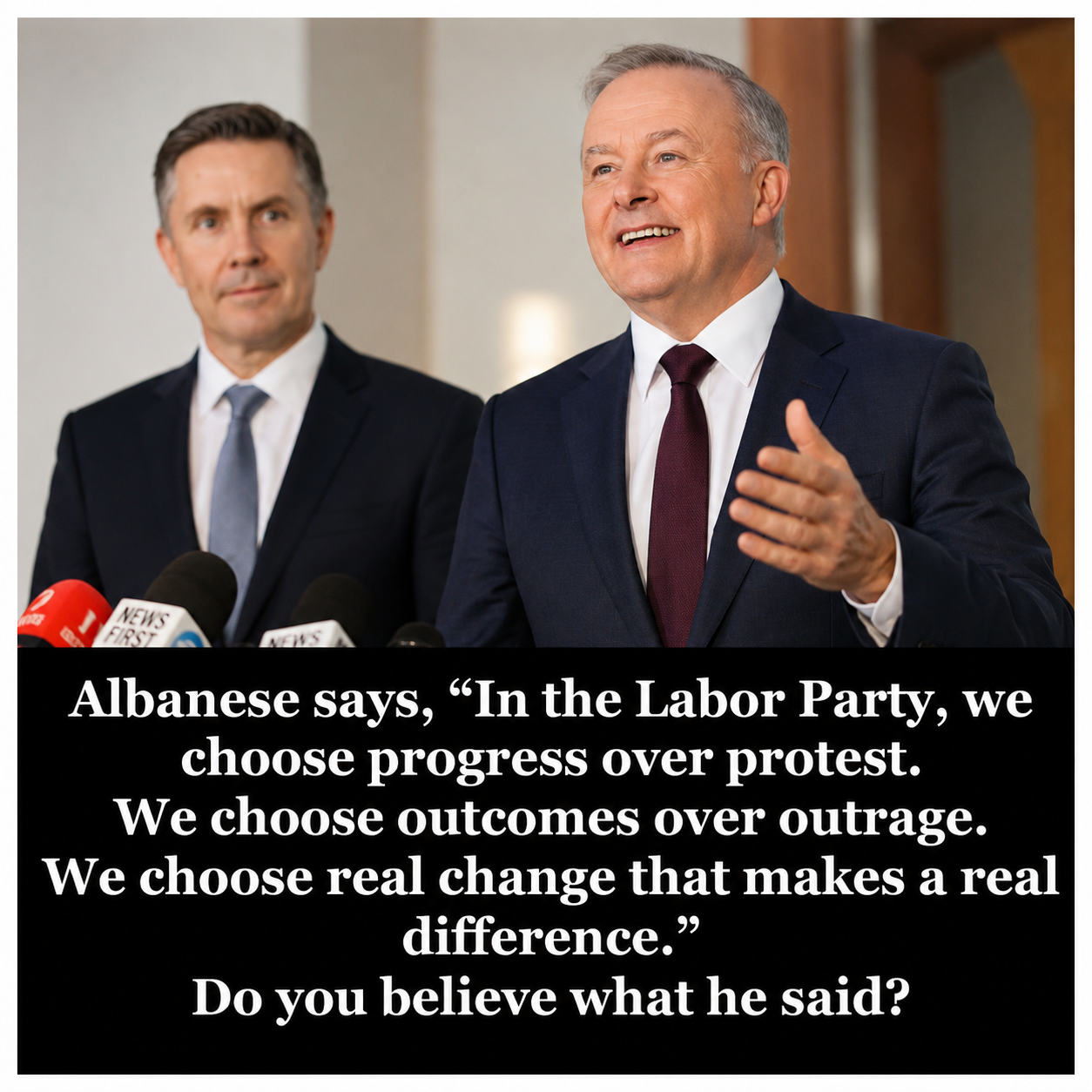
“We choose progress over protest. We choose purpose over chaos. We choose unity over division. We choose outcomes over outrage. We choose real change that makes a real difference.”
The speech reflected Labor’s broader campaign strategy of framing the political contest as one between a reform-focused government and a fragmented conservative opposition.
The Prime Minister’s comments came amid renewed political attention on One Nation following a series of opinion polls showing increased support for Pauline Hanson’s party.
Several recent national surveys have suggested One Nation has gained ground among voters concerned about cost-of-living pressures, migration, housing affordability and government spending.
Labor strategists have increasingly identified the party as an important electoral challenge, particularly in regional Australia and outer metropolitan electorates where disillusionment with the major parties has been growing.
Although Mr Albanese described the Liberals, Nationals and One Nation as effectively pursuing the same agenda, the three parties remain separate political organisations with distinct policies and leadership structures.
The Liberal Party and National Party operate together under the long-standing federal Coalition agreement, while One Nation contests elections independently and is not part of that formal Coalition arrangement.
Nevertheless, Labor has argued that overlaps in policy positions on issues such as industrial relations, migration and aspects of economic management justify portraying them collectively as Australia’s conservative political bloc.
Industrial relations featured prominently in the Prime Minister’s criticism.
Labor has consistently promoted its workplace reforms—including changes to bargaining laws, labour hire regulation and stronger protections for gig economy workers—as evidence of its commitment to improving wages and job security.
The government also points to legislation protecting penalty rates, strengthening workplace rights and expanding paid parental leave as key achievements during its time in office.
Mr Albanese argued those measures would be placed at risk if conservative parties were able to form government.
Housing affordability formed another major element of the Prime Minister’s address.
Labor has introduced a range of housing initiatives aimed at increasing supply, assisting first-home buyers and encouraging new residential construction.
Those measures include the Housing Australia Future Fund, expanded shared-equity arrangements and financial support for new social and affordable housing developments.
The government argues these initiatives are designed to improve access to home ownership, particularly for younger Australians facing high property prices and rising rents.
Opposition parties have criticised aspects of Labor’s housing strategy, arguing additional supply reforms and planning changes are needed alongside financial assistance.
Health policy also featured heavily in Mr Albanese’s speech.
The Prime Minister accused conservative parties of threatening Medicare, a claim Labor has frequently made during election campaigns over several decades.
Labor has highlighted increased bulk-billing incentives, expanded urgent care clinics and additional health funding as evidence of its commitment to Australia’s universal healthcare system.
The Coalition has rejected suggestions it intends to dismantle Medicare, instead arguing it supports the system while proposing different approaches to healthcare funding and service delivery.
One Nation likewise maintains its own health policy platform, although Labor contends several of the party’s broader fiscal proposals could affect future public spending priorities.
The speech also demonstrated how significantly One Nation has risen in Labor’s political calculations.
While previous Labor conferences largely focused criticism on the Coalition, this year’s gathering devoted considerable attention to Pauline Hanson’s party and its increasing electoral influence.
Political commentators observed that the Prime Minister mentioned One Nation repeatedly without referring directly to Senator Hanson by name, instead concentrating on the party’s policy positions and electoral appeal.
Labor National Secretary Paul Erickson later reinforced that message, arguing the next election would involve competition not only with the Coalition but also with One Nation’s growing support base.
Senior Labor figures have acknowledged privately that dissatisfaction over living costs, migration and economic uncertainty has created opportunities for minor parties seeking to attract voters frustrated with traditional politics.
As a result, Labor has increasingly sought to frame One Nation as part of a broader conservative alternative rather than treating it solely as a protest movement.
For the Coalition and One Nation, Labor’s rhetoric reflects a political strategy designed to consolidate progressive voters by presenting a stark ideological contrast.
Conservative parties have generally rejected Labor’s characterisation of their policies, arguing the government has misrepresented their positions while attempting to divert attention from cost-of-living pressures, energy prices and housing affordability.
Political debate over wages, taxation, industrial relations and government spending is expected to remain central as Australia moves closer to the next federal election.
Labor continues to argue that responsible public investment, stronger workplace protections and expanded public services provide the best pathway to long-term prosperity.
Its opponents counter that lower taxes, restrained government expenditure and policies encouraging private-sector growth offer a more sustainable approach to improving living standards.
Those competing visions formed the backdrop to Mr Albanese’s address and are likely to shape much of Australia’s political debate over the coming months.
The Prime Minister concluded his speech by urging Labor members to remain focused on governing rather than engaging in what he described as divisive politics.
His repeated emphasis on “progress over protest”, “purpose over chaos” and “unity over division” reflected the government’s attempt to present itself as a stable governing force while contrasting its record with the agenda it attributes to its political opponents.
Whether that message resonates with voters will become clearer as campaigning intensifies and Australians weigh competing approaches to economic management, public services, industrial relations and national priorities before the next election.






