One Nation leader Pauline Hanson has suffered another significant legal defeat after the Full Federal Court unanimously upheld a ruling that found she breached Australia’s Racial Discrimination Act by telling Greens senator Mehreen Faruqi to “piss off back to Pakistan” in a social media post.
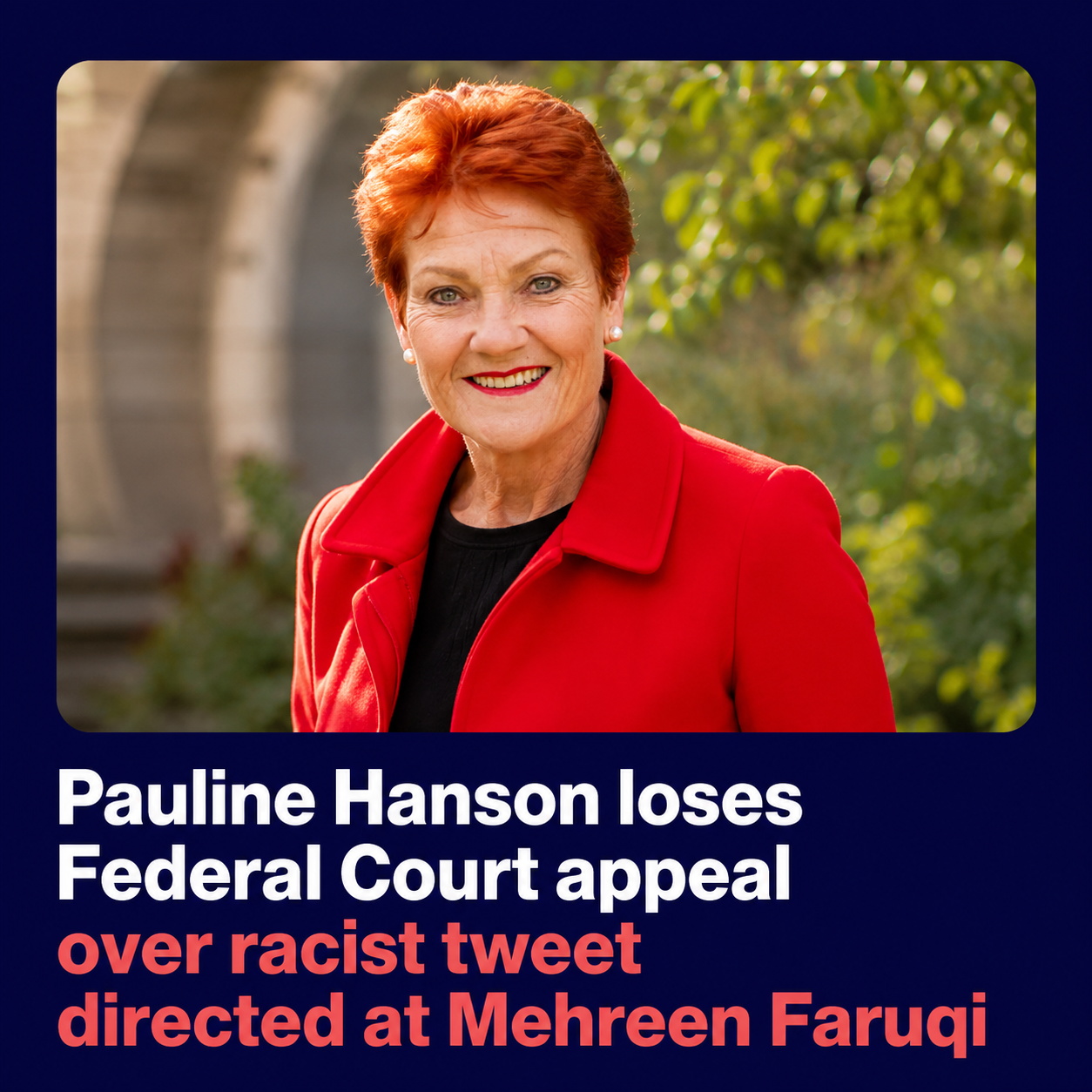
The judgment confirms an earlier Federal Court ruling delivered in 2024 by Justice Angus Stewart, who concluded Senator Hanson’s comments amounted to unlawful racial discrimination under Section 18C of the Racial Discrimination Act 1975. After reviewing the appeal, the Full Court found no legal error in the original decision and dismissed every ground advanced by Senator Hanson.
The latest ruling marks the culmination of nearly four years of litigation arising from a social media exchange that quickly became one of Australia’s most closely watched legal disputes involving freedom of political communication and racial discrimination.
The controversy began on 8 September 2022, the day Queen Elizabeth II died.
Senator Mehreen Faruqi, the Greens’ deputy leader and the first Muslim woman elected to an Australian parliament, posted on X, formerly Twitter, saying she could not mourn “the leader of a racist empire built on stolen lives, land and wealth of colonised peoples” while expressing sympathy for those grieving the late Queen.
The post attracted widespread political attention and sparked fierce criticism from a number of conservative politicians and commentators.
Among the strongest responses came from Senator Hanson, who replied by telling Senator Faruqi to “pack your bags and piss off back to Pakistan”.
Although framed by Senator Hanson as political criticism, the comment quickly prompted allegations that it relied upon a long-standing racist trope suggesting migrants should leave Australia if they express views that others dislike. Senator Faruqi subsequently commenced legal proceedings under the Racial Discrimination Act.
In November 2024, Justice Angus Stewart ruled in Senator Faruqi’s favour.
His judgment described the post as an “angry personal attack” and concluded that it constituted a “strong form of racism”. He found the statement was reasonably likely to offend, insult, humiliate or intimidate people because of their race or national origin, bringing it within the scope of Section 18C.
The judge also concluded that the comments carried an anti-Muslim or Islamophobic character and reflected a well-recognised racist message implying Australians from migrant backgrounds remain outsiders regardless of their citizenship or public service.
Justice Stewart ordered Senator Hanson to delete the offending social media post and awarded legal costs in favour of Senator Faruqi.
Rather than accepting the decision, Senator Hanson lodged an appeal before the Full Federal Court.
Her legal team argued the original judgment had interpreted both the legislation and the social media exchange too broadly. Counsel submitted that while the language used might have been offensive, it did not amount to unlawful racial discrimination and should instead be viewed as part of robust political debate protected by Australia’s implied constitutional freedom of political communication.
The Full Court rejected those submissions in a unanimous decision delivered by Justice Melissa Perry on behalf of a three-judge bench.
The court concluded Justice Stewart had correctly interpreted the law and that the evidence supported his findings. Importantly, the judges also rejected constitutional arguments advanced on Senator Hanson’s behalf, reaffirming that Australia’s anti-discrimination legislation remains compatible with the implied freedom of political communication recognised by the High Court.
The decision reinforces the principle that while politicians enjoy substantial freedom to participate in public debate, that freedom is not unlimited and does not provide immunity from laws designed to protect Australians from racial discrimination.
Following the judgment, Senator Hanson expressed disappointment that her appeal had failed.
She argued the outcome would further restrict public discussion in Australia and suggested freedom of speech had been diminished. Senator Hanson also indicated she is considering applying for special leave to appeal to the High Court, Australia’s highest judicial authority.
Such an appeal would not occur automatically. The High Court first determines whether a proposed appeal raises legal questions of national importance before deciding whether to grant special leave. Only a relatively small proportion of applications proceed to a full hearing.
Senator Faruqi welcomed the dismissal of the appeal, describing the judgment as an important victory extending beyond her personal case.
She said the unanimous decision demonstrated that racism and Islamophobia have consequences under Australian law and rejected suggestions that discriminatory comments should be protected merely because they occur during political debate.
“Justice has prevailed,” Senator Faruqi told reporters after the ruling, adding that hate speech should never be mistaken for free speech.
The decision has also been welcomed by Australia’s Race Discrimination Commissioner, Giridharan Sivaraman, who described the appeal outcome as an important reaffirmation of legal protections against racism.
The Commissioner said the judgment demonstrated that Australia’s legal system continues to recognise the harm caused by racial abuse while preserving space for vigorous political discussion conducted without discriminatory attacks based on race or ethnicity.
The case has attracted national attention because it highlights the continuing debate surrounding Section 18C of the Racial Discrimination Act, one of Australia’s most politically contested legal provisions.
The section makes it unlawful to engage publicly in conduct reasonably likely to offend, insult, humiliate or intimidate another person because of their race, colour or national or ethnic origin.
Supporters argue the law provides essential protection for multicultural communities and promotes respectful public discourse.
Critics, including Senator Hanson and a number of conservative commentators, have long argued Section 18C restricts freedom of expression and can discourage open political debate.
The Federal Court’s latest judgment confirms that, in the court’s view, the legislation strikes an appropriate constitutional balance between protecting political communication and preventing unlawful racial discrimination.
Unlike countries such as the United States, Australia does not have a constitutional bill of rights guaranteeing unrestricted freedom of speech.
Instead, Australian courts recognise an implied freedom of political communication that protects the operation of representative government but allows Parliament to impose reasonable legal limits serving legitimate public objectives.
The Full Federal Court found Australia’s racial discrimination laws fall within those constitutional limits and remain enforceable against elected representatives, just as they apply to every other Australian.
The Hanson-Faruqi proceedings have therefore become far more than a dispute between two politicians.
They now stand as one of the most significant modern authorities on the interaction between political speech, constitutional freedoms and Australia’s anti-discrimination framework.
The litigation has also demonstrated how a single social media post can evolve into years of complex constitutional argument and judicial scrutiny, reflecting the growing legal significance of online political communication.
Attention will now turn to whether Senator Hanson formally seeks special leave to appeal to the High Court.
If the High Court declines to hear the matter, the unanimous Full Federal Court ruling will remain the final and authoritative legal determination, reinforcing that racially discriminatory public statements—even when made during heated political debate—may breach Australia’s anti-discrimination laws and attract significant legal consequences.






