Anthony Albanese arrived at Labor’s 50th National Conference in Adelaide with little left to prove inside his own party.
Fresh from an emphatic federal election victory, the Prime Minister presided over one of the most tightly managed conferences in recent ALP history. Major policy disputes were largely resolved before delegates entered the convention hall, leaving the public image of a united government focused on delivering its second-term agenda.
Yet one issue refused to disappear.
The party’s approach to Israel and the Palestinian territories emerged as the conference’s most politically sensitive debate, exposing tensions between Labor’s evolving grassroots membership, senior ministers, Jewish community leaders and MPs pushing for a harder stance on Israel.
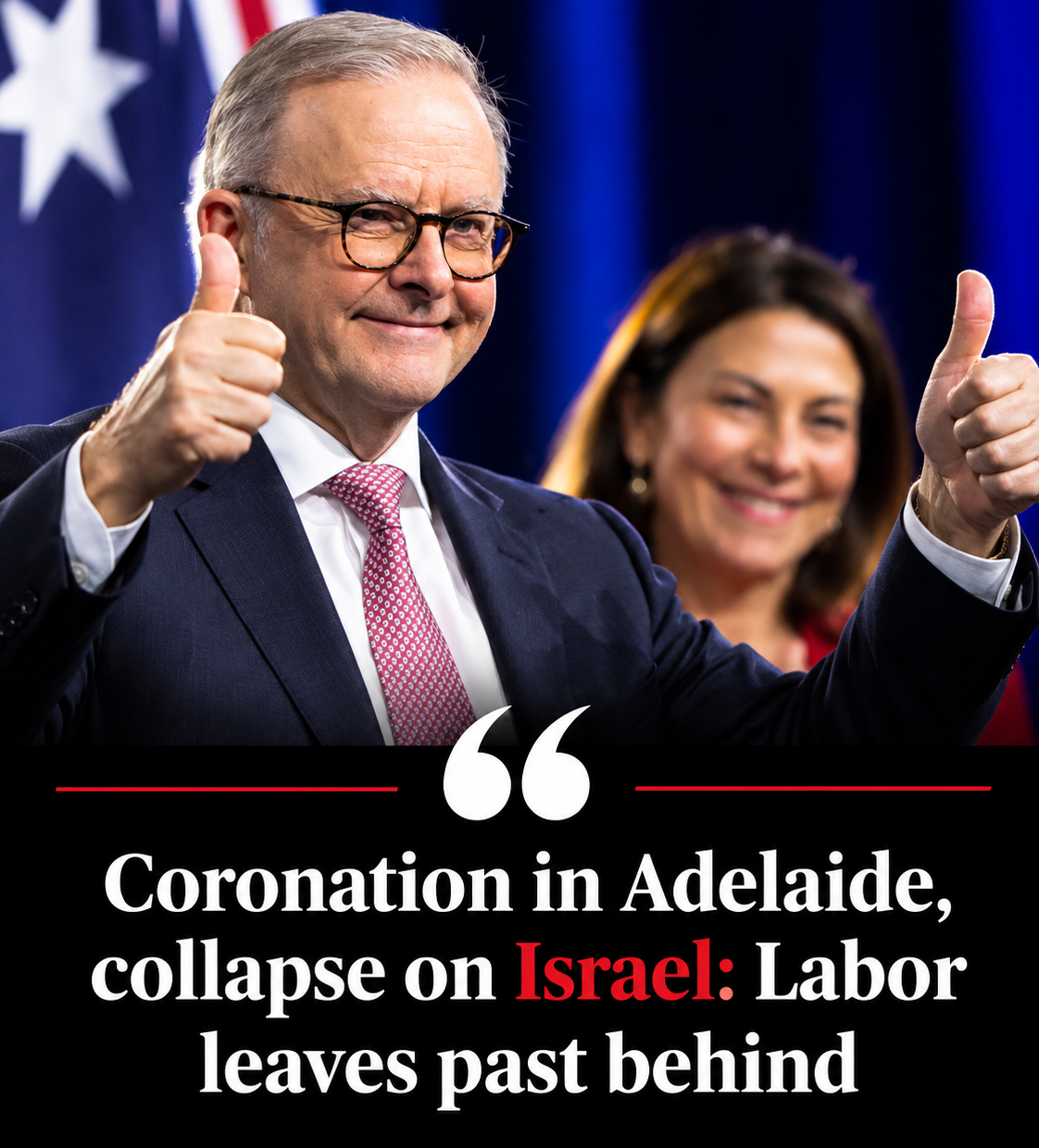
Although Albanese succeeded in preventing an open factional battle on the conference floor, the platform ultimately adopted by delegates has prompted fresh questions about whether Labor is moving away from Australia’s long-standing bipartisan approach to the Middle East.
For many observers, the conference demonstrated two contrasting realities at once: Albanese’s unprecedented authority within Labor, and growing unease over the party’s direction on one of the world’s most divisive foreign policy issues.
The Prime Minister’s influence over the conference was evident from beginning to end.
Unlike earlier Labor conferences that were remembered for dramatic floor fights and highly public factional disputes, Adelaide unfolded under carefully negotiated agreements that prevented most controversial amendments from reaching delegates.
Political analysts noted that Labor’s modern policy process, combined with Albanese’s leadership following Labor’s commanding election victory, meant potential disagreements were largely settled behind closed doors rather than under television cameras.
The result was a conference that projected discipline and unity.
That image, however, masked significant negotiations over foreign policy language relating to Israel, Hamas and the future recognition of a Palestinian state.
Labor reaffirmed its support for a negotiated two-state solution, backing the long-standing objective of Israel and a future Palestinian state existing side by side in peace and security.
The platform also continued to condemn terrorism, including attacks carried out by Hamas.
However, one important change attracted immediate attention.
Previous versions of Labor’s platform had explicitly required Hamas to disarm and the Palestinian Authority to undertake governance reforms before recognition of Palestinian statehood could be considered.
Those specific conditions no longer appear in the revised platform adopted at the Adelaide conference.
Supporters of the revised wording argue the platform better reflects Australia’s increasingly coordinated approach with like-minded international partners while maintaining balance between Israeli security concerns and Palestinian aspirations.
Critics, however, believe removing those conditions risks weakening Labor’s traditional insistence that Hamas cannot play a future governing role while remaining an armed militant organisation.
The changes immediately drew criticism from several Jewish organisations.
The Executive Council of Australian Jewry and other pro-Israel advocacy groups argued the revised language represented a departure from Australia’s traditional bipartisan position, expressing concern that Hamas’ responsibilities had been downgraded while greater emphasis was placed on Israeli actions.
The debate became even more politically delicate because it unfolded against continuing international concern over the humanitarian crisis in Gaza following the October 2023 Hamas attacks and Israel’s subsequent military campaign.
Within Labor itself, however, pressure was coming from multiple directions.
Former cabinet minister Ed Husic sought to push the party even further by proposing language that would have recognised findings from a United Nations inquiry concerning Israel’s conduct during the conflict.
His proposal never reached a formal debate.
Unable to secure sufficient procedural support after factional negotiations, the amendment failed before delegates voted on the broader platform.
Husic later criticised Labor’s internal culture, suggesting considerable effort had gone into preventing discussion rather than allowing delegates to openly debate the issue.
The Prime Minister rejected suggestions that dissent had been suppressed.
Speaking after the conference, Albanese maintained delegates had every opportunity to contribute through Labor’s policy committees and defended the final platform as achieving an appropriate balance between support for Israel’s security and recognition of Palestinian aspirations.
He pointed to contributions from Jewish Labor MP Josh Burns and Palestinian-Australian MP Basem Abdo as examples of the balanced discussion the government wished to promote.
Burns and Abdo became symbolic figures during the conference, with both publicly supporting the adopted platform despite their differing personal connections to the conflict.
Their appearance together was widely viewed inside Labor as reinforcing the leadership’s message that empathy and dialogue should prevail over ideological confrontation.
Even so, not everyone accepted that interpretation.
Some Jewish leaders argued the revised wording sends an unintended message internationally by removing conditions they believe are fundamental to any lasting peace agreement.
Others warned that Australia’s Middle East policy has historically rested upon bipartisan consensus rather than significant shifts driven by internal party politics.
The debate also highlights broader changes taking place inside the Labor Party.
Over recent decades, Labor’s Left faction has grown in influence both inside caucus and among conference delegates.
That changing internal balance has increasingly shaped debates on foreign affairs, climate policy and defence, even when the parliamentary leadership ultimately adopts more moderate positions.
Despite occasional ideological differences, Albanese has demonstrated an ability to maintain remarkable discipline across these competing interests.
Observers noted that the conference produced few of the dramatic confrontations once associated with ALP national gatherings, reflecting both stronger organisational processes and the Prime Minister’s commanding political position.
For Albanese personally, Adelaide reinforced his standing as Labor’s dominant leader.
Few prime ministers have entered a national conference with such extensive authority over both the parliamentary party and its organisational wing.
His government emerged with endorsements across a broad domestic policy agenda, while potentially divisive disputes were largely contained before they could overshadow the conference itself.
Nevertheless, the Israel debate demonstrated that foreign policy remains one of the few areas capable of exposing genuine ideological differences inside Labor.
The adopted platform is expected to guide party policy for the next three years, although Australia’s official foreign policy will continue to be determined by the Albanese Government rather than conference resolutions alone.
Whether the revised language ultimately influences future decisions—particularly surrounding any possible recognition of Palestinian statehood—will likely depend on developments in the Middle East as well as Australia’s coordination with international partners.
For now, the Adelaide conference leaves two enduring political impressions.
Anthony Albanese demonstrated that he has consolidated almost complete control over Australia’s governing party.
At the same time, Labor’s evolving language on Israel and Palestine has reopened a debate that many believed had long been settled within Australian politics, ensuring questions about the party’s future direction on the Middle East are unlikely to disappear any time soon.






