Melbourne’s residential property market is enduring its weakest winter auction season in several years, with hundreds of homes withdrawn from auction schedules as higher borrowing costs, weaker buyer demand and changing investment conditions continue to weigh on confidence.
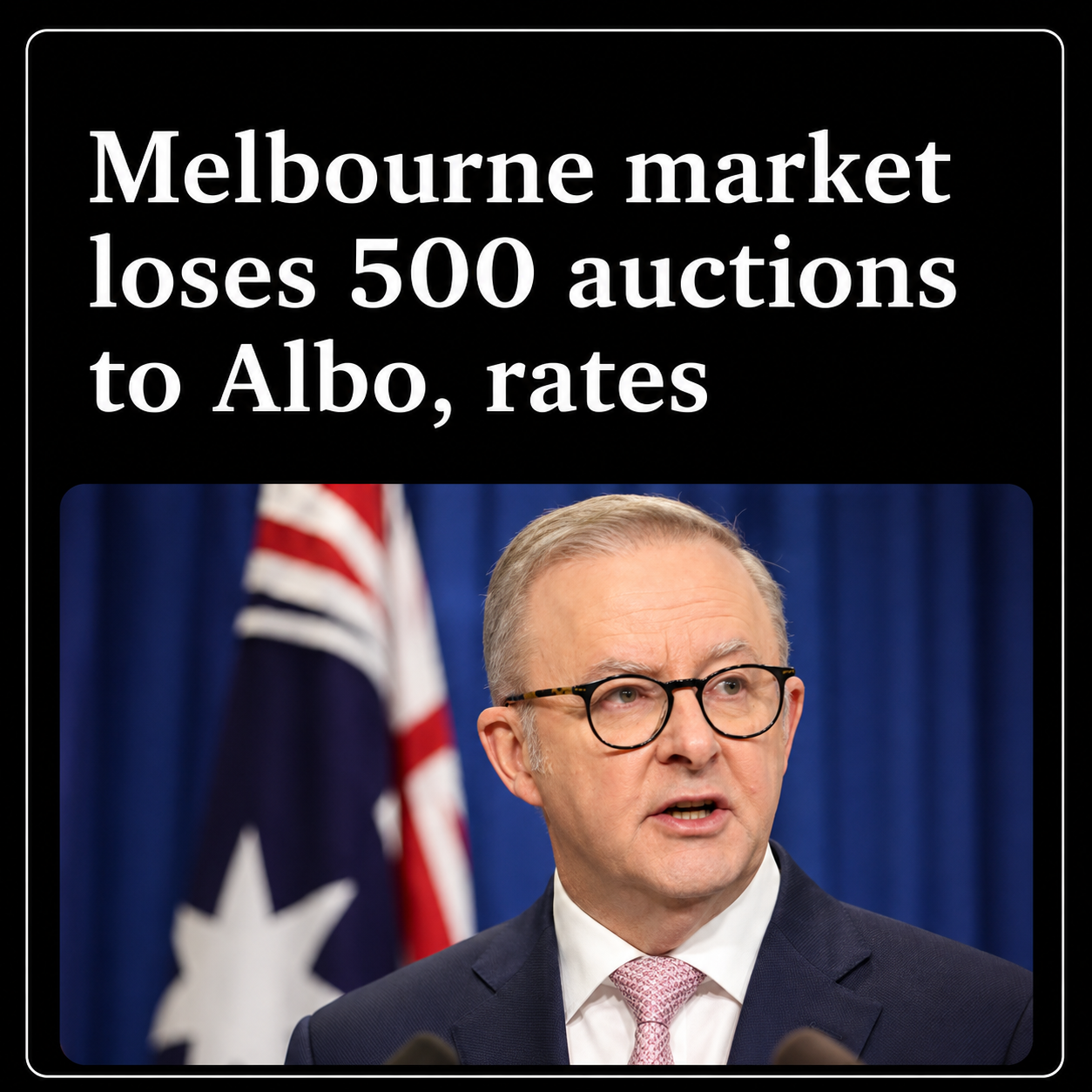
According to the latest PropTrack figures, only 682 homes are scheduled to go under the hammer across Melbourne this weekend—81 fewer than the equivalent weekend last year and around 12 per cent lower year-on-year. Looking ahead, just 590 auctions are expected next week, representing a decline of approximately 23 per cent compared with the same week in 2025. Overall, the city has now lost more than 500 winter auction listings compared with last year.
The decline reflects a significant cooling in seller confidence.
Many homeowners appear to be postponing auctions rather than risking disappointing results in a market where buyer activity has softened and successful sales have become increasingly difficult to achieve.
PropTrack senior economist Angus Moore described the current period as Melbourne’s weakest winter for auction numbers since 2023, warning that conditions could remain subdued for several more months if borrowing costs continue to rise. He noted that upcoming inflation data could influence the Reserve Bank’s next decision, with financial markets closely watching the possibility of another interest-rate increase.
Higher interest rates have become one of the biggest headwinds facing Melbourne’s housing market.
As mortgage costs increase, many prospective buyers find their borrowing capacity reduced, while others choose to delay major purchasing decisions until there is greater certainty about the direction of interest rates. Sellers, in turn, become more reluctant to test the market when fewer buyers are actively competing for properties.
The weakness is also evident in auction clearance rates.
Melbourne recorded a final clearance rate of 49.7 per cent last week, marking the fifth consecutive week below the 50 per cent threshold. Preliminary figures had initially suggested a stronger outcome, but the rate declined after additional unsuccessful auction results were reported in subsequent days. Property analysts generally regard clearance rates above 60 per cent as indicative of a balanced or stronger seller’s market.
Several factors are contributing to the downturn.
Economists point to a combination of higher interest rates, persistent cost-of-living pressures and uncertainty following the Federal Government’s May Budget, which introduced major changes to tax concessions for residential property investors. Those reforms include limiting negative gearing on existing homes purchased after budget night and replacing the 50 per cent capital gains tax discount with an inflation-based calculation for future investments.
Many industry participants believe those changes have had an immediate impact on investor sentiment.
Buyer advocate Cate Bakos told ABC News that investors have “all but left the market” for established Melbourne housing, while financial advisers report increasing numbers of clients are considering selling investment properties rather than purchasing new ones. Although owner-occupiers remain active in some market segments, reduced investor participation has affected overall demand.
The decline in investor activity has flowed through to auction volumes.
With fewer buyers competing, many vendors are choosing private sales or delaying listings altogether. Others are adjusting price expectations after witnessing weaker auction results across Melbourne throughout winter.
Real Estate Institute of Victoria chief executive Toby Balazs said the clearance rate continues to serve as an important measure of confidence across the property market. While acknowledging current conditions are challenging, he suggested softer markets may create opportunities for buyers who have been waiting for less competitive conditions.
Property values have also begun to reflect the changing environment.
Recent PropTrack data indicates Melbourne has experienced one of the weakest housing performances among Australia’s capital cities during 2026. Separate analysis shows prices have fallen across the overwhelming majority of Melbourne suburbs since the Federal Budget, with premium locations experiencing some of the sharpest declines.
Not every part of the market is struggling equally, however.
Affordable outer suburban areas continue to attract interest from owner-occupiers and first-home buyers, particularly where homes remain within reach despite tighter lending conditions. Some individual auctions continue to generate strong competition, especially for well-presented family homes in desirable locations, demonstrating that demand has weakened rather than disappeared entirely.
Industry observers also point to upcoming regulatory changes in Victoria that may be influencing seller behaviour.
New legislation requiring vendors to disclose reserve prices before auctions is expected to take effect later this year. Some agents believe uncertainty surrounding those changes may be encouraging certain sellers to avoid auctions altogether until the new rules become clearer.
The current slowdown follows several difficult months for Melbourne’s property market.
Earlier in winter, the city recorded its weakest June auction clearance rate since PropTrack began compiling comparable data, while other industry measures also pointed to declining market confidence. Economists say the combination of tighter monetary policy and reduced investor incentives has created one of the most challenging environments for Melbourne sellers in recent years.
Even so, analysts caution against interpreting the current weakness as the beginning of a prolonged housing collapse.
Population growth, limited housing supply and continuing demand from owner-occupiers remain important supports for the market over the longer term. While further interest-rate increases could place additional pressure on prices and auction activity, many economists expect demand to recover once borrowing conditions stabilise.
For now, Melbourne’s winter property market remains characterised by caution. Vendors are increasingly delaying auctions, buyers are weighing the impact of higher mortgage costs and policy changes, and clearance rates remain below the levels typically associated with a strong market. Whether activity rebounds during spring will depend largely on inflation, interest-rate decisions and whether confidence returns to both buyers and sellers over the coming months.






