A former senior Australian Federal Police officer has challenged the Albanese Government’s explanation for why it says it cannot prevent suspected Islamic State fighters from returning to Australia, arguing ministers have overstated the legal effect of recent High Court decisions.
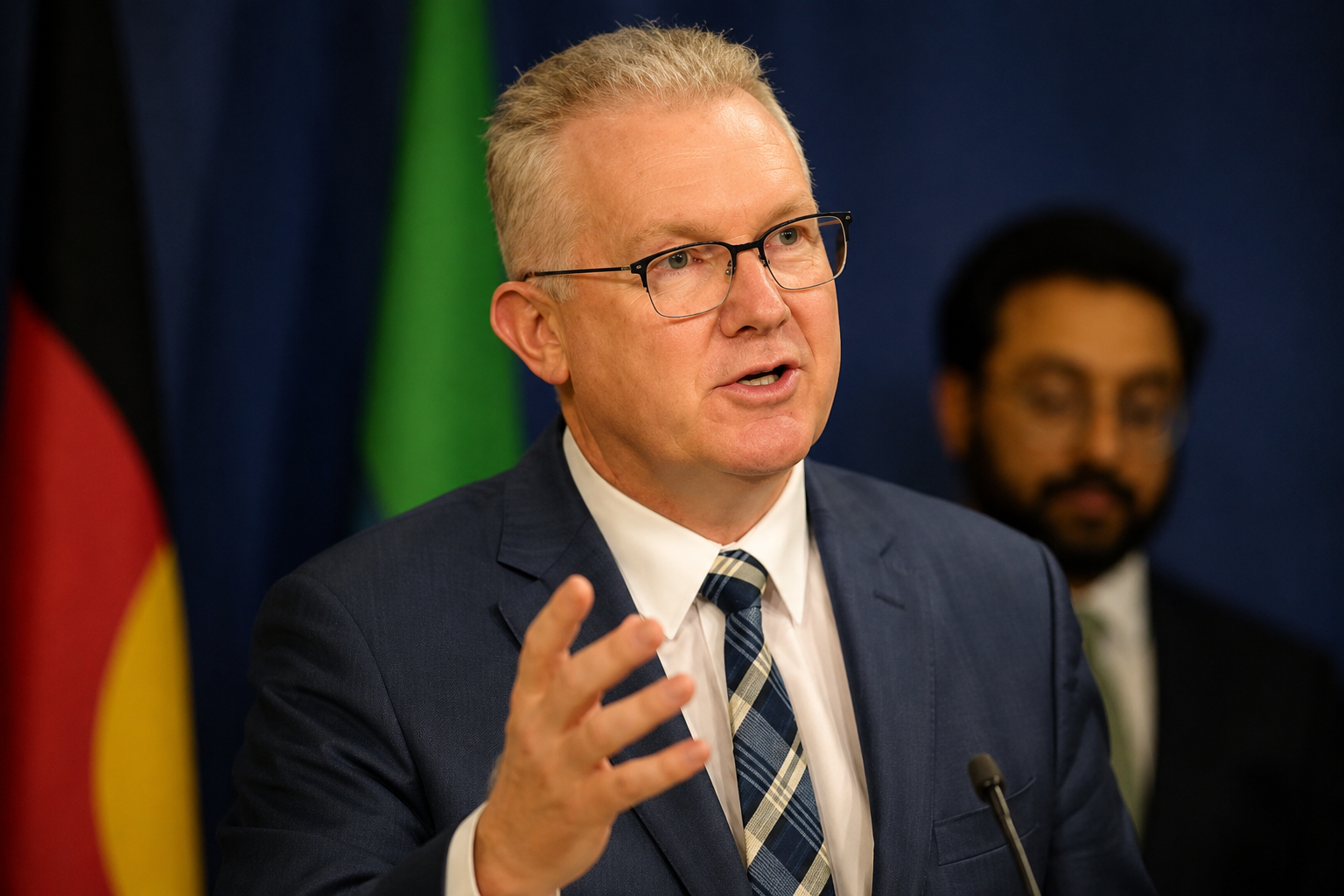
Former Australian Federal Police detective superintendent David Craig has accused Home Affairs Minister Tony Burke of incorrectly suggesting that High Court jurisprudence effectively prevents the government from stopping Australian citizens suspected of involvement with ISIS from re-entering the country.
The disagreement centres on Australia’s Temporary Exclusion Order (TEO) regime, introduced in 2019 under the Counter-Terrorism (Temporary Exclusion Orders) Act. The legislation allows the government to temporarily delay the return of certain Australian citizens who are overseas and suspected of involvement in terrorism, while requiring them to return under controlled conditions once a permit is issued. It does not permanently strip Australian citizens of their right to re-enter Australia.
The issue came to national attention after questions were raised about several Australian-linked Islamic State members detained in Syria who may seek to return home.
Responding to those concerns, Tony Burke argued that Australia’s legal powers had been pushed “to the edges” of what is constitutionally permissible, suggesting the government could not simply prohibit Australian citizens from returning indefinitely because of constitutional protections recognised by the High Court.
David Craig disputes that interpretation.
He argues that while the High Court has delivered several important constitutional judgments affecting executive detention and citizenship powers in recent years, it has never directly ruled on the constitutional validity or operational limits of the Temporary Exclusion Order regime itself. According to Craig, ministers should therefore avoid presenting the High Court as having already determined that broader exclusion powers would necessarily be unconstitutional.
“The High Court has never explicitly ruled on the thresholds of the Temporary Exclusion Order regime,” Craig argues, maintaining that Parliament still possesses scope to strengthen Australia’s legal framework if it chooses.
The legal debate reflects a distinction that has become increasingly important in Australia’s counter-terrorism framework.
Unlike non-citizens, Australian citizens possess an implied constitutional right to enter Australia arising from citizenship itself. Governments cannot simply revoke that right without clear legislative authority that is consistent with the Constitution. The Temporary Exclusion Order legislation was designed to delay—not permanently prevent—the return of Australian citizens assessed as posing national security risks, allowing authorities to coordinate security arrangements before their arrival.
Supporters of the current framework argue the legislation strikes an appropriate balance between protecting national security and respecting constitutional principles.
Critics, however, contend that the regime remains too limited when dealing with Australians who allegedly joined terrorist organisations overseas.
The Albanese Government has consistently maintained that any Australian citizen who returns after involvement with ISIS can be investigated, prosecuted where sufficient evidence exists, subjected to control orders, monitored by security agencies and, where appropriate, imprisoned following conviction.
Australian Security Intelligence Organisation (ASIO), the Australian Federal Police and state police agencies continue to monitor individuals assessed as presenting terrorism risks under Australia’s broader national security framework.
The debate has been intensified by a series of High Court decisions over recent years that have reshaped aspects of executive power.
Judgments concerning indefinite immigration detention, citizenship and preventive detention have reinforced constitutional limits on executive authority, prompting governments to reassess how existing national security laws operate. Legal experts note, however, that those decisions addressed different legislative schemes rather than the Temporary Exclusion Order legislation specifically.
That distinction lies at the heart of Craig’s criticism.
He argues ministers should not suggest the High Court has already foreclosed options that have never actually been tested before the Court.
The disagreement also illustrates broader tensions within Australian counter-terrorism policy.
Since the defeat of the Islamic State’s territorial caliphate, Western governments have faced difficult decisions over citizens detained in camps across north-eastern Syria. Some countries have repatriated women and children while prosecuting adults where evidence permits. Others have sought to delay returns because of security concerns and the practical challenges of gathering admissible battlefield evidence.
Australia has gradually repatriated several groups of women and children from Syrian detention camps since 2022 while continuing to assess individual cases involving adult detainees. The government has consistently stated that each case is considered separately with advice from national security agencies.
Legal scholars generally agree that permanently excluding Australian citizens from their own country would face significant constitutional obstacles.
However, there remains ongoing debate about precisely how far Parliament could strengthen temporary exclusion measures without exceeding constitutional limits. Because the High Court has not directly ruled on the Temporary Exclusion Order regime itself, some aspects of that question remain legally unresolved.
The disagreement between Tony Burke and David Craig therefore concerns less the existence of constitutional constraints than the extent to which those constraints have already been definitively determined by Australia’s highest court.
Whether Parliament chooses to revisit the Temporary Exclusion Order framework is ultimately a political decision. Any future attempt to significantly expand executive powers over returning Australian citizens would almost certainly face close legal scrutiny and could eventually require the High Court itself to determine the constitutional limits that are currently the subject of debate.






