A new nationwide polling model has delivered one of the most dramatic projections seen in Australian politics in recent years, suggesting Pauline Hanson’s One Nation could emerge as a major parliamentary force capable of helping determine who forms the nation’s next government.
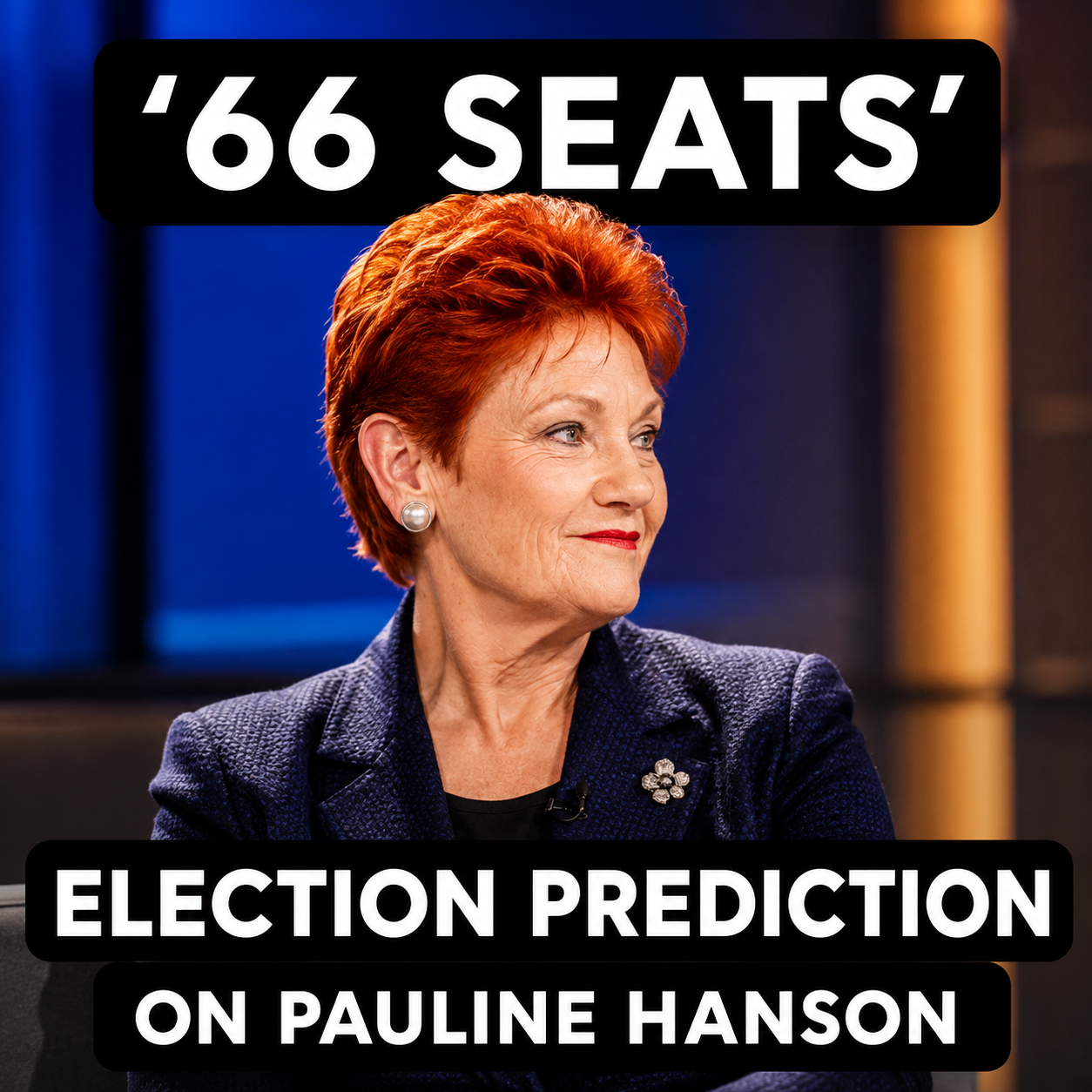
The latest Multilevel Regression and Poststratification (MRP) model released by polling firm DemosAU estimates that, if a federal election were held today, One Nation could win between 53 and 66 seats in the House of Representatives. Labor is projected to secure between 60 and 72 seats, leaving neither party with the 76 seats required for an outright majority.
The modelling points to a hung parliament in which negotiations with other parties and independents would become crucial. Under this scenario, Labor would likely require the continued support of the Greens and crossbench MPs to remain in office, while One Nation would need cooperation from the Coalition if it hoped to help form an alternative government.
The findings have generated considerable political attention because they represent a substantial shift from Australia’s traditional two-party landscape.
DemosAU’s modelling, based on polling conducted between May and July involving more than 9,000 respondents, places One Nation on a primary vote of around 30 per cent, ahead of Labor on 26 per cent, with the Coalition on 21 per cent and the Greens on 13 per cent.
Political analyst George Hasanakos of DemosAU said the projections indicate One Nation is now competitive across large parts of regional, rural and outer metropolitan Australia.
According to the modelling, One Nation is leading in 39 of Australia’s 41 regional and rural electorates, with particularly strong performances forecast in Queensland and gains across parts of New South Wales, Victoria and Western Australia.
Despite the headline-grabbing numbers, the projections do not mean One Nation is expected to form government outright.
Australia uses a preferential voting system, meaning primary vote support is only one part of determining election outcomes. Preference flows from eliminated candidates can dramatically change the final result in many electorates, particularly where three or more parties are competitive.
Even the DemosAU modelling acknowledges that One Nation would almost certainly require Coalition support to have any realistic pathway to government. Likewise, Labor would depend on Greens and independent MPs if it fell short of an outright majority.
The Coalition has so far publicly rejected the prospect of governing alongside One Nation.
Opposition Leader Angus Taylor has repeatedly stated there are no plans for a formal Coalition agreement with Pauline Hanson’s party, although some Liberal figures have indicated they are willing to discuss future parliamentary cooperation if election arithmetic requires it.
The latest projections also reinforce a trend that has been developing throughout 2026.
Earlier polling showed One Nation overtaking the Coalition in parts of regional Australia and becoming increasingly competitive in outer suburban electorates where voters have expressed concern over cost-of-living pressures, housing affordability, immigration levels and confidence in the major parties.
Analysts say the party’s strongest growth continues to come from regional communities and outer metropolitan areas rather than Australia’s inner-city electorates, where Labor, the Greens and teal independents remain comparatively stronger.
The modelling therefore suggests that while One Nation’s geographic support is broadening, its electoral opportunities remain concentrated outside Australia’s largest metropolitan centres.
The projections have also renewed debate over the future of Australia’s political system.
For decades, Labor and the Coalition have dominated federal politics, but recent elections have seen increasing support for minor parties and independents. The expansion of the crossbench has already made minority governments more plausible, and the latest polling suggests that trend could accelerate further if voter dissatisfaction with the major parties continues.
Political scientists caution, however, that MRP polling is designed to estimate electorate-level outcomes rather than predict election results with certainty.
Unlike traditional national opinion polls, MRP models combine survey responses with demographic and geographic data to estimate likely voting patterns across all electorates. While increasingly influential, the methodology still relies on assumptions about voter behaviour, turnout and preference distributions that may change during an election campaign.
Campaign dynamics, candidate quality, local issues, preference recommendations and shifting voter sentiment can all substantially alter seat outcomes before polling day.
Nevertheless, the latest modelling illustrates how rapidly Australia’s political landscape has evolved.
Whether One Nation ultimately approaches the upper end of the projected 53-to-66-seat range remains uncertain. What appears increasingly clear is that Pauline Hanson’s party has become a far more significant electoral force than in previous federal contests, with the potential to influence not only the composition of the next Parliament but also the negotiations that determine who ultimately forms government.






