The Albanese Government has sought to distance itself from a controversial proposal by a Labor-affiliated trade union to remove the Union Jack from the Australian flag, insisting its attention remains firmly focused on cost-of-living pressures and other everyday concerns rather than symbolic constitutional debates.
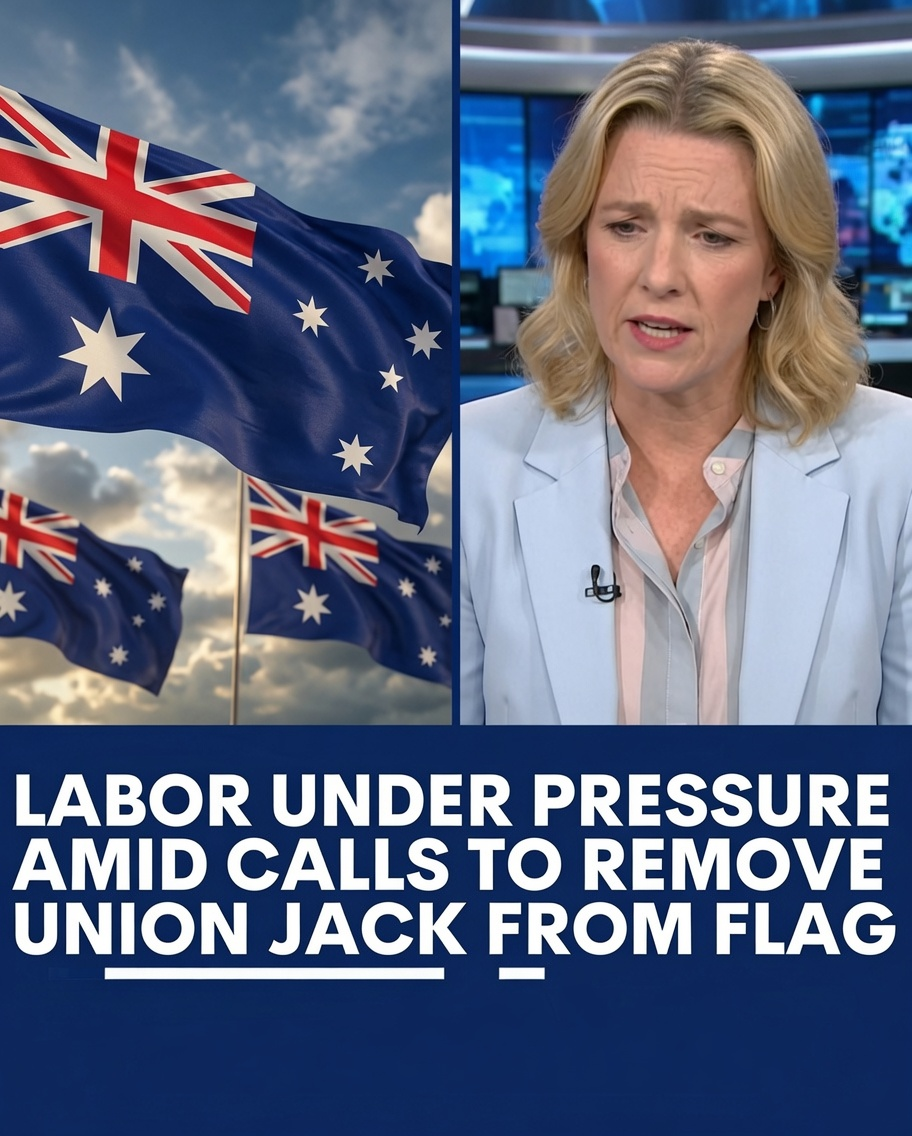
The debate emerged ahead of the Australian Labor Party’s National Conference in Adelaide after the Australian Manufacturing Workers’ Union (AMWU) included a proposal in its broader policy blueprint calling for the removal of what it described as “symbols of oppression”, including the Union Jack on Australia’s national flag.
The document argues that colonial-era symbols should be removed from public life alongside broader reforms relating to First Nations justice, taxation and public services.
The proposal quickly generated political attention because the AMWU is one of Labor’s long-standing affiliated unions and plays an influential role within sections of the party. However, proposals advanced by affiliated unions do not automatically become Labor policy and must be debated through the party’s internal processes before any adoption.
Responding to questions before the conference, Housing Minister Clare O’Neil repeatedly played down the significance of the proposal.
Speaking on Sunrise, O’Neil said Australians were far more concerned about household budgets, housing affordability and essential services than debates over the national flag.
“That’s the cost of living, the bills that they’ve got that are piling up, it’s about making sure that we take those next steps to get the young people around our country fair opportunities for home ownership; it’s about how we protect Medicare and aged care for Australians who will need them and how we build a better future for the next generation,” she said.
During the interview, O’Neil was repeatedly asked whether she personally supported removing the Union Jack from the flag. After several rounds of questioning, she said she did not support changing the flag and reiterated that it was not an issue occupying the government’s attention.
The Prime Minister’s office also indicated that changing Australia’s national flag has not been government policy and is not part of Labor’s legislative agenda.
The AMWU’s proposal forms part of a much broader “Blueprint for Action” submitted ahead of the conference.
In addition to advocating removal of the Union Jack and certain colonial monuments, the document proposes higher taxes on wealth and inheritances, increased taxation of gas exports, expanded universal public services and stronger measures supporting First Nations Australians.
The proposal immediately became a political flashpoint.
Coalition politicians argued Labor-linked unions were prioritising symbolic cultural issues rather than addressing inflation, housing affordability and economic pressures facing Australian households.
Nationals Senate leader Bridget McKenzie defended the existing flag, arguing it reflects Australia’s democratic institutions, constitutional history and longstanding relationship with the United Kingdom. Independent MP Dai Le likewise rejected changing the flag, saying it represented opportunity for migrants such as herself rather than oppression.
Supporters of reviewing the flag argue Australia’s national symbols should better reflect the country’s modern identity and recognise Indigenous history alongside Australia’s multicultural society.
Opponents contend the existing flag represents Australia’s constitutional development, military history and democratic traditions, and warn that changing it would reopen divisive debates without addressing practical challenges facing voters.
Australia has debated its national flag for decades.
The current design was first flown in 1901 after Federation and incorporates the Union Jack, the Commonwealth Star and the Southern Cross. While the Union Jack reflects Australia’s historical links to Britain, successive opinion polls over many years have shown Australians divided over whether the design should be retained or replaced.
Previous campaigns for a new flag have periodically emerged but have not resulted in official change, with any alteration widely expected to require substantial public support and political consensus.
The latest proposal therefore arrives within a much longer national conversation rather than creating an entirely new debate.
It also comes as Labor seeks to maintain focus on its broader policy agenda at the National Conference.
Delegates are expected to debate a wide range of issues including workplace relations, taxation, housing, health, industrial policy, climate measures and economic reform.
Government ministers have consistently argued those substantive policy discussions—not symbolic constitutional questions—represent the conference’s principal purpose.
Political observers note that internal party conferences routinely receive proposals from affiliated unions, branches and members covering issues that never become government policy.
Whether any individual proposal ultimately succeeds depends on negotiations between factions, conference delegates and the party leadership.
The flag proposal nevertheless generated disproportionate attention because it touches on longstanding questions of national identity, colonial history and Australia’s relationship with its British heritage.
Those issues have become increasingly prominent in recent years following debates over constitutional recognition of Indigenous Australians, Australia Day, republicanism and the role of national symbols in contemporary Australia.
For Labor, however, the immediate political challenge has been avoiding the perception that symbolic debates are distracting from economic concerns.
That explains why ministers have repeatedly redirected questions towards housing affordability, cost-of-living relief, Medicare and employment rather than engaging extensively with the proposal itself.
The Opposition, by contrast, has argued the proposal illustrates a broader tendency among some unions and sections of the Labor movement to prioritise cultural issues over everyday economic concerns.
Whether the AMWU proposal gains any further traction remains uncertain.
At present, it remains a policy proposal advanced by an affiliated union rather than an adopted position of either the Australian Labor Party or the Albanese Government.
As Labor’s National Conference continues, attention is expected to remain focused on whether delegates choose to debate the proposal further or instead concentrate on the government’s legislative and economic priorities ahead of the next phase of its parliamentary agenda.






