A 67-year-old Bondi woman has been charged after allegedly directing anti-Semitic abuse at one of Australia’s most prominent Jewish community leaders during a visit to the Bondi terror memorial, in an incident that has reignited debate about hate speech, antisemitism and the limits of political expression.
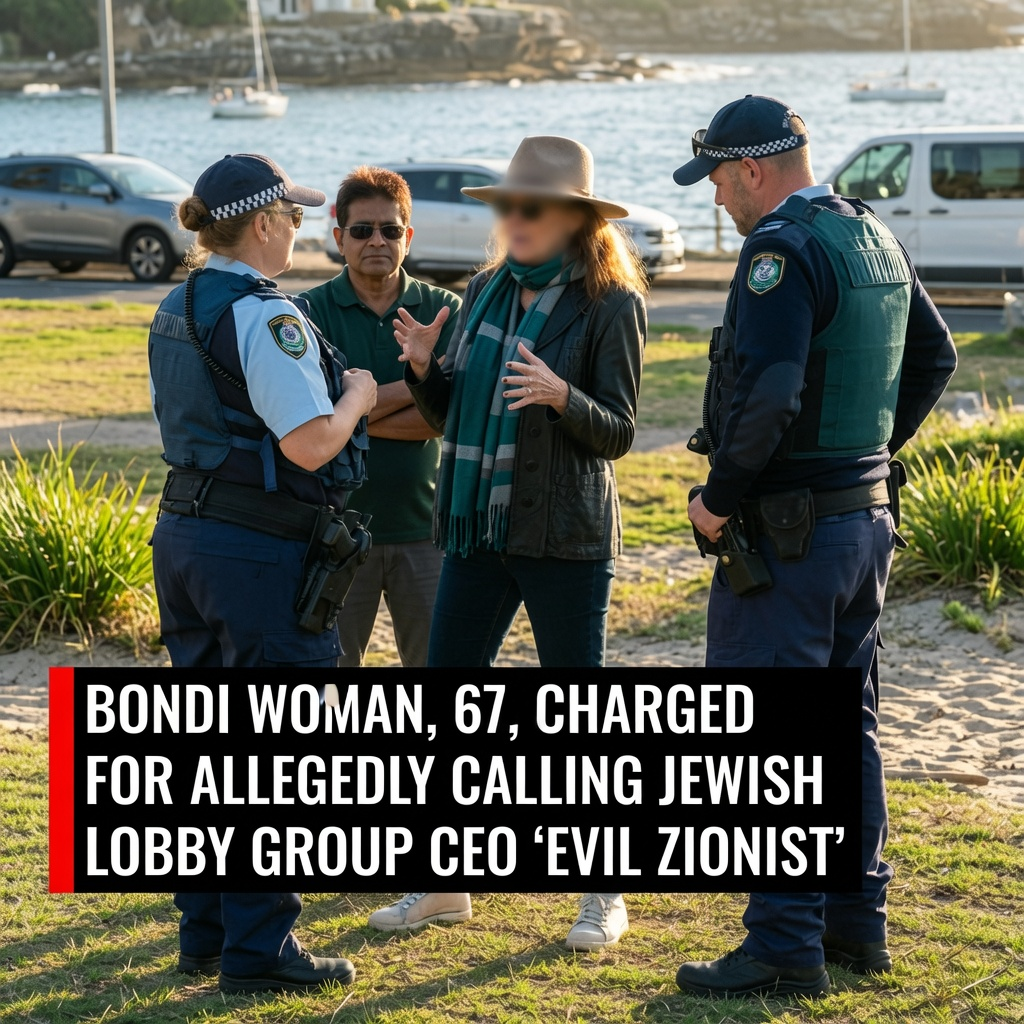
New South Wales Police allege the woman confronted Executive Council of Australian Jewry (ECAJ) co-chief executive Alex Ryvchin and members of his group at Archer Park, Bondi, on Wednesday afternoon.
The group was visiting the site with players and officials from the Sydney Swans Football Club to learn more about the Bondi terror attack and hear from a survivor connected to the Jewish community.
According to Ryvchin, the woman questioned why “Zionists” were present before allegedly asking “what an evil Zionist was doing here”. He later described the confrontation publicly, saying it occurred at a location that had become sacred to many members of Australia’s Jewish community because of the lives lost during the Bondi terrorist attack.
NSW Police confirmed officers attached to Eastern Suburbs Police Area Command attended Archer Park at approximately 4.30pm on Wednesday following reports that a woman had confronted a group of people.
Following further investigations, police charged the Bondi woman with offensive behaviour.
In a statement, police said they will allege the woman verbally abused members of the group by making anti-Semitic comments.
She has been issued with a Court Attendance Notice and is scheduled to appear before Waverley Local Court on 23 September.
As the matter is now before the courts, the allegations remain untested and the woman is entitled to the presumption of innocence unless proven guilty according to law.
The accused has disputed the account of the confrontation.
Speaking to The Daily Telegraph, she described the incident as a misunderstanding and denied using the word “evil”.
She said she had been at the location to support marathon runner Chad Aziz, who was completing a 4,000-kilometre run across Australia, and claimed the exchange had been misinterpreted.
“There was nothing, absolutely nothing,” she said.
“It was a misunderstanding.”
She further maintained that nobody present had used the word “evil”, directly contradicting Ryvchin’s version of events.
Ryvchin welcomed the decision to lay charges, thanking NSW Police for what he described as their prompt and professional response.
He said the Jewish community would not accept hatred or intimidation, particularly at a location associated with one of the darkest chapters in recent Australian history.
“The Jewish community will not succumb to hatred and vilification,” he said.
He added that anti-Zionism should not be used as a cover for conduct that allegedly targets Jewish Australians, arguing that where behaviour crosses into unlawful vilification there should be legal consequences.
The incident has attracted political attention in New South Wales.
Premier Chris Minns and Opposition Leader Kellie Sloane both publicly condemned the alleged confrontation after details emerged, joining community leaders in expressing concern about reports of anti-Semitic abuse occurring at a site closely associated with victims of terrorism.
The allegations arise during a period of heightened public sensitivity surrounding antisemitism in Australia.
Since the escalation of conflict in the Middle East and subsequent domestic security incidents, Jewish organisations have reported a significant increase in threats, harassment and hate-related incidents directed at Jewish Australians.
In response, governments at both state and federal levels have introduced stronger hate crime legislation and expanded security measures around places of worship, schools and community organisations. A Royal Commission examining antisemitism and social cohesion has also been hearing evidence from community leaders, including Alex Ryvchin.
Ryvchin has become one of Australia’s most recognisable advocates on issues relating to antisemitism, hate speech and social cohesion.
As co-chief executive of the Executive Council of Australian Jewry, he regularly represents Australia’s Jewish community in public debate and has previously argued that existing hate speech laws require further strengthening to better protect targeted communities.
The alleged confrontation also occurred at a location carrying deep symbolic significance.
Archer Park, near Bondi Beach, became closely associated with the Bondi terrorist attack and has since served as a place of remembrance for victims, survivors and their families.
Visits by community organisations, sporting clubs and public officials have become part of broader efforts to honour those affected and promote community solidarity following the tragedy.
Legal experts note that Australian law draws an important distinction between political opinion and unlawful conduct.
People are generally free to express political views, including opinions about Zionism, Israel or international conflicts. However, where language is alleged to amount to offensive behaviour, unlawful vilification or other criminal conduct, police may investigate and, where appropriate, lay charges under relevant legislation.
Because the matter is now before the courts, many of the factual disputes—including precisely what words were spoken and in what context—will ultimately be determined through the judicial process rather than through media reporting.
The case also reflects the continuing challenge facing Australian authorities as they seek to balance freedom of political expression with protecting individuals and communities from alleged hate-based abuse.
Community leaders from across different faiths have repeatedly urged Australians to avoid allowing international conflicts to inflame tensions domestically, emphasising the importance of respectful public debate and social cohesion.
For now, the focus turns to the forthcoming court proceedings, where prosecutors will seek to prove the allegations while the accused woman will have the opportunity to contest them.
The outcome is likely to be closely watched, not only because of the individuals involved but also because it sits within a broader national conversation about antisemitism, hate speech, public order and the boundaries between political protest and unlawful abuse.






