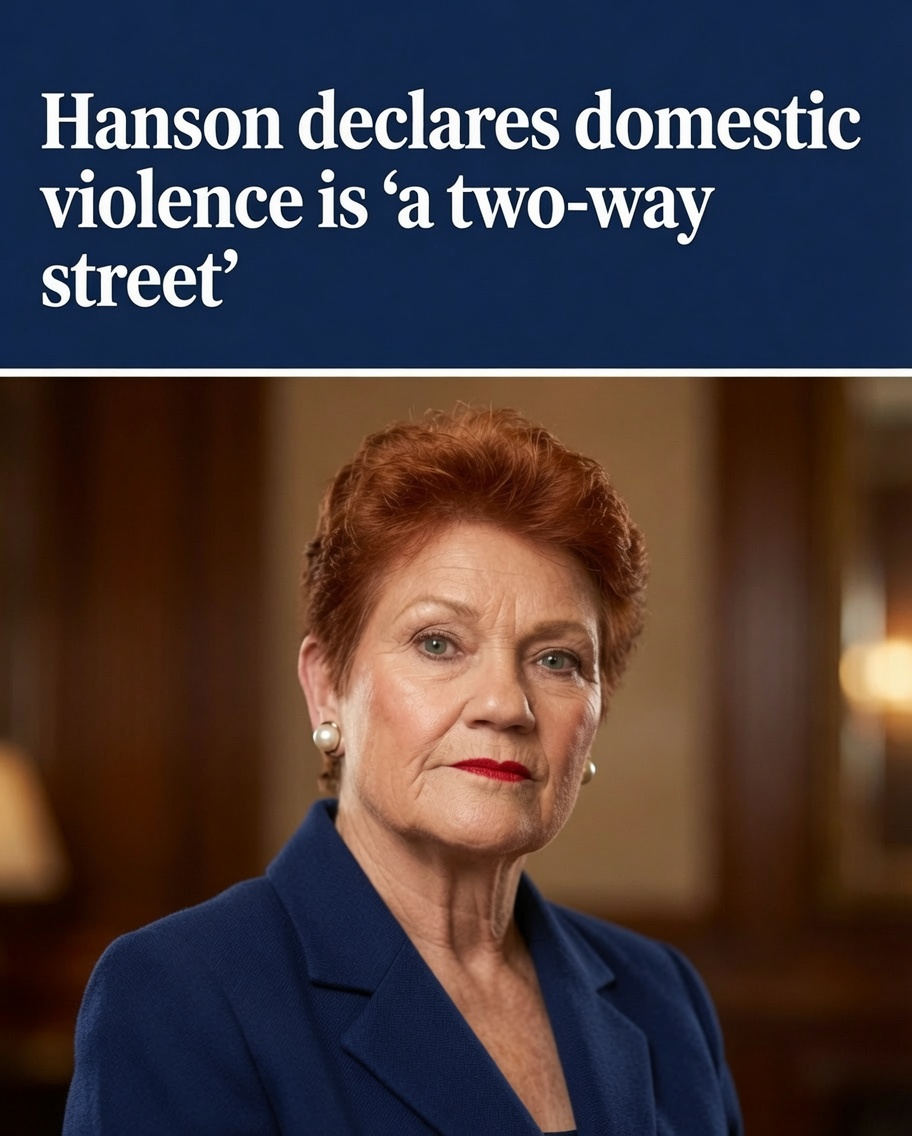
Fresh political controversy has erupted after One Nation leader Pauline Hanson and federal MP Barnaby Joyce made separate comments about domestic and family violence, prompting criticism from victim advocates, politicians and community leaders at a time when Australia is again confronting the deadly impact of violence against women.
The debate comes after five women were allegedly killed by men during the month, renewing calls for stronger prevention measures, greater investment in support services and more effective responses to gender-based violence.
Speaking during a radio interview, Hanson described domestic violence as “a two-way street” and argued that women “shouldn’t put up with it”. She said abusive relationships could involve harmful behaviour from either partner and encouraged women experiencing violence to leave if they could.
Around the same time, Barnaby Joyce urged Australian men to “be cool” and channel their “inner James Bond”, suggesting that self-control and restraint were essential qualities for men dealing with anger or conflict.
Although Joyce said men should avoid violence altogether, his choice of language also attracted widespread criticism, with opponents arguing the comments risked trivialising a serious national issue.
The remarks quickly generated strong reactions from domestic violence services, victim advocates and political leaders.
Critics argued that while violence can occur in many forms and affect people of all genders, Australia’s domestic violence statistics consistently show women are disproportionately the victims of serious injury and homicide committed by current or former intimate partners.
Advocacy organisations warned that describing domestic violence primarily as “a two-way street” risks oversimplifying patterns of coercive control, intimidation and repeated abuse that often characterise violent relationships.
Domestic violence specialists have long argued that many victims remain in abusive relationships because leaving can be one of the most dangerous periods, particularly where financial dependence, children, threats, isolation or coercive control are involved.
For that reason, support organisations say advice to “just leave” does not fully reflect the complex realities many victims face.
Responding to the controversy, several community organisations urged politicians to use language that encourages victims to seek professional support while placing responsibility for violent behaviour squarely on perpetrators.
The debate has unfolded against the backdrop of ongoing concern about domestic and family violence across Australia.
Governments at both federal and state level have committed billions of dollars over recent years to prevention programs, crisis accommodation, policing initiatives and frontline services following a series of high-profile killings that have prompted national reflection.
The National Plan to End Violence against Women and Children identifies domestic, family and sexual violence as one of Australia’s most significant social and public safety challenges, with governments working alongside community organisations to improve prevention, early intervention and victim support.
Recent years have also seen Australian jurisdictions introduce or expand coercive control laws, recognising that abuse often extends beyond physical violence to include psychological manipulation, intimidation, financial control and social isolation.
These reforms have sought to better reflect the lived experiences of many victims whose abuse develops over extended periods rather than through isolated incidents.
Hanson’s comments are not the first time she has attracted criticism over domestic violence policy.
Over several years she has questioned aspects of family law reform and argued that public discussion should also recognise male victims of domestic violence.
Supporters of Hanson say she is highlighting the fact that men can also experience abuse and that policy responses should recognise all victims regardless of gender.
Critics counter that acknowledging male victims should not obscure the overwhelming evidence showing women face the greatest risk of severe and fatal intimate partner violence.
Joyce’s remarks similarly divided opinion.
Some supporters interpreted his comments as a call for men to exercise self-discipline and reject violence.
Others argued that invoking the fictional spy James Bond while discussing domestic homicide diminished the gravity of the issue and distracted from practical policy solutions.
The political controversy also comes during a period of renewed momentum for One Nation.
Pauline Hanson has remained highly visible through recent speeches on immigration and national identity, a European tour that included appearances at conservative political events, and a series of interviews that have generated widespread media attention.
Those appearances have helped keep One Nation at the centre of Australia’s political debate, even as recent opinion polls suggest the party’s rapid surge in support may have moderated slightly.
The latest dispute illustrates how comments on social policy can quickly become national political issues when they intersect with broader concerns about public safety and community expectations.
Domestic violence remains an issue on which governments, law enforcement agencies and specialist organisations continue to emphasise prevention, early intervention and victim safety.
Across Australia, specialist services encourage anyone experiencing domestic or family violence to seek assistance from police or accredited support organisations where it is safe to do so, rather than attempting to manage dangerous situations alone.
As political debate continues, the broader national conversation remains focused on reducing the number of women killed by current or former partners, improving support for all victims of domestic and family violence, and strengthening measures aimed at preventing abuse before it escalates into tragedy.
While Hanson and Joyce have defended or clarified aspects of their comments, the backlash demonstrates the heightened sensitivity surrounding public discussion of domestic violence, particularly during periods when multiple alleged killings have placed the issue at the forefront of Australia’s national agenda.






