Australian film legend Paul Hogan has publicly distanced himself from Pauline Hanson’s vision of a “monocultural” Australia, rejecting the One Nation leader’s attempt to hold him up as an example of the national identity she believes the country should embrace.
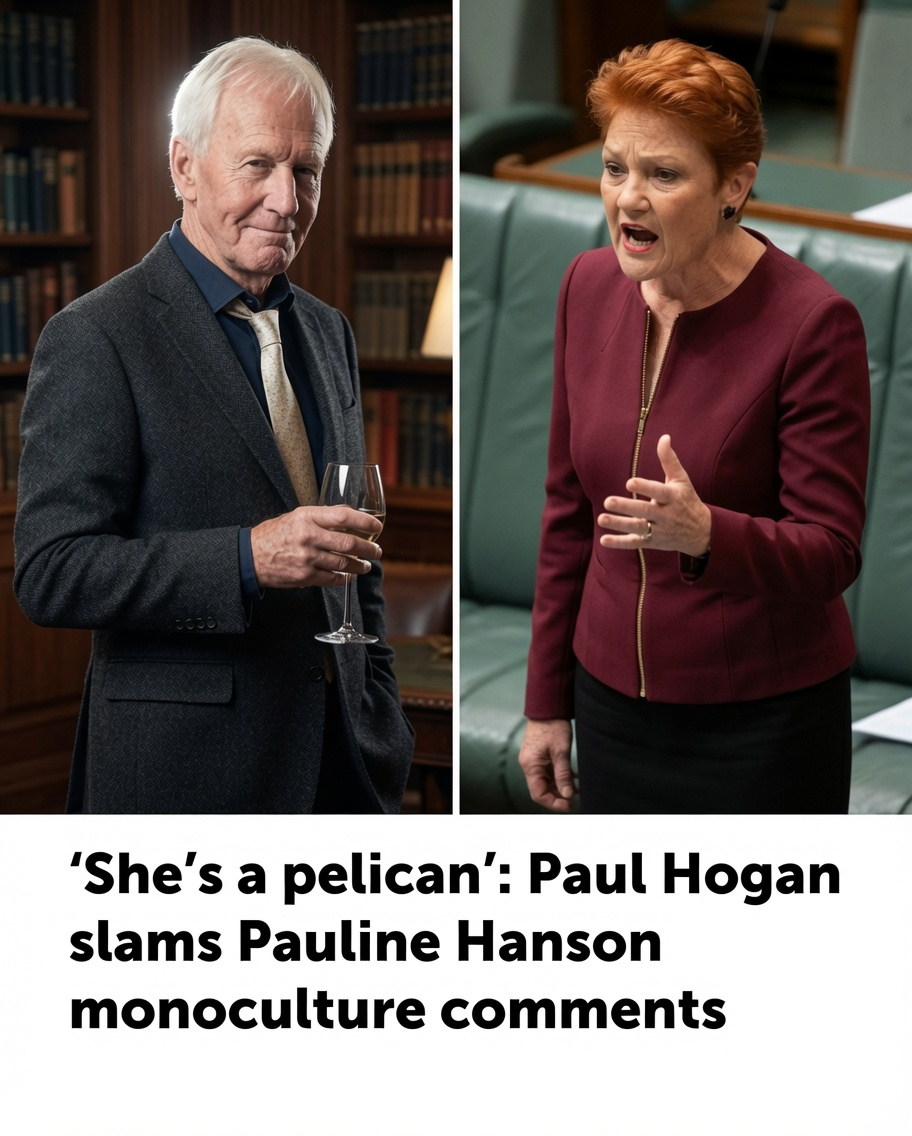
In a wide-ranging interview, the Crocodile Dundee star criticised Hanson’s recent comments on multiculturalism, arguing that modern Australia has been built by people from many different backgrounds and that national identity should be defined by shared commitment rather than ethnicity or cultural uniformity.
The comments came after Hanson reignited debate over immigration and multiculturalism during her maiden address to the National Press Club earlier this month.
In that speech, the One Nation leader argued Australia should move away from multiculturalism and instead become what she described as a “monocultural” nation, explaining that she envisioned Australians living “under the one cultural umbrella”.
Rather than retreating from the controversy, Hanson repeated the argument in the Senate days later.
Seeking to explain what she meant by “monoculture”, she cited Paul Hogan and the fictional television personality Norman Gunston as examples of what she regarded as quintessential Australian culture.
“These are the essential features of Australian monoculture, and there’s nothing remotely exclusionary about them,” Hanson told the Senate.
Hogan has now made it clear he does not want to be associated with that message.
Speaking to the Australian Financial Review, the actor dismissed Hanson’s comments and said her understanding of Australia belongs to another era.
“She’s living in the past, obviously,” Hogan said.
He also rejected the suggestion that Australia should aspire to become monocultural.
“I’ve always had a very simple rule: What makes a good Australian is wanting to be one,” he said.
Hogan reserved some of his strongest criticism for Hanson’s broader political rhetoric.
Comparing her approach to that of US President Donald Trump, he said:
“She’s a pelican… outrageous, so racist. It sounds very much like this stupid boofhead over here, Trump.”
The exchange has added another high-profile voice to the debate surrounding Hanson’s recent statements, which have generated strong reactions across Australia’s political, sporting and cultural communities.
Although Hanson has insisted her use of the word “monoculture” does not refer to race, she has argued Australia should place greater emphasis on shared values, national identity and cultural integration.
Critics, however, contend that abandoning multiculturalism would fundamentally alter one of modern Australia’s defining principles and risk excluding many communities that have helped shape the country.
Hogan’s own life experience formed the basis of his rejection of Hanson’s argument.
Growing up in Western Sydney before finding fame as one of Australia’s best-known entertainers, Hogan recalled working alongside people from a wide variety of cultural backgrounds during his years as a rigger on the Sydney Harbour Bridge.
He said those experiences convinced him that Australia’s diversity had strengthened rather than weakened the nation.
“My old gang was an Assyrian, a Thursday Islander, a Welshman, an Aboriginal, a couple of Irish convicts.”
“It was the same cosmopolitan types everywhere I worked, Italians, Greek, Irish, Chinese, a bit of everybody there. That’s the way we were.”
He concluded that Australia’s history itself makes the idea of a single culture difficult to sustain.
“How can it be a monoculture? We’re all migrants, except the Aboriginals, who as far as we know have been here for 60,000 years.”
The disagreement comes at a politically significant moment for Hanson and One Nation.
The party has experienced a remarkable rise in national opinion polling over recent months, fuelled largely by debates surrounding immigration, housing affordability, cost-of-living pressures and dissatisfaction with the major political parties.
However, more recent surveys suggest some of that momentum has eased following the controversy surrounding Hanson’s National Press Club speech and subsequent public comments.
The latest Roy Morgan polling showed support for One Nation had declined for a second consecutive week after reaching a recent peak, although the party remained substantially stronger than at previous elections.
The monoculture debate has also unfolded alongside Hanson’s high-profile overseas tour.
During the trip she travelled to Britain, attended the Conservative Political Action Conference (CPAC GB), met Reform UK leader Nigel Farage and appeared on a podcast hosted by British anti-immigration activist Tommy Robinson.
Those appearances generated widespread discussion in Australia, with supporters praising Hanson for engaging with conservative political movements overseas while critics questioned both her rhetoric and the choice of people with whom she associated.
For Hogan, however, the issue extends beyond day-to-day politics.
His comments reflect a long-held belief that Australian identity has never depended on everyone sharing the same ancestry, religion or cultural background.
Instead, he argues the country’s character has been shaped by successive generations of migrants who have contributed to Australian society while embracing a shared commitment to the nation.
That perspective broadly aligns with Australia’s post-war multicultural framework, which has encouraged migrants to retain aspects of their cultural heritage while participating fully in Australian civic life.
Successive federal governments from both major political parties have generally supported multiculturalism as a central element of Australia’s national identity, although debates over immigration levels, integration and social cohesion continue to feature prominently in political discussion.
Hanson, meanwhile, has maintained that critics have misunderstood her comments.
She argues her vision is not about excluding people based on race but about encouraging stronger integration into Australian society through common values and national identity.
Nevertheless, the language of “monoculture” has attracted widespread criticism because of Australia’s long history as a nation shaped by migration from across Europe, Asia, the Middle East, Africa and the Pacific, alongside the world’s oldest continuing Indigenous cultures.
Hogan’s intervention is particularly significant because few Australians are more closely associated with the country’s international image.
His portrayal of Mick “Crocodile” Dundee introduced millions of overseas audiences to an easy-going version of Australian culture during the 1980s and remains one of the country’s most recognisable cultural exports.
By rejecting Hanson’s interpretation of what Australia should represent, Hogan has become one of the most prominent public figures to challenge her monoculture proposal.
The exchange underscores how questions of immigration, national identity and multiculturalism continue to sit at the centre of Australia’s political debate, with differing visions of what it means to be Australian likely to remain an important issue well beyond the current parliamentary term.






