Support for Pauline Hanson’s One Nation has eased for a second consecutive week, according to the latest Roy Morgan polling, suggesting the party’s extraordinary surge earlier this winter may be beginning to lose momentum even as it remains one of the most significant forces in Australian politics.
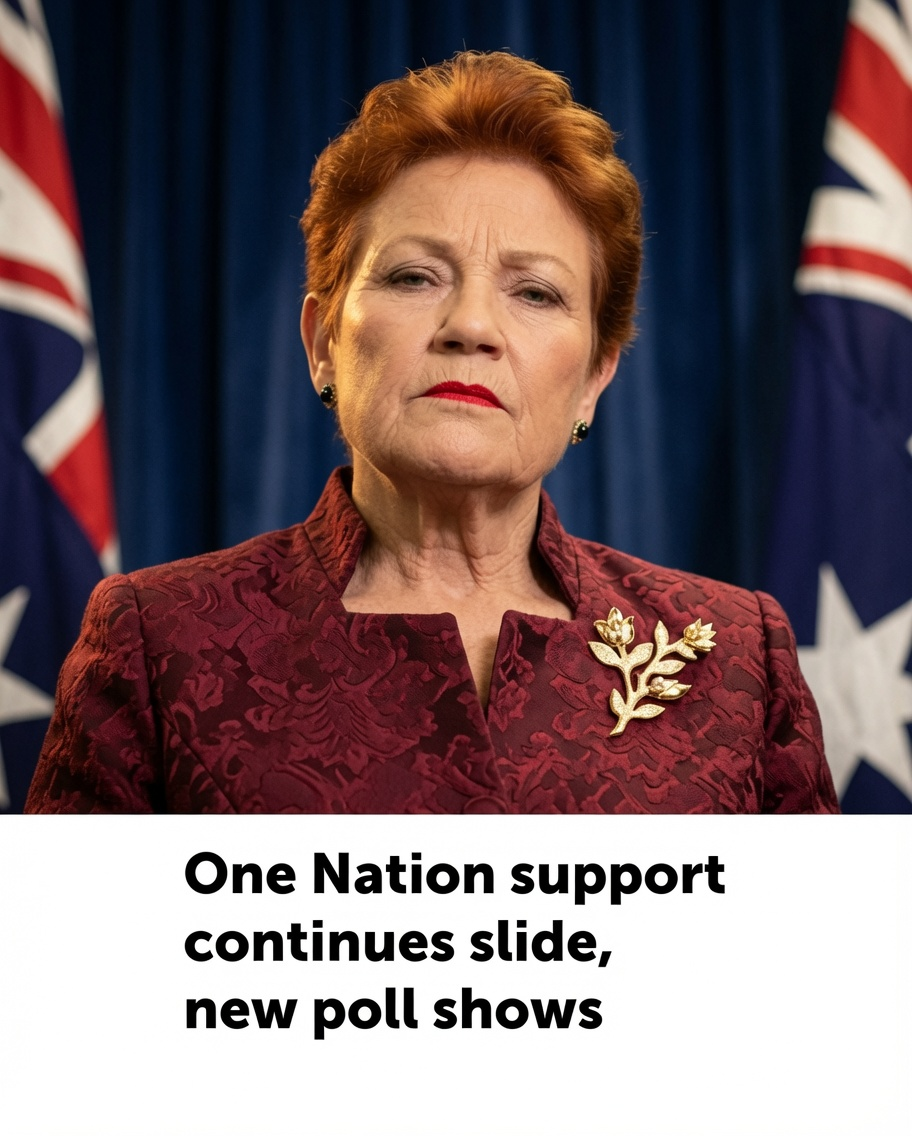
The survey indicates Labor continues to hold an election-winning advantage after preferences are distributed, despite One Nation maintaining a historically strong primary vote and continuing to outperform both major conservative parties on some primary vote measures.
According to Roy Morgan, support for One Nation has fallen for the second week in succession after reaching a recent high following Senator Hanson’s inaugural address to the National Press Club.
Across the past fortnight, the party’s primary support has dropped by around nine percentage points from its peak of 31.5 per cent to 22.5 per cent. While the decline is significant, the party remains substantially stronger than it was before its recent surge and continues to poll well above its result at the last federal election.
On a two-party preferred basis, however, Roy Morgan’s modelling still places the Albanese Government in a position that would allow Labor to retain office if an election were held now.
The poll estimates Labor remains ahead after preferences are allocated, highlighting the continuing importance of Australia’s preferential voting system, where primary vote alone does not determine election outcomes.
One Nation’s recent polling trajectory has attracted considerable attention because of the party’s remarkable rise throughout recent months.
Earlier this year, Roy Morgan polling briefly placed Pauline Hanson’s party ahead of both Labor and the Coalition on primary vote, an unprecedented result for the minor party that reflected growing voter frustration over the cost of living, housing affordability, migration and dissatisfaction with Australia’s major political parties.
That surge transformed One Nation from a long-established minor party into one of the dominant stories in federal politics.
The party also strengthened its parliamentary position after winning the federal seat of Farrer, providing One Nation with representation in the House of Representatives for the first time.
Political analysts viewed the result as evidence that the party had broadened its appeal beyond its traditional Queensland base and into regional communities experiencing economic and demographic change.
The latest decline comes after Senator Hanson’s widely discussed appearance at the National Press Club, where she argued Australia should become “monocultural” and described that concept as living under “the one cultural umbrella”.
The remarks immediately generated intense political debate.
Government ministers, opposition figures, community leaders and prominent Australians criticised the comments, arguing they were inconsistent with Australia’s multicultural identity.
Among those publicly rejecting Hanson’s proposal was Australian entertainment icon Paul Hogan, who defended multiculturalism as one of the country’s strengths.
The polling movement also coincides with Hanson’s high-profile overseas trip through Europe.
During the visit she travelled to London, where she attended the Conservative Political Action Conference (CPAC GB) and met Reform UK leader Nigel Farage.
She also attracted attention for an interview with British anti-immigration activist Tommy Robinson and for attending a Dolce & Gabbana fashion event alongside mining billionaire Gina Rinehart.
Those appearances generated extensive media coverage in Australia, with supporters praising Hanson for engaging with overseas conservative movements while critics questioned both her choice of associates and some of the political messages delivered during the tour.
Whether that publicity contributed to the recent softening in support remains unclear.
Opinion polls capture a snapshot of public sentiment at a particular point in time, and individual surveys can fluctuate from week to week because of sampling variation, changing news events and broader political developments.
Roy Morgan’s findings nevertheless suggest that while One Nation’s rapid upward trajectory may have slowed, the party continues to command a much larger share of public support than it has typically enjoyed throughout most of its history.
For Labor, the latest results provide some encouragement.
Although the government’s primary vote remains below levels traditionally associated with comfortable majority governments, preferential voting continues to work in its favour.
Under Australia’s electoral system, voters rank candidates in order of preference rather than selecting only one party. If no candidate secures an outright majority of first-preference votes, preferences from eliminated candidates are redistributed until someone reaches more than 50 per cent.
As a result, election outcomes frequently differ from simple primary vote rankings, particularly when minor parties attract significant support.
That dynamic has become increasingly important as Australia’s political landscape fragments.
Support for Labor and the Coalition has gradually declined over the past two decades while a growing proportion of voters back minor parties and independents.
One Nation has been among the principal beneficiaries of that shift, alongside the Greens and the expanding crossbench of independent MPs.
Political scientists note that sustained support above 20 per cent would represent an extraordinary achievement for any Australian minor party and would fundamentally reshape electoral contests across many regional and outer suburban seats.
Even after the latest decline, One Nation remains well above the levels that historically characterised the party during much of the past decade.
The Coalition, meanwhile, continues facing the strategic challenge of responding to One Nation’s growing influence without alienating moderate voters.
Opposition Leader Angus Taylor has ruled out entering a formal coalition agreement with Pauline Hanson’s party, while acknowledging that many Australians backing One Nation are expressing genuine concerns about migration, energy policy and the rising cost of living.
Labor has taken a different approach, arguing One Nation’s rise reflects economic anxiety but warning against adopting what it describes as divisive rhetoric on immigration and national identity.
The latest polling therefore reinforces two competing political realities.
First, Labor remains in a position that could deliver another election victory if current voting patterns continue.
Second, One Nation has established itself as one of the country’s most influential political forces despite the recent easing in support, ensuring Pauline Hanson is likely to remain a central figure in Australia’s political debate well ahead of the next federal election.
With the election not due until 2028, both major parties will be watching closely to determine whether the latest movement represents the beginning of a longer-term correction or simply a temporary pause following one of the most dramatic polling surges in modern Australian politics.






