Australia and Fiji have elevated their relationship to an unprecedented level after signing two landmark treaties in Suva—the Vuvale Union and the Ocean of Peace Alliance—in what both governments describe as one of the most significant bilateral partnerships either nation has ever undertaken.
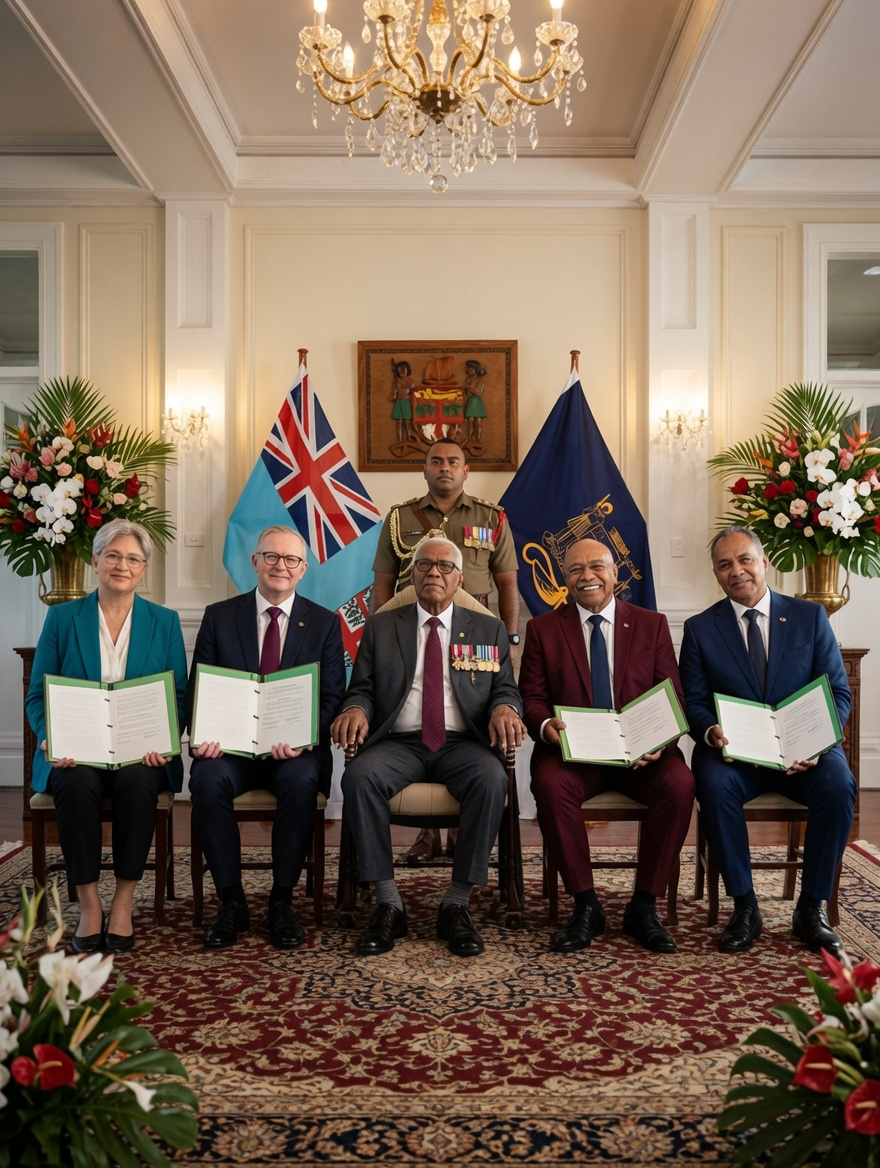
The agreements were signed by Australian Prime Minister Anthony Albanese and Fijian Prime Minister Sitiveni Rabuka during a ceremony in Fiji’s capital, marking a historic expansion of cooperation across security, economic development and people-to-people ties. Australian Foreign Minister Penny Wong described the occasion as a defining moment for the Pacific partnership between the two countries.
“Australia and Fiji are Vuvale—family—and now we are allies,” Wong said following the signing ceremony.
She said the two agreements represented “one of the most important endeavours Australia has ever undertaken with any country” and reflected a shared commitment to ensuring that “the future of the Pacific is shaped by the Pacific.”
According to Wong, the new Vuvale Union establishes ambitious cooperation across three pillars of the bilateral relationship: security, economic prosperity and stronger connections between the peoples of Australia and Fiji. The agreement aims to deepen collaboration across government, business, education, labour mobility, infrastructure and regional development while reinforcing the long-standing cultural and historical links between the two nations.
The second treaty, the Ocean of Peace Alliance—also known as the Veitacini Treaty—carries even broader strategic significance.
It is Fiji’s first formal defence alliance and Australia’s fourth treaty-level security partnership, joining long-standing arrangements with the United States, New Zealand and Papua New Guinea. The agreement establishes a framework for closer defence cooperation, joint planning, intelligence sharing and mutual assistance should either country face external aggression. It also allows other Pacific nations to join the alliance in the future, subject to the unanimous agreement of existing members.
Prime Minister Rabuka, who first proposed the Ocean of Peace Alliance, described the agreement as an important step towards strengthening Pacific-led security cooperation.
He said the alliance was designed to protect the sovereignty of Pacific Island countries while ensuring that regional security decisions continue to be made by Pacific nations themselves. At the same time, Rabuka stressed that Fiji would maintain an independent foreign policy and that the agreement was not directed against any particular country.
Prime Minister Albanese likewise framed the treaties as an investment in regional stability rather than geopolitical rivalry.
He said Australia and Fiji had stood “shoulder to shoulder” for decades through peacekeeping operations, humanitarian responses, disaster recovery efforts and development cooperation, and that the new agreements formalised a relationship already built on deep trust.
“Today, Australia and Fiji have come together as two proud sovereign nations,” Albanese said, describing the combined treaties as among the most significant international agreements Australia has concluded with any country.
The Vuvale concept has become an increasingly important feature of Australia–Fiji relations over recent years.
“Vuvale” means “family” in the Fijian language and has been adopted by both governments to symbolise the close relationship between the two countries. Since the Vuvale Partnership was first established in 2019, cooperation has expanded across defence, policing, labour mobility, climate resilience, education and economic development.
The new Vuvale Union builds on that foundation by creating a more comprehensive and legally binding framework for future cooperation.
Economically, the agreements include significant long-term Australian investment aimed at supporting Fiji’s development priorities.
Australian officials say the partnership will facilitate infrastructure investment, strengthen trade and investment links, expand labour mobility opportunities and support economic resilience throughout the Pacific. Reuters reported that Australia plans to invest more than A$1 billion in Fiji over the coming decade under the broader partnership framework.
Security cooperation is expected to deepen substantially under the Ocean of Peace Alliance.
The treaty provides a structured framework for military cooperation, joint exercises, disaster response, maritime security and capacity building. While Australia has worked closely with Fiji’s military for decades, officials say the alliance creates a more comprehensive legal basis for future cooperation while respecting Fiji’s sovereignty and independent decision-making.
The agreements arrive at a time of heightened strategic competition across the Pacific.
Australia has significantly expanded its engagement with Pacific Island nations in recent years through new defence agreements, infrastructure funding, climate initiatives and development partnerships. Canberra has repeatedly stated that its objective is to help Pacific nations strengthen their own resilience and maintain sovereign decision-making as geopolitical competition intensifies.
The timing also attracted international attention after China conducted a missile test in the Pacific shortly after the treaties were signed, prompting concern from several regional governments. Australian ministers described the launch as destabilising, while Fiji reiterated that its alliance with Australia was intended to support regional peace rather than target any specific country.
Climate change also remains a central pillar of the Australia–Fiji relationship.
Both governments have committed to working together on climate resilience, disaster preparedness and sustainable development, recognising that Pacific Island countries face some of the world’s greatest climate-related risks. Rabuka said the new partnership would strengthen cooperation not only in security but also in achieving climate justice and long-term regional resilience.
People-to-people links are another major focus of the Vuvale Union.
The agreement seeks to expand educational exchanges, workforce partnerships, cultural programs and labour mobility opportunities, reflecting the long-standing ties between Australian and Fijian communities. Thousands of Fijians live and work in Australia, while Australia remains one of Fiji’s closest economic and development partners.
Foreign Minister Wong said Australia’s approach would continue to be guided by listening to Pacific priorities, respecting Pacific leadership and working collaboratively “in the Pacific way.”
She argued that a stronger, safer and more sovereign Pacific ultimately benefits both Australia and the wider region.
“Australia will continue to strengthen our relationships by listening, respecting and acting on Pacific priorities,” Wong said.
As implementation of the treaties begins, both governments have indicated that the agreements are intended to endure for generations rather than respond to immediate geopolitical developments. By combining enhanced defence cooperation with deeper economic integration and stronger community links, the Vuvale Union and Ocean of Peace Alliance establish a new framework for Australia–Fiji relations that both Canberra and Suva believe will help shape the future of the Pacific for decades to come.






