Veteran journalist Liam Bartlett has delivered a sharply critical assessment of Pauline Hanson following weeks spent accompanying the One Nation leader through Britain and Europe, arguing that one of the defining characteristics of her political career is an unwavering refusal to reconsider controversial decisions—even when confronted with evidence challenging her views.
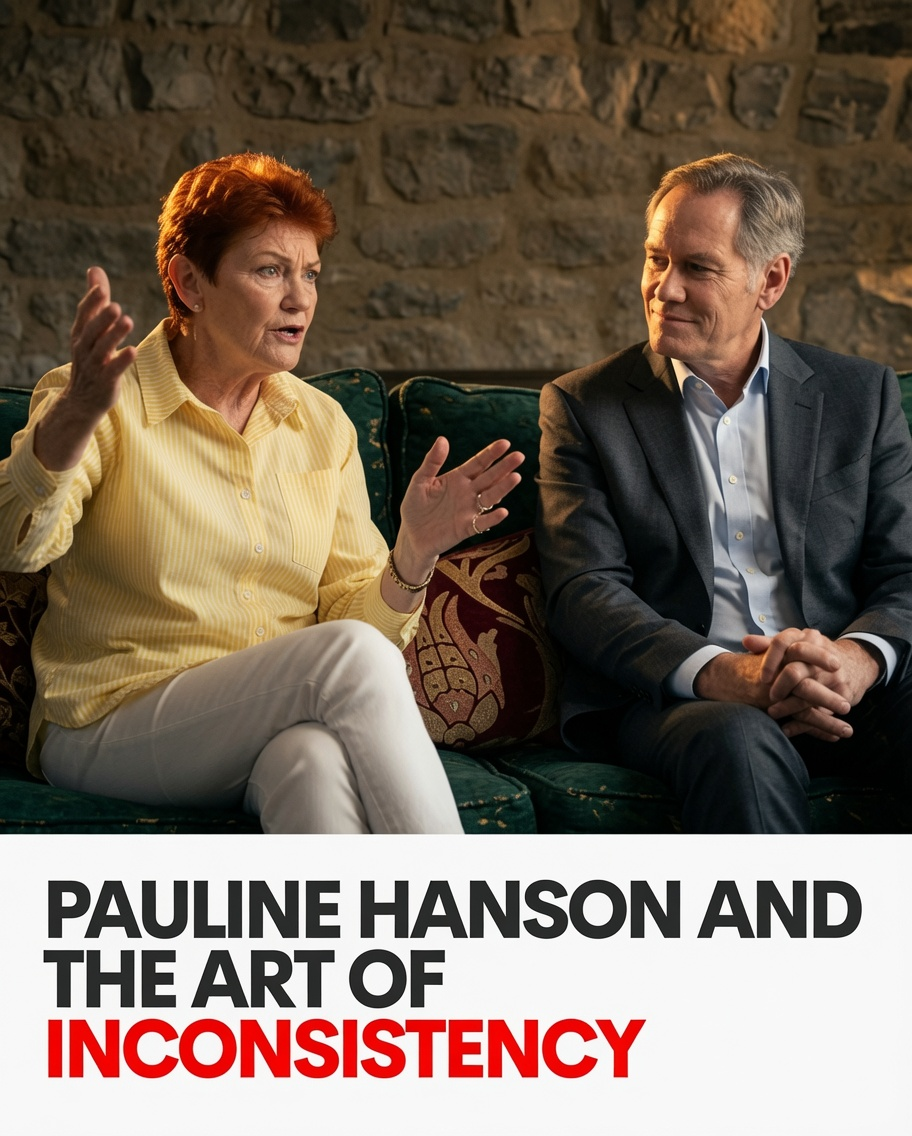
Writing after filming Seven’s Spotlight documentary on Hanson’s overseas tour, Bartlett described the experience as a political roller coaster, saying the senator remains remarkably resistant to changing course despite nearly three decades in public life.
Borrowing one of former British Prime Minister Margaret Thatcher’s most famous political phrases, Bartlett wrote that Hanson is “not for turning”, arguing she rarely accepts the need to retreat, retract or substantially modify statements that generate controversy.
According to Bartlett, Hanson invited the television crew to accompany what she described as a “fact-finding mission” through the United Kingdom, believing the trip would demonstrate to Australian voters that her views on migration and multiculturalism were informed by first-hand observation rather than political rhetoric.
The journey included appearances at conservative political events, meetings with prominent right-wing figures and visits to communities Hanson argued illustrated the consequences of high migration and multicultural policies.
Bartlett acknowledged that the concept of documenting Hanson’s international tour offered viewers an opportunity to observe how one of Australia’s most recognisable minor-party leaders approached major political issues outside the domestic campaign environment.
However, he argued the project increasingly became dominated by controversial decisions that overshadowed its original purpose.
The most significant of those decisions, in Bartlett’s view, was Hanson’s meeting with British far-right activist Tommy Robinson, whose real name is Stephen Yaxley-Lennon.
Robinson has a long history of criminal convictions and legal proceedings in the United Kingdom, alongside years of controversy over his activism on immigration and Islam.
Bartlett wrote that he and other members of the production team were surprised when One Nation chief of staff James Ashby proposed not only meeting Robinson but also filming Hanson appearing on Robinson’s podcast.
While the journalists accepted the arrangement because it would provide valuable television footage and insight into Hanson’s political judgement, Bartlett said they privately questioned why the leader of an Australian parliamentary party would choose to associate so publicly with such a divisive figure.
He argued the decision risked undermining Hanson’s broader political message by shifting attention away from policy discussions and towards the company she chose to keep.
According to Bartlett, the concern was not simply that Robinson held controversial views but that his extensive legal history and reputation would inevitably dominate public discussion once the interview became public.
When Bartlett challenged Hanson during the trip about whether the meeting represented a political miscalculation, he said she remained entirely unapologetic.
More significantly, he wrote that she appeared either unconcerned by—or insufficiently informed about—the full background of Robinson and the controversies surrounding him.
That response reinforced Bartlett’s broader argument that Hanson rarely revises her positions, even when confronted with information that might lead many politicians to reconsider.
Instead, he suggested, she views consistency itself as a political virtue, preferring to maintain a firm public position rather than risk appearing indecisive.
Hanson has consistently defended her decision to meet Robinson.
She has argued that speaking with controversial figures does not amount to endorsing every aspect of their past conduct and has maintained that politicians should be prepared to hear perspectives excluded from mainstream political debate.
Following criticism of the meeting, Hanson said she wanted to better understand British experiences with migration and social integration, insisting her objective was to gather information rather than simply reinforce pre-existing views.
Her UK tour included visits to areas of England where Robinson has long campaigned on issues relating to immigration and community integration, as well as speeches at conservative conferences where Hanson criticised multiculturalism, called for lower migration and argued Australia should avoid repeating what she described as Britain’s mistakes.
Those remarks generated widespread political criticism in Australia, with Prime Minister Anthony Albanese accusing Hanson of talking Australia down while overseas.
Several ministers and opposition politicians also distanced themselves from Hanson’s comments, although some conservative figures defended her right to raise concerns about migration and cultural integration.
Bartlett’s commentary extends beyond the Robinson meeting itself.
He portrays Hanson as a politician whose greatest strength and greatest weakness may be the same quality: an unwillingness to change direction.
Supporters frequently interpret that consistency as evidence of authenticity, arguing Hanson says what she believes regardless of political pressure.
Critics, however, contend that refusing to acknowledge mistakes can prevent meaningful engagement with new evidence or changing circumstances.
Throughout her nearly 30-year political career, Hanson has repeatedly attracted controversy over comments relating to immigration, multiculturalism, Islam, Indigenous affairs and more recently domestic violence.
Yet despite sustained criticism, she has generally maintained that her views reflect the concerns of ordinary Australians and has accused sections of the media of deliberately misrepresenting her positions.
Recent polling has suggested One Nation has gained support in several parts of Australia, indicating that Hanson’s confrontational political style continues to resonate with a significant segment of voters despite ongoing controversy.
Political analysts note that Hanson has become one of Australia’s most durable minor-party leaders precisely because she has maintained a distinctive political identity while larger parties have frequently adjusted their own positions over time.
Whether that consistency represents conviction or inflexibility remains a matter of political interpretation.
Bartlett’s account offers readers an unusual perspective because it comes from a journalist who spent extended time observing Hanson during an overseas campaign rather than reporting from a distance.
His conclusion is ultimately less about any single controversial statement than about the political instincts that continue to shape Hanson’s decision-making.
For Bartlett, the Robinson meeting became the clearest illustration of those instincts—a decision he believes many experienced politicians would have avoided.
For Hanson, however, it represented another example of her longstanding willingness to engage with contentious issues and controversial figures regardless of the political consequences.
The differing interpretations underline why Pauline Hanson remains one of Australia’s most polarising political figures nearly three decades after entering federal politics.
Whether viewed as principled, provocative or politically reckless, her refusal to “turn” continues to define both her supporters’ admiration and her critics’ frustration.






