Barnaby Joyce’s wife, Vikki Campion, says ABC’s flagship current affairs program 7.30 is no longer welcome at the family’s rural property after a live television interview in which the veteran politician’s frustrated shout at a barking dog became one of Australia’s most talked-about political moments of the week.
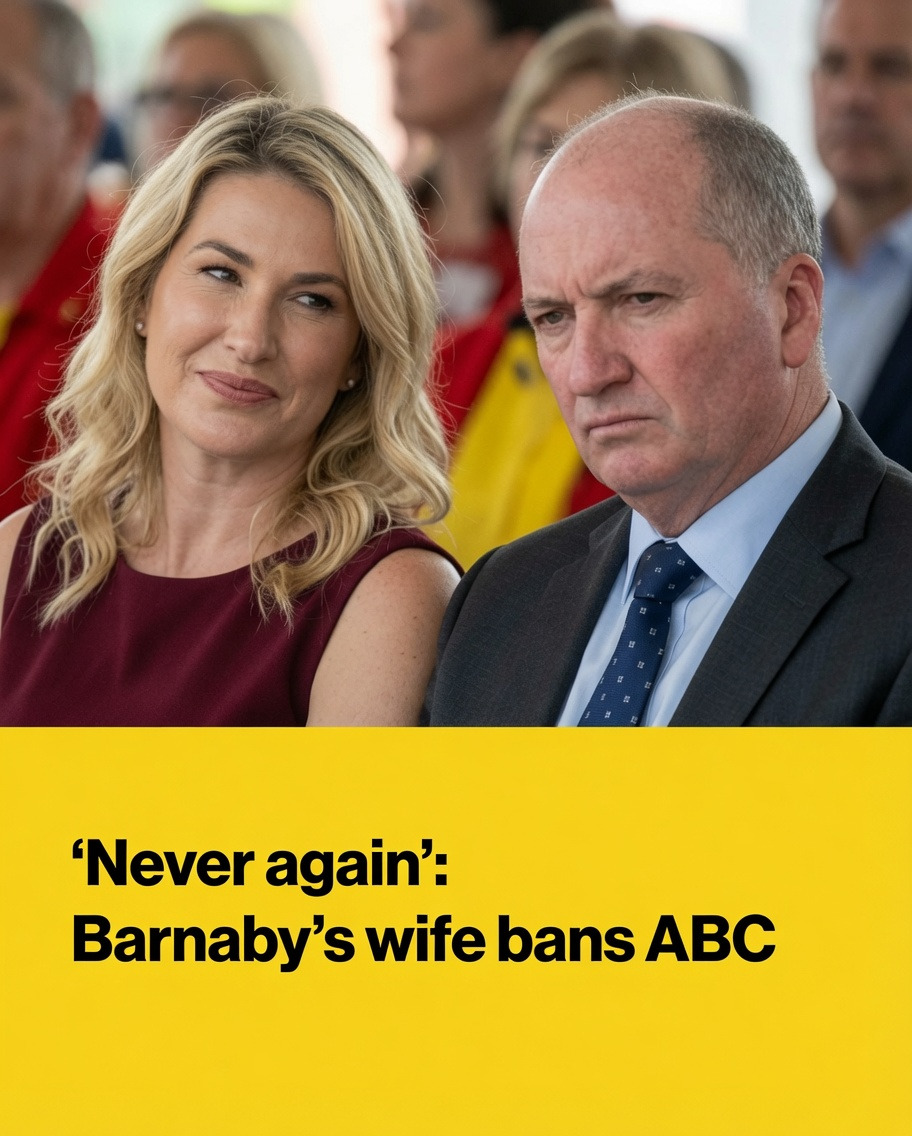
Campion announced the decision in a post published on her Substack newsletter, declaring that the ABC program would not be invited back to the property following what she described as an unfair portrayal of life on a working farm.
“Never again. ABC 7.30 is banned from my property,” she wrote after the interview featuring Joyce went viral across television, news websites and social media.
The controversy began during a live interview conducted by 7.30 host Sarah Ferguson, who was questioning Joyce about One Nation leader Pauline Hanson’s recent overseas trip and broader political issues.
Partway through the interview, Joyce abruptly interrupted the conversation, loudly yelling at his dog to stop barking before quickly apologising and attempting to resume answering Ferguson’s questions.
The unexpected moment rapidly spread online, generating millions of views and becoming the dominant focus of media coverage, often overshadowing the political discussion that had prompted the interview.
While many viewers treated the incident humorously, Campion argued that much of the commentary ignored the practical realities of conducting a television interview from an operational farming property rather than a purpose-built television studio.
“Sorry we aren’t a television studio; we are a working farm, and this is what it sounds like,” she wrote.
According to Campion, the dog was reacting to a vehicle moving through the property after dark rather than behaving unpredictably.
“What viewers and a sanctimonious host missed on Monday night was a mostly-black dog, barking into the pitch-black night at a passing vehicle she found suspicious,” Campion said, defending Joyce’s response as an ordinary instruction to a working farm dog.
Campion also criticised what she described as a disconnect between metropolitan media organisations and regional Australia.
Drawing on her own experience working in media and politics, she argued that many television crews underestimate the logistical challenges involved in broadcasting from remote rural properties.
She said producers had previously complained about naturally occurring farm noises, including insects, livestock and machinery, while expecting television-quality production standards in locations without dedicated broadcasting facilities.
Her criticism extended beyond the interview itself to what she described as broader attitudes within sections of the Sydney media towards rural communities and agricultural life.
Campion also revealed that Ferguson had encouraged Joyce not to worry about the barking dog and instead continue answering questions, but she believed the circumstances were misunderstood by viewers once the clip circulated online.
For many Australians living in regional areas, she argued, raising one’s voice to direct a working dog is neither unusual nor evidence of mistreatment.
The incident nevertheless prompted debate on social media, with some animal welfare advocates questioning Joyce’s conduct while others dismissed the criticism as an overreaction.
Joyce subsequently addressed the viral moment himself, apologising for shouting during the interview while explaining that the dog had become distracted by activity around the property.
He said farm dogs are frequently required to respond quickly to commands and insisted the incident should not be interpreted as cruelty towards the animal.
“Sorry about that,” Joyce said after interrupting the interview, later reiterating that there had been no intention to harm the dog.
The episode has become the latest in a long series of highly publicised moments involving the outspoken New England MP, whose political career has frequently generated national headlines.
Joyce has served as Deputy Prime Minister, Agriculture Minister and leader of the National Party before later joining One Nation, remaining one of Australia’s most recognisable political figures. Throughout that career he has often combined blunt communication with an unmistakably rural public persona.
Sarah Ferguson, meanwhile, is one of Australia’s most experienced current affairs journalists and has hosted ABC’s 7.30 since 2022. She is known for conducting detailed interviews that frequently place senior political figures under sustained questioning on matters of public interest.
The clash has also reignited broader discussion about the challenges of modern political broadcasting.
Since the expansion of remote interviews during recent years, politicians increasingly participate from homes, electorate offices, regional communities and workplaces rather than controlled television studios.
While this approach often provides viewers with a more authentic setting, it also introduces unpredictable interruptions ranging from technical failures and poor internet connections to children, pets and environmental noise.
Several such moments have become memorable international media events, often attracting greater public attention than the interviews themselves.
Supporters of Campion argue the ABC interview demonstrated the realities of rural Australia rather than any lack of professionalism.
Critics, however, contend that the interview simply captured an unscripted moment and that Ferguson continued conducting the interview in a professional manner despite the interruption.
Neither the ABC nor Ferguson has indicated that the broadcaster’s approach to interviewing Joyce or other politicians will change following the controversy.
The broadcaster has continued reporting on the political issues discussed during the interview while the viral clip has taken on a life of its own across social media platforms.
For Campion, however, the episode appears to have settled one question permanently.
Her declaration that 7.30 is no longer welcome at the family farm signals continuing frustration with what she believes was an unfair portrayal of both her husband and rural Australian life.
Whether the ban remains symbolic or affects future interview opportunities, the incident has highlighted how an unexpected moment lasting only a few seconds can quickly evolve into a national political and media controversy in the digital age.






