One Nation leader Pauline Hanson is facing renewed scrutiny after previously overlooked comments about domestic violence resurfaced in the wake of widespread criticism over her recent description of abuse as “a two-way street”.
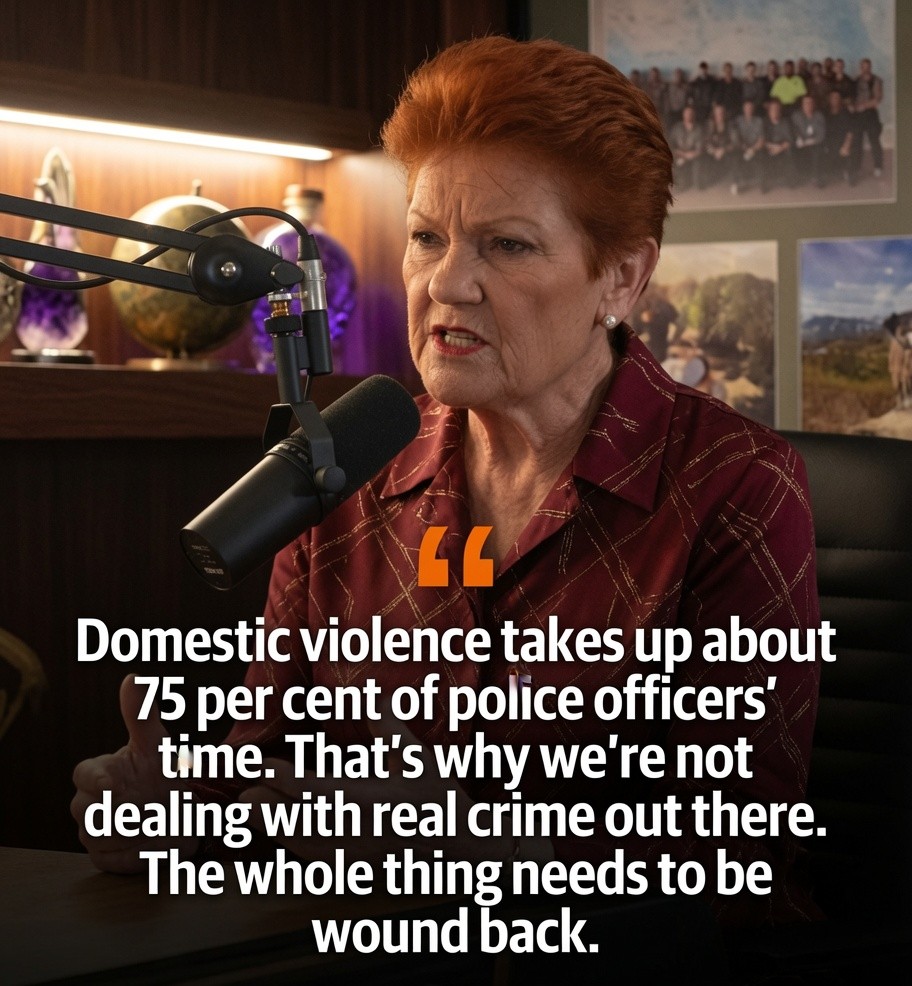
The earlier remarks were made during an appearance on the Broken Fathers podcast in late 2025 but have attracted fresh attention following Hanson’s comments this week during a Brisbane radio interview, where she said domestic violence was “wrong, but it’s also a two-way street”. The combination of the two sets of comments has intensified political and public criticism of the One Nation leader.
During the podcast interview, Hanson argued that Australia’s family law system had become unfairly weighted against men and claimed aspects of domestic violence policy were being misused.
She called for significant changes to the Family Court system, questioned child support arrangements and suggested some domestic violence protections were being exploited.
“I believe that you’ve got to wind back a lot of issues to do with the family law court … Go after the child support. A lot of people see it as a cash cow,” Hanson said during the interview.
Hanson also criticised Australia’s entitlement to paid family and domestic violence leave, describing it as a “holiday” and arguing that the policy encouraged false claims.
She further claimed police resources were increasingly being consumed by domestic violence investigations.
“Domestic violence takes up about 75 per cent of police officers’ time now. That’s why we’re not dealing with real crime out there. The whole thing needs to be wound back,” she said.
The resurfaced podcast followed Hanson’s appearance on 4BC radio this week, where she was asked what message she had for men who assault their partners.
Hanson replied that domestic violence was “a two-way street”, adding that many Australians were living under enormous financial and emotional pressure because of the rising cost of living, employment uncertainty and family stress.
She also encouraged women experiencing abuse not to remain in unsafe relationships, saying they “shouldn’t put up with it”.
Those remarks immediately attracted criticism from domestic violence advocates, legal experts and politicians across the political spectrum.
Critics argued that describing domestic violence as a “two-way street” risks oversimplifying patterns of coercive control and intimate partner violence, while advising victims simply to leave ignores the significant dangers many face when attempting to escape abusive relationships.
Specialists consistently warn that separation is often the period of highest risk for victims because perpetrators may escalate violence when they believe they are losing control.
Sex Discrimination Commissioner Anna Cody described Hanson’s comments as harmful, while the Australian Council of Trade Unions rejected her criticism of paid domestic violence leave, saying the entitlement allows victims to attend court, meet police, secure emergency accommodation and make safety arrangements rather than functioning as a holiday.
Labor ministers also condemned the remarks.
Social Services Minister Tanya Plibersek said violence should never be excused and argued that telling victims simply to leave “completely misses the point”, emphasising that the period immediately before and after separation is statistically one of the most dangerous for women experiencing domestic violence.
Education Minister Jason Clare similarly rejected any suggestion that domestic violence should be viewed as mutual conflict, stressing that violence against partners is a serious criminal offence.
Opposition figures also distanced themselves from Hanson’s comments.
Coalition representatives said domestic violence should be discussed carefully and based on evidence, while acknowledging that both men and women can experience family violence but noting that women are disproportionately affected by severe intimate partner violence.
Domestic violence organisations argued that Hanson’s comments about paid leave and policing misunderstood how the system operates.
Paid family and domestic violence leave was introduced to enable workers experiencing abuse to access medical treatment, legal advice, counselling, court hearings, relocation assistance and other safety measures without risking their employment.
Support services say many victims use the entitlement to organise practical steps needed to leave abusive environments rather than for extended time away from work.
Advocates also challenged Hanson’s claim regarding police workloads.
They argued that while family and domestic violence represents a substantial proportion of police demand, this reflects the scale of the problem rather than unnecessary enforcement, with frontline officers often responding to repeated incidents involving escalating risks to victims and children.
Hanson has rejected accusations that she was attempting to minimise domestic violence.
Responding through social media and subsequent interviews, she said her comments had been taken out of context and insisted she recognised domestic violence as unacceptable regardless of whether victims were women or men.
She argued she had spoken from personal experience and maintained that public discussion should also acknowledge male victims and shortcomings within the family law system.
The One Nation leader has previously spoken publicly about experiencing domestic violence during her own life and has long advocated for reviews of Australia’s family law framework, arguing fathers often receive unequal treatment in custody and child support disputes.
Supporters of Hanson say those concerns deserve greater political attention, particularly regarding male victims of family violence and the operation of family courts.
Critics, however, argue that raising those issues should not come at the expense of evidence-based messaging about domestic violence or statements that could discourage victims from seeking professional support.
The renewed controversy comes at a time when violence against women remains one of Australia’s most significant public policy challenges.
Governments have invested heavily in prevention programs, crisis accommodation, policing initiatives and behavioural intervention programs for perpetrators, while experts continue to emphasise that domestic violence is driven by a complex combination of behavioural, social and economic factors rather than a single cause.
The resurfacing of Hanson’s earlier podcast comments has therefore broadened the debate beyond her latest radio interview.
Rather than focusing solely on one controversial phrase, the discussion now encompasses her broader views on family law, domestic violence leave, policing priorities and the role governments should play in supporting victims.
With One Nation’s electoral support improving in recent polling, Hanson’s comments have attracted heightened political attention, ensuring domestic violence policy—and the language used by political leaders when discussing it—will remain under close scrutiny in the weeks ahead.






