Prime Minister Anthony Albanese has come under renewed political criticism after declaring the Australian Labor Party is “more democratic and more diverse than ever” during Labor’s 50th National Conference in Adelaide, with critics using the moment to question the government’s record on political transparency, cost-of-living pressures and recent legislative reforms.
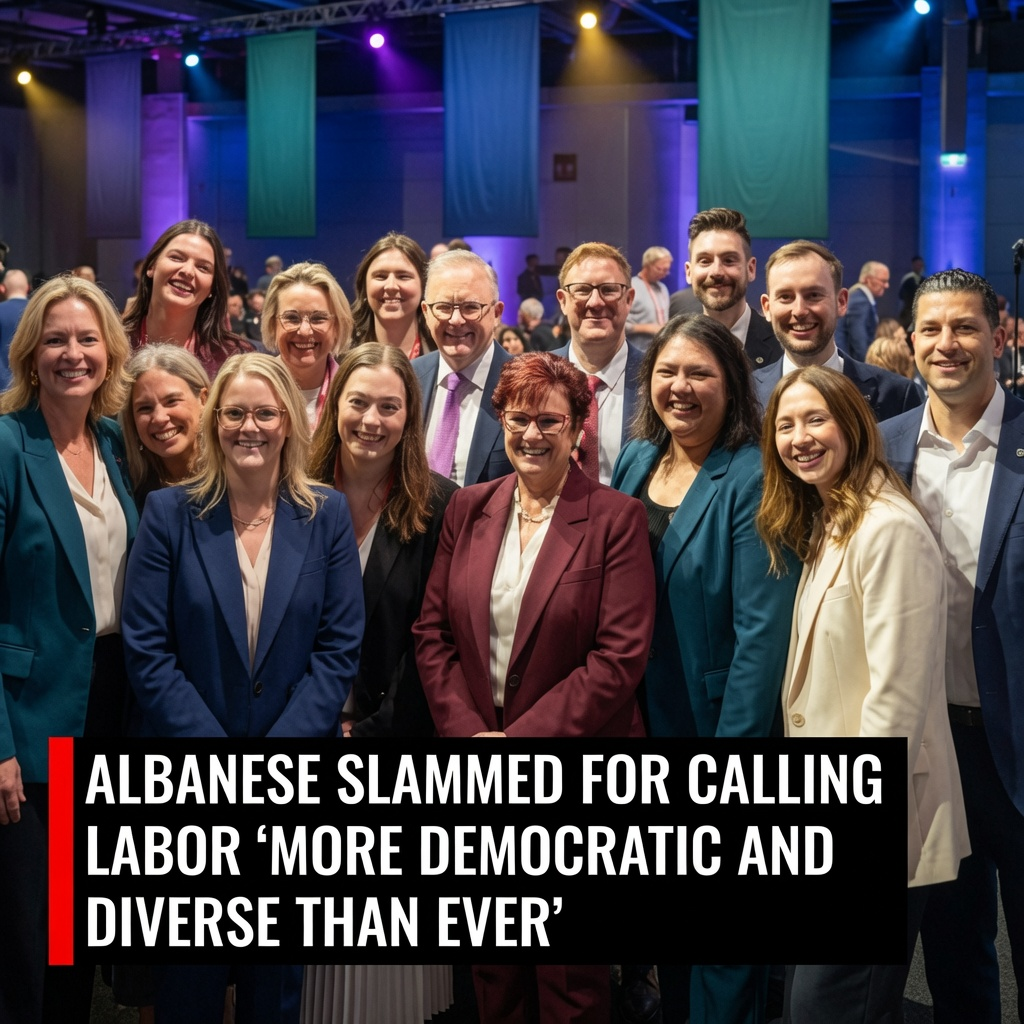
Albanese made the remarks while celebrating Labor’s newest intake of federal MPs elected at the 2025 election, describing the parliamentary team as reflecting the changing face of modern Australia.
“Labor is more democratic and more diverse than ever. Our class of 2025 represents that – as does our movement. And as we mark our 50th National Conference we continue our work to deliver real change for Australians,” the Prime Minister wrote alongside photographs from the conference.
The comments were intended to highlight Labor’s electoral success and the growing diversity of its parliamentary ranks. However, they quickly attracted criticism on social media and from political opponents, who argued the Prime Minister’s message contrasted sharply with concerns many Australians continue to express about living standards, housing affordability and government accountability.
Some critics also linked the Prime Minister’s comments to the government’s recently enacted prohibited hate organisation laws, which resulted in the White Australia Party being declared a prohibited extremist organisation under federal legislation. Supporters of the legislation argue the measures are designed to combat violent extremism and organised hate groups, while opponents have raised concerns about the scope and application of the new laws.
The backlash has also coincided with continuing political discussion surrounding allegations relating to donations connected to Chinese-born billionaire property developer and political donor Huang Xiangmo. Those matters have generated renewed scrutiny of political donations and foreign influence, although no findings have established wrongdoing by Prime Minister Albanese in relation to the allegations currently being debated publicly.
The timing of the criticism is significant, with Labor’s National Conference serving as the party’s principal policy-making forum and an opportunity for the government to project unity following its substantial victory at the 2025 federal election.
The conference in Adelaide has focused on a broad range of policy issues, including taxation, energy, gambling advertising, industrial relations, artificial intelligence, housing and Australia’s international relationships. Party leaders have repeatedly emphasised stability, economic management and delivering reforms promised during the election campaign.
In his conference address, Albanese contrasted Labor’s agenda with the rise of populist politics, arguing Australians deserve practical policy solutions rather than what he described as divisive culture-war rhetoric.
Without naming One Nation directly, the Prime Minister criticised political movements that he said focus on grievance instead of constructive policy, arguing that identifying problems is insufficient without realistic solutions.
“People’s genuine frustrations deserve a practical response, not just an emotional one,” Albanese told delegates, adding that Australia’s future should be built on optimism rather than division.
Those remarks were widely interpreted as a response to One Nation leader Pauline Hanson, whose recent speeches on immigration, multiculturalism and national identity have generated significant political debate both in Australia and overseas.
Labor ministers have consistently argued that Australia’s diversity is one of the country’s greatest strengths and that multiculturalism has contributed significantly to national economic growth, international engagement and social cohesion.
The Prime Minister’s supporters point to Labor’s parliamentary team as evidence of that diversity, noting increased representation of women, Indigenous Australians and members from culturally diverse backgrounds compared with earlier generations of the party.
Political analysts also observe that Labor’s parliamentary caucus today is substantially different from previous decades, reflecting demographic changes across Australia and deliberate efforts by major parties to broaden representation.
Critics, however, argue that representation alone does not address the practical concerns dominating public debate.
Cost-of-living pressures remain one of the most significant political issues facing the Albanese Government. Australians continue to grapple with elevated housing costs, rental affordability challenges, energy prices and broader household financial pressures despite easing inflation compared with previous years.
Opposition parties have sought to focus attention on those issues, arguing Labor should prioritise economic outcomes over symbolic messaging or internal party celebrations.
The political response on social media reflected those concerns, with some users questioning whether describing Labor as more democratic and diverse accurately captured public sentiment during a period of ongoing economic pressure.
The debate also revived discussion surrounding Australia’s political donation system.
Foreign political donations have been prohibited under Commonwealth law since reforms introduced in 2018 following concerns about overseas influence in Australian politics. Political donations from Australian citizens and entities remain subject to disclosure requirements administered by the Australian Electoral Commission.
Questions surrounding donations linked to high-profile business figures have periodically resurfaced across governments of different political persuasions, contributing to broader calls for increased transparency and stronger integrity measures.
Labor has defended its integrity agenda by pointing to reforms including the establishment of the National Anti-Corruption Commission, strengthened transparency measures and legislation targeting foreign interference.
Government ministers argue those reforms demonstrate Labor’s commitment to accountability and democratic institutions, while rejecting suggestions that recent political controversies undermine those achievements.
The conference itself has largely been characterised by an emphasis on party unity rather than internal conflict.
Unlike many previous national conferences marked by contentious factional disputes, this year’s gathering has been carefully managed to present a united front while allowing debate on selected policy issues. Observers have noted that although differences remain within Labor, the party leadership has successfully avoided the highly public confrontations that once defined national conferences.
The broader political contest nevertheless continues to intensify.
Recent polling has suggested increased support for minor parties, including One Nation, reflecting growing voter dissatisfaction over housing affordability, migration, energy policy and living standards. Labor has responded by arguing that practical economic reforms offer a stronger long-term alternative than populist politics focused primarily on public frustration.
For Albanese, the declaration that Labor is “more democratic and more diverse than ever” was intended to celebrate the evolution of the party after five decades of national conferences.
For critics, however, the statement has become another opportunity to challenge the government’s performance on issues extending well beyond party diversity, including economic management, political accountability and public confidence in federal institutions.
As Labor’s National Conference concludes, the political debate illustrates how even celebratory messages can rapidly become focal points for wider arguments about the government’s record and Australia’s political direction.






