Foreign Affairs Minister Penny Wong has delivered a strongly worded condemnation of One Nation leader Pauline Hanson, accusing the veteran senator of once again using inflammatory rhetoric about Muslims to generate political attention while undermining Australia’s multicultural values.
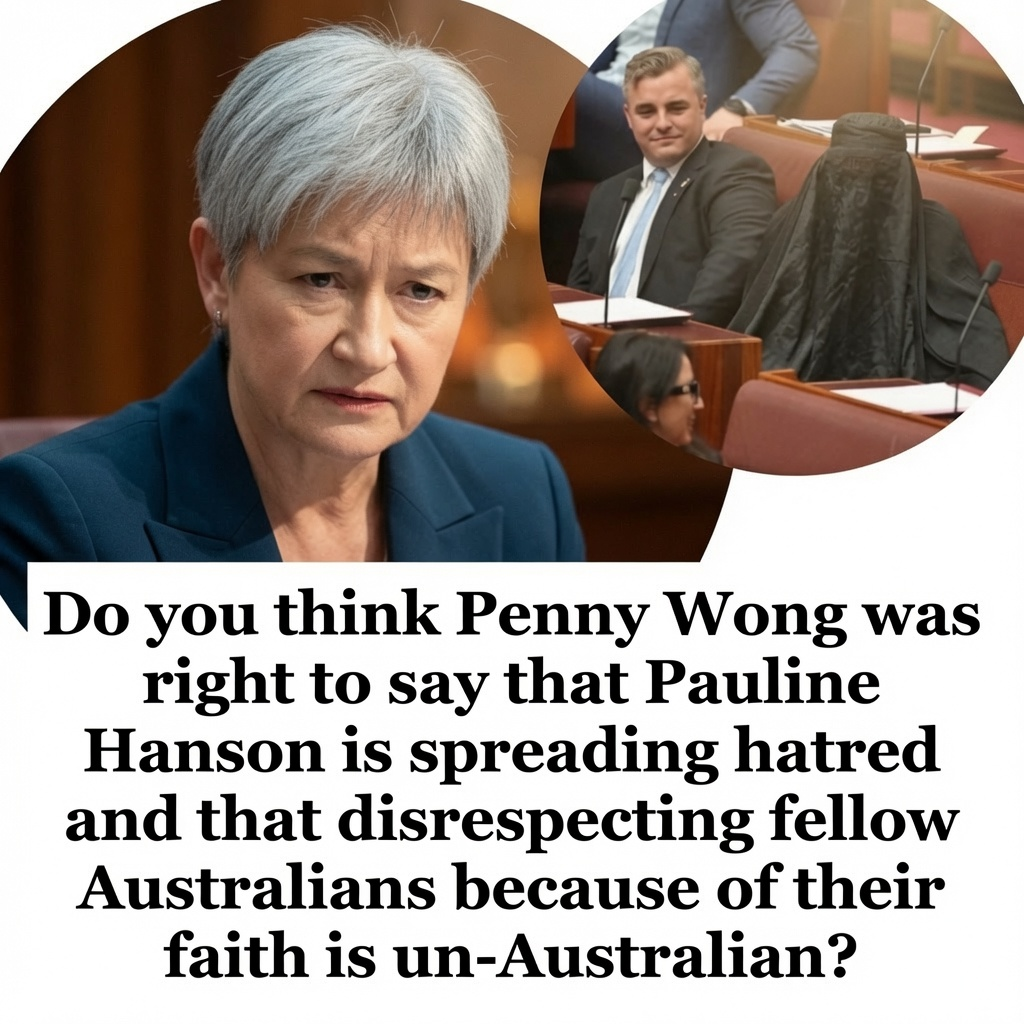
Speaking in response to Hanson’s latest comments about Islam and Muslim Australians, Wong drew a direct connection between the One Nation leader’s recent remarks and her controversial maiden speech to Parliament three decades ago.
Wong recalled that in her first speech to the House of Representatives in 1996, Hanson warned that Australia was “in danger of being swamped by Asians”—remarks that became one of the defining moments in modern Australian political history.
“Pauline Hanson, in her first speech at Parliament House, said Australia was in danger of being swamped by Asian people like me. Now, she has added Muslims to the list,” Wong said.
The Foreign Minister then reflected on her own first parliamentary speech, explaining that she had responded to Hanson’s message with a warning of her own.
“In my very first speech in Parliament, I said that because of people like her, Australia was in danger of being swamped by hatred.”
Wong argued that Hanson’s latest intervention was consistent with a long-established political strategy.
“Purely to get attention and not for the first time; it’s an old play,” Wong said, accusing the One Nation leader of mocking and vilifying an entire religious faith rather than engaging in constructive public debate.
The exchange follows renewed controversy after Hanson made comments questioning Islam and Muslim Australians during recent media appearances and overseas speeches, prompting widespread criticism from Labor ministers, multicultural organisations and several Coalition figures.
Hanson has argued that Australia should substantially reduce migration, strengthen cultural integration and adopt tougher policies towards political Islam. She has also maintained that her criticism is directed at an ideology rather than individuals and has defended her comments as an exercise of free speech.
Those explanations have failed to satisfy Wong, who argued that freedom of expression carries responsibilities, particularly for elected representatives.
“Freedom of expression is central to who we are as Australians, but so too is respect,” she said.
“I believe, and I think most of the Senate believes, that disrespecting fellow Australians because of their faith is, in itself, un-Australian.”
Wong’s intervention reflects the Albanese Government’s broader defence of multiculturalism, which ministers have repeatedly described as one of Australia’s greatest national strengths.
Successive Labor governments have argued that Australia’s diversity has contributed significantly to its economic growth, international engagement and social development, while emphasising that Australians from different cultural and religious backgrounds are united by shared democratic values.
The latest dispute also revives one of the longest-running political rivalries in federal politics.
Both Wong and Hanson entered Parliament during periods of intense national debate over immigration and multiculturalism, although they have consistently represented sharply contrasting visions of Australia’s identity.
Hanson’s maiden speech in 1996 became internationally known after warning that Australia risked being “swamped by Asians” and criticising multiculturalism and immigration policy. The speech generated immediate controversy and continues to be referenced in political discussions nearly three decades later.
Wong, who migrated from Malaysia as a child and became Australia’s first Asian-born Foreign Minister, has frequently spoken about her own experiences as the daughter of migrants and has argued that Australia’s diversity is a national asset rather than a weakness.
The current controversy centres on Hanson’s recent comments about Muslims, including statements questioning whether there are “good Muslims” and criticism of Islamic beliefs, remarks that prompted the government to move a motion censuring the One Nation leader in the Senate earlier this year. The censure motion ultimately passed with support from Labor, the Greens and several Coalition senators.
Supporters of the censure argued Hanson’s comments unfairly targeted millions of Muslims worldwide, including hundreds of thousands of Australian citizens who peacefully contribute to the country’s communities, businesses and public institutions.
Hanson rejected the censure, describing it as political theatre and maintaining that she was raising legitimate concerns about extremism, immigration and national security rather than attacking individuals because of their religion.
The broader political debate reflects growing attention to religious discrimination and social cohesion in Australia.
Recent government initiatives have included the appointment of a Special Envoy to Combat Islamophobia following increases in reports of anti-Muslim incidents, alongside similar measures addressing antisemitism and other forms of religious hatred.
Political analysts note that disputes over immigration, multiculturalism and religious identity have remained central themes in Australian politics for decades, particularly during periods of economic uncertainty and heightened concern about national security.
While One Nation continues to argue for lower migration, stronger cultural assimilation and tougher measures against religious extremism, both Labor and the Coalition have generally defended multiculturalism as a defining feature of modern Australia, even where they differ over migration levels and border policy.
For Wong, the latest exchange is about more than a disagreement between political opponents.
She argues that Australia’s national character is measured not only by its commitment to free speech but also by the respect shown to fellow citizens regardless of their faith or cultural background.
For Hanson, meanwhile, the controversy reinforces her long-standing claim that the major parties are unwilling to confront difficult conversations about immigration, integration and national identity.
As debate over migration, multiculturalism and religious freedom continues to shape Australia’s political landscape, the renewed clash between Wong and Hanson illustrates how questions first raised in Parliament decades ago continue to influence national politics today.






