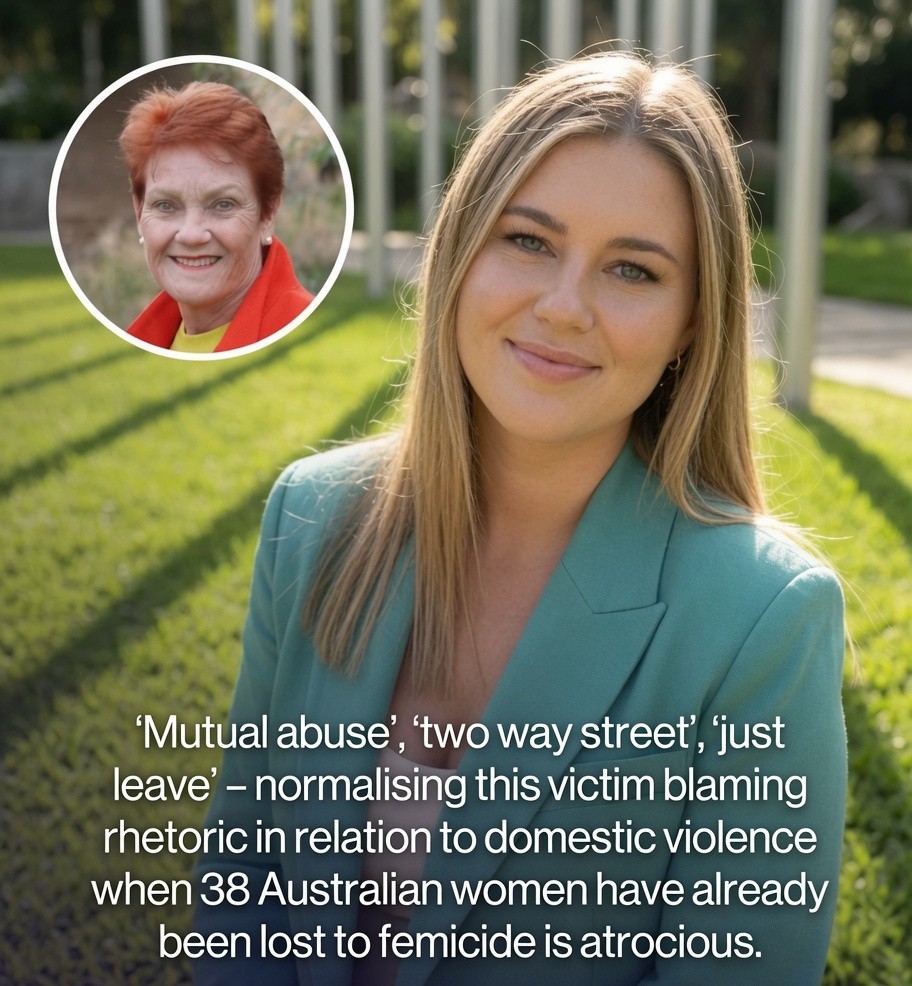
One Nation leader Pauline Hanson has come under intense criticism after describing domestic violence as “a two-way street” during a Brisbane radio interview, prompting accusations of victim-blaming from Brittany Higgins, family violence advocates, senior government ministers and Australia’s Sex Discrimination Commissioner.
The controversy erupted after Hanson appeared on Brisbane radio station 4BC, where she was asked about domestic and family violence during a period of heightened national concern following a series of alleged killings of women by current or former partners.
Responding to the question, Hanson condemned domestic violence but added that it was “also a two-way street”, arguing that women as well as men could lose control under pressure.
“It is wrong, but it’s also a two-way street. I’m not saying that it’s just men, women can lose their cool as well,” Hanson said.
She went on to reveal that she had personally experienced domestic violence as a younger mother and urged women living in abusive relationships not to remain in situations where they felt unsafe.
“If these women are getting abused by men out there, then don’t put up with it,” she said.
The remarks immediately attracted widespread criticism.
Political advocate Brittany Higgins accused Hanson of promoting narratives that shift responsibility away from perpetrators and place undue responsibility on victims.
Posting on social media, Higgins described the comments as “dangerous” and argued that phrases such as “two-way street” and suggestions that victims should “just leave” ignored the realities experienced by many people trapped in abusive relationships.
She said such language risked reinforcing misconceptions at a time when Australia continues to confront high levels of violence against women.
Domestic violence organisations echoed those concerns.
Advocates argued that while both men and women can experience or perpetrate family violence, the overwhelming majority of serious intimate partner violence, coercive control and domestic homicide in Australia is committed by men against women.
They warned that framing domestic violence as a mutual conflict risks obscuring the unequal patterns of power and control that often define abusive relationships.
Another point of criticism centred on Hanson’s suggestion that victims should leave abusive relationships.
Family violence experts have long argued that leaving an abusive partner is frequently the most dangerous stage of an abusive relationship.
Victims may face threats of retaliation, financial dependence, housing insecurity, concern for children, emotional manipulation and coercive control, making separation significantly more complex than simply walking away.
Advocates therefore emphasise the importance of carefully planned safety strategies and specialist support services rather than assuming victims can leave immediately without additional risks.
Senior members of the Federal Government also criticised Hanson’s remarks.
Social Services Minister Tanya Plibersek said telling women to “just leave” ignored the reality that separation is often the period of greatest danger for victims.
Education Minister Jason Clare similarly argued that domestic violence should not be portrayed as a shared responsibility because doing so risks diminishing accountability for perpetrators.
Australia’s Sex Discrimination Commissioner, Dr Anna Cody, later joined the criticism, describing Hanson’s comments as harmful and warning that public figures have a responsibility to communicate carefully about domestic and family violence.
Children’s Commissioner Deb Tsorbaris likewise said victims and their children often face complex barriers to reaching safety and require community support rather than simplistic solutions.
Following the backlash, Hanson defended herself on social media.
She argued that sections of the media and her political opponents had selectively quoted her interview and ignored the fact that she explicitly described domestic violence as “a scourge”.
Hanson maintained she was not excusing abusive behaviour and said her comments reflected her own lived experience as a survivor.
She also insisted acknowledging that men can be victims and women can be perpetrators should not be interpreted as minimising violence against women.
The controversy has unfolded against the backdrop of growing national concern about domestic and family violence.
Governments across Australia have committed billions of dollars to prevention programs, crisis accommodation, counselling, policing initiatives and legal reforms in response to persistent rates of violence against women and children.
Recent high-profile killings have intensified calls for stronger prevention measures, earlier intervention and improved support for victims attempting to leave abusive relationships.
Experts appearing regularly before parliamentary inquiries and government reviews have stressed that domestic violence extends well beyond physical assault.
It may include coercive control, financial abuse, emotional abuse, sexual violence, intimidation and isolation from family or support networks.
Those behaviours can make it extremely difficult for victims to safely leave without assistance from specialist services or law enforcement.
For that reason, advocates argue that public messaging should consistently reinforce perpetrator accountability while encouraging victims to seek professional support rather than suggesting responsibility rests with them to end the abuse.
The dispute has also generated broader discussion about how public figures should communicate on sensitive social issues.
Supporters of Hanson argue her comments have been interpreted unfairly because she acknowledged her own experience as a survivor and repeatedly condemned domestic violence throughout the interview.
Critics counter that, regardless of intent, describing domestic violence as “a two-way street” or suggesting victims should simply leave risks reinforcing misconceptions that specialists have spent years attempting to correct.
Although political leaders from across the spectrum broadly agree that domestic violence is unacceptable, the latest controversy demonstrates continuing disagreement over how the issue should be discussed publicly and what messages best support victims while promoting accountability for offenders.
As Australia continues to confront domestic and family violence as a national policy priority, the debate surrounding Hanson’s comments has renewed attention on the importance of evidence-based public communication, survivor safety and the complex realities faced by people living with abuse.






