One Nation leader Pauline Hanson has launched a sweeping attack on the Albanese government, declaring Labor is making Australia “poorer, weaker and less safe” as Prime Minister Anthony Albanese faces renewed pressure over federal funding for critical services in the Northern Territory.
Hanson’s criticism reflects the increasingly aggressive political contest over whether Australians are materially better off after several years of Labor government, with cost-of-living pressures, housing, migration, defence and public services all becoming central points of attack.
The latest confrontation comes as Albanese has faced questions over Commonwealth support for hospital infrastructure in Darwin, where the Northern Territory’s health system is under significant pressure from population demands, workforce shortages and the unusually high cost of delivering medical care across remote communities.
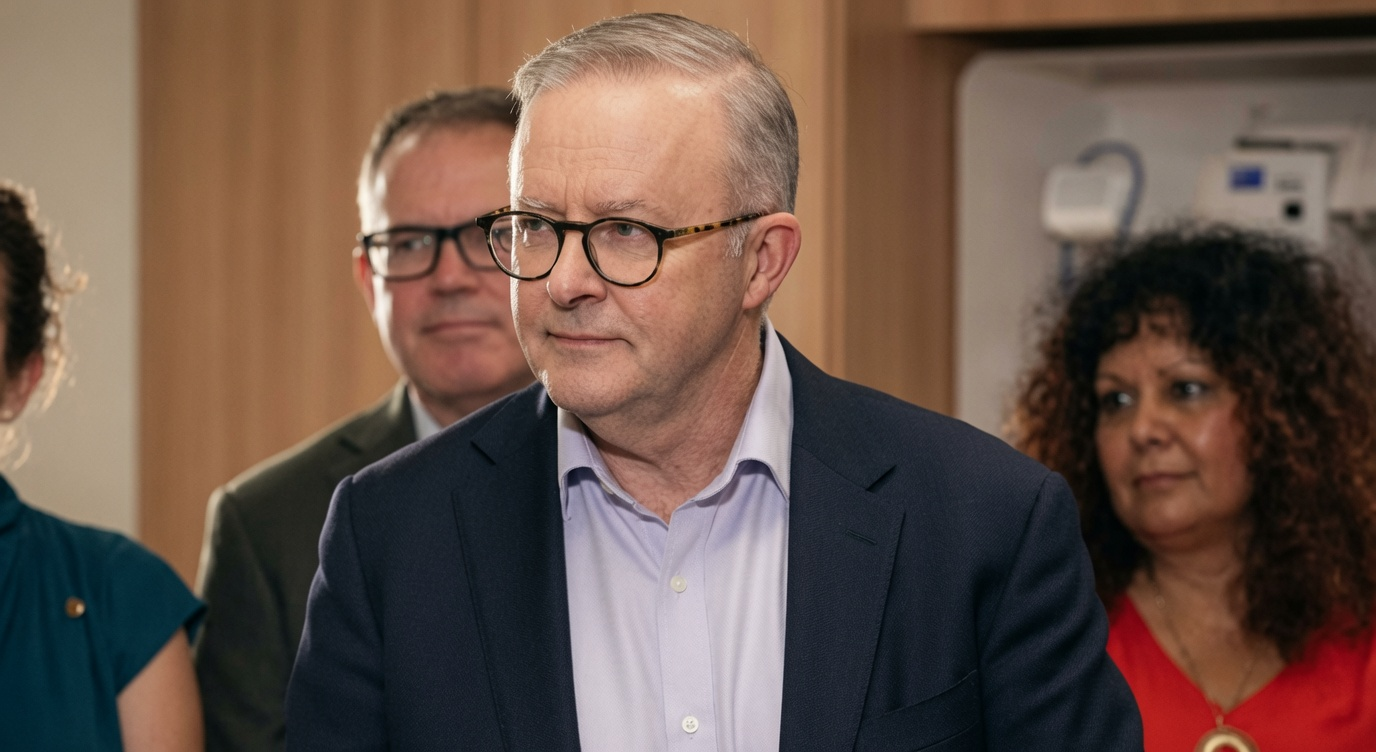
During questioning from reporters, Albanese pushed back against suggestions that his government had failed to provide sufficient support, rejecting the framing of a federal funding “delay” and defending Labor’s broader investment in health.
The dispute has become politically significant because local leaders and health advocates have sought substantially greater Commonwealth assistance than the amount initially committed, intensifying arguments over whether Canberra is adequately supporting essential infrastructure in northern Australia.
For Hanson, the episode fits a much broader political message.
She argues Australians are paying more, receiving less and living in a country whose economic resilience, defence capability and social cohesion have deteriorated under Labor.
Labor strongly disputes that characterisation, pointing to investments in Medicare, hospitals, defence, housing and cost-of-living relief while arguing many of the pressures confronting Australia are the result of global shocks and structural problems accumulated over decades.
The political question is whether voters believe those explanations — or whether they increasingly judge the government by the pressure they experience in their own household budgets and communities.
Darwin hospital funding becomes a flashpoint
Health services in the Northern Territory operate under conditions unlike those faced by most metropolitan health systems.
Darwin serves not only its own urban population but functions as a critical medical hub for patients from remote communities spread across an enormous geographic area.
The Territory also faces complex health challenges, including higher rates of chronic disease in some populations, significant Indigenous health disadvantage and the cost of transporting patients over vast distances.
Royal Darwin Hospital and Palmerston Regional Hospital therefore play an outsized role in the Top End’s health system.
Pressure on infrastructure, bed capacity, staffing and emergency services has repeatedly prompted calls for additional investment.
The political dispute centres on how much support the Commonwealth should provide and how quickly major infrastructure needs can be addressed.
Local requests for substantially larger funding commitments have created tension when compared with the level of federal support announced or committed at particular stages.
Critics have portrayed the difference as evidence Canberra is short-changing the Territory.
The federal government’s position is broader: hospital funding is shared across jurisdictions, major infrastructure projects require planning and agreement, and Commonwealth health investment cannot be assessed through a single funding announcement in isolation.
That distinction matters because Australian hospitals are primarily operated by state and territory governments, while the Commonwealth provides substantial funding through national agreements and specific programs.
Political disputes over hospital funding therefore often involve disagreements not only over the amount of money available, but over who should pay, when funding should be delivered and what projects should receive priority.
Why northern health infrastructure matters nationally
The Darwin debate has implications beyond local health policy.
Northern Australia has become increasingly important to the country’s defence and strategic planning.
Darwin hosts a major Australian Defence Force presence and regular rotations of United States Marines, while the broader Top End is central to Australia’s military posture in the Indo-Pacific.
That makes civilian infrastructure — including hospitals, roads, ports, energy systems and housing — part of a wider national resilience discussion.
A city expected to support a growing strategic and defence role also needs sufficient medical capacity for its civilian population and workforce.
Successive federal governments have committed billions of dollars to defence infrastructure across northern Australia as strategic competition in the Indo-Pacific intensifies.
Critics of Canberra’s spending priorities increasingly ask whether investment in civilian infrastructure is keeping pace.
The question is particularly potent when governments can announce major defence expenditure while local communities say essential hospitals, housing and services remain under strain.
Hanson’s ‘poorer’ argument taps into cost-of-living pain
The first part of Hanson’s attack — that Australia is becoming “poorer” — draws on one of the government’s greatest political vulnerabilities.
Australian households experienced a severe decline in real disposable income during the post-pandemic inflation shock.
High inflation reduced purchasing power, while rapidly rising interest rates dramatically increased repayments for households with variable-rate mortgages.
Renters were hit by severe housing shortages and rising rents in many parts of the country.
Higher nominal wages did not always translate into higher living standards because households were simultaneously paying more for food, electricity, insurance, housing and other essentials.
International economic analysis has confirmed that Australia experienced an unusually difficult period for household disposable incomes compared with many other advanced economies.
That does not establish Hanson’s broader political claim that every Australian is poorer because of Labor.
The economic squeeze resulted from multiple factors, including global inflation following the pandemic, supply-chain disruptions, commodity and energy shocks, Reserve Bank interest-rate decisions, taxation and domestic structural weaknesses.
Some of those pressures began before Albanese became prime minister in May 2022.
But governments are ultimately judged by economic conditions during their time in office, regardless of whether every cause originated with their policies.
That creates a persistent problem for Labor.
Even when inflation moderates, the higher price level remains.
A household paying substantially more for groceries, insurance and housing does not necessarily feel better off simply because those prices are now increasing more slowly.
Labor points to relief and economic recovery
The Albanese government has responded by highlighting tax cuts, energy assistance, cheaper medicines, expanded Medicare investment and other cost-of-living measures.
It has also argued that wage growth and improvements in inflation are helping restore household purchasing power after the worst phase of the squeeze.
Labor’s economic case is that responsible fiscal policy must provide targeted relief without reigniting inflation.
The government has repeatedly rejected calls for measures it argues would inject excessive demand into the economy or undermine long-term budget sustainability.
But the political difficulty is that voters often assess economic management through immediate personal experience rather than aggregate indicators.
GDP growth can remain positive while GDP per person falls.
Wages can rise while purchasing power remains under pressure.
Inflation can decline while groceries remain far more expensive than several years earlier.
Those distinctions help explain why improving headline economic statistics do not always produce an immediate improvement in public sentiment.
What does Hanson mean by ‘weaker’?
One Nation’s claim that Australia has become “weaker” encompasses several policy areas, including defence, energy security, economic sovereignty and national resilience.
Hanson has long argued that Australia has become excessively dependent on foreign supply chains and investment while losing domestic manufacturing capability.
One Nation advocates greater national control over strategic industries and resources and has criticised policies it says leave Australia vulnerable to international disruption.
The Albanese government, meanwhile, has substantially increased its focus on strategic industry and defence manufacturing.
Its Future Made in Australia agenda seeks to encourage domestic investment in sectors considered important to the energy transition and national economic security.
The government has also committed Australia to the AUKUS nuclear-powered submarine partnership with the United States and United Kingdom, one of the largest and most expensive defence programs in Australian history.
Labor argues these policies strengthen rather than weaken Australia.
Critics respond that defence capability cannot be measured simply by future spending commitments.
Australia faces immediate workforce shortages, procurement delays and questions about whether existing military capability is adequate while major AUKUS platforms remain years away.
The result is a debate over two different concepts of national strength: long-term strategic investment versus current readiness and sovereign capability.
‘Less safe’ is an even broader political claim
Hanson’s assertion that Australia is becoming “less safe” draws together concerns about crime, terrorism, border security, immigration and geopolitical instability.
These are distinct issues and cannot be accurately reduced to a single national measure of safety.
Australia remains one of the world’s more stable democracies, with strong institutions and comparatively high levels of public safety.
However, recent events have intensified community anxiety.
The December 2025 terrorist attack at Bondi Beach profoundly affected the national security debate, while antisemitism, online radicalisation and extremist movements have become major concerns for law-enforcement and intelligence agencies.
Australia also operates in a more contested strategic environment as tensions involving China, the United States and the wider Indo-Pacific reshape defence planning.
Hanson has linked security concerns strongly to immigration and what she describes as failures of multicultural policy.
Her critics argue that this framing risks conflating migration with criminality or extremism and can unfairly target entire communities.
The government maintains that Australia can preserve a large migration program while applying security screening, enforcing visa rules and supporting multicultural cohesion.
One Nation argues migration levels should be dramatically lower and that Australia should impose much stricter requirements on who is admitted.
Immigration sits at the centre of One Nation’s challenge
Few issues distinguish Hanson from the major parties more clearly than immigration.
Australia experienced a sharp post-pandemic surge in net overseas migration as borders reopened, international students returned and employers sought workers.
That surge coincided with an acute housing shortage.
Although migration is not the sole cause of Australia’s housing crisis, rapid population growth increases demand for homes, transport, hospitals, schools and other infrastructure.
When supply cannot respond quickly enough, pressure intensifies.
One Nation has used that relationship to argue Australia’s population policy is placing unsustainable pressure on living standards.
Labor has moved to reduce migration from its post-pandemic peak and tightened parts of the visa system, but rejects the scale of reductions advocated by Hanson.
The government argues migration remains essential to the economy, universities, health care, construction and other industries facing skills shortages.
The debate therefore involves a difficult balance.
Too little migration can create labour shortages and weaken economic growth.
Too much population growth relative to housing and infrastructure can worsen congestion, rents and pressure on essential services.
Darwin’s health funding dispute illustrates why that balance matters at a local level: population and strategic growth must eventually be matched by hospitals, housing and public infrastructure.
One Nation’s growing support changes the significance of Hanson’s attacks
For much of Hanson’s political career, major parties could dismiss One Nation as a protest movement with limited prospects of challenging them nationally.
That calculation has become more difficult.
Polling during 2026 has repeatedly shown One Nation attracting levels of primary support far above its historical federal election performance, although results have varied substantially between pollsters and from week to week.
The party’s rise reflects broader fragmentation in Australian politics.
Labor and the Coalition are both competing with voters who no longer see the traditional two-party contest as their only meaningful choice.
Hanson’s economic message is designed to appeal directly to those dissatisfied voters.
Rather than focusing on one policy failure, she is offering a simple overarching argument: Australians are financially worse off, the country has lost strength and governments have failed to keep communities secure.
Its political effectiveness comes from connecting several different anxieties under one narrative.
Its weakness as a factual proposition is the same thing.
Economic living standards, military capability, crime, terrorism, migration and hospital funding are separate policy areas with different causes and trends.
No single statistic can establish that Australia as a whole is simultaneously “poorer, weaker and less safe”.
The political fight is ultimately about lived experience
For Albanese, arguments over Darwin hospital funding demonstrate the challenge governments face when national policy meets local expectations.
A federal government can point to billions of dollars in overall health spending, but that does not necessarily satisfy a community waiting for a specific hospital expansion or additional beds.
The same dynamic applies to the cost of living.
Labor can point to falling inflation and policy relief, but households may still focus on the fact that their weekly expenses are much higher than they were several years ago.
It applies to housing, where national construction targets mean little to a renter unable to find an affordable home.
And it applies to national security, where long-term defence investments can coexist with public anxiety about immediate threats.
That gap between government statistics and personal experience is where political challengers such as Hanson find their strongest opportunities.
The Albanese government’s task is not merely to demonstrate that it is spending money or implementing policies.
It must persuade voters that those policies are producing improvements they can actually see and feel.
One Nation faces a different test.
As its political support grows, it will increasingly be expected to demonstrate that its proposed alternatives can deliver better outcomes rather than simply identify public dissatisfaction.
Reducing migration, changing tax settings, expanding domestic industry or altering energy and defence policy all involve economic trade-offs that become more consequential as a party moves closer to mainstream electoral relevance.
Hanson’s declaration that Labor is making Australia “poorer, weaker and less safe” is therefore best understood as a political verdict rather than an objective national measurement.
But it resonates because it draws on pressures that are real: households have endured a major living-cost squeeze, housing remains difficult to afford, essential services face capacity pressures and Australia is navigating a more uncertain security environment.
The argument heading into the next phase of federal politics will be over responsibility — and, more importantly, which party can credibly offer voters a path towards reversing those pressures.






