Former prime minister Tony Abbott has reignited one of Australia’s most contentious political debates, declaring that multiculturalism has failed and arguing that “diversity is not our strength” as the country grapples with questions about immigration, social cohesion and national identity.
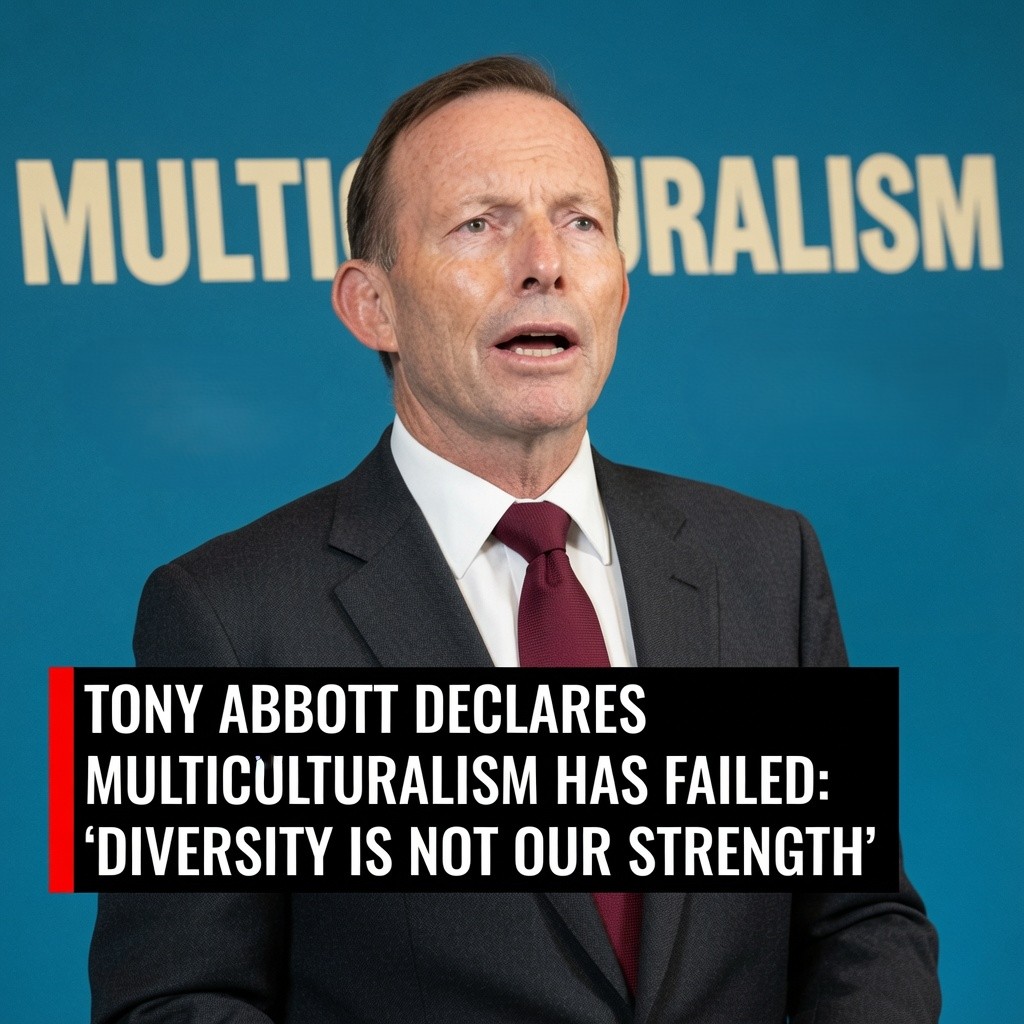
Abbott made the comments in a video shared by former deputy prime minister John Anderson, who argued Australia needed to rediscover a stronger shared national identity.
In the video, Abbott said Australia should welcome migrants who embrace the nation’s democratic values while warning that policies encouraging separate cultural identities had weakened social cohesion.
“Plainly, multiculturalism has failed and diversity is not our strength,” Abbott said.
He argued the Bondi terrorist attack should serve as a wake-up call for Australia to “celebrate diversity less and unity more” while preserving what he described as the country’s national character.
Abbott stressed that his criticism was directed at multicultural policy rather than immigration itself.
He said migrants who share Australian values strengthen the nation, but argued problems arise when newcomers fail to integrate into the broader community.
“If immigrants share our values and want to join Team Australia, our country grows stronger,” Abbott said.
“But if they just want to live in hotel Australia and take advantage of the facilities, our country becomes more fragmented and more divided.”
The former Liberal leader argued that previous generations of migrants were expected to integrate quickly into Australian society, whereas modern multicultural policies encouraged people to retain separate cultural identities for longer.
According to Abbott, Australia should remain open to people of every race and religion provided they respect the country’s democratic institutions, freedoms and laws.
He also said migration should ensure “tomorrow’s Australia” remained recognisably connected to the nation Australians know today.
Abbott’s intervention comes amid an increasingly heated national discussion over multiculturalism, immigration levels and social cohesion following recent political and security debates.
The issue gained renewed prominence after One Nation leader Pauline Hanson argued Australia should become “monocultural”, saying the nation should embrace a single unifying culture while remaining multiracial.
Her comments generated widespread political debate across Parliament and placed pressure on Opposition Leader Angus Taylor to clarify the Coalition’s position.
Initially, Taylor repeatedly declined to explicitly endorse multiculturalism when questioned by journalists, instead emphasising that migrants should share Australia’s values and obey its laws. After several days of criticism, he clarified that he supports a version of multiculturalism based on common civic values rather than what he described as Labor’s approach.
Taylor later rejected suggestions Australia should resemble a monocultural country such as Japan, saying he wanted Australia “to look like Australia” while maintaining shared national values.
Other senior Coalition figures have also offered differing perspectives.
Leadership contender Andrew Hastie criticised the idea of monoculturalism while describing multiculturalism as a politically loaded term, and senior Liberals including Andrew McLachlan and Ted O’Brien have publicly defended Australia’s multicultural character.
The debate has also highlighted differences between current and former Liberal leaders.
While Abbott argues multiculturalism has evolved into an ideology that weakens national unity, former prime minister John Howard has continued to defend Australia’s multicultural success, arguing the country has demonstrated that people from many backgrounds can integrate successfully while embracing Australian values.
Prime Minister Anthony Albanese has strongly rejected suggestions Australia should move away from multiculturalism.
He has argued Australia has “never been a monocultural society” and that successive generations of migrants have helped build the modern nation.
According to Albanese, Australia’s diversity has generally strengthened the country rather than weakened it.
The dispute reflects broader concerns about immigration, housing affordability, infrastructure pressures and community cohesion that have become increasingly prominent in Australian politics.
Opinion polling has suggested public attitudes toward multiculturalism remain generally positive but have become more divided than in previous years, particularly following debates over migration levels and national security.
Australia has operated an official multicultural policy for decades, encouraging migrants to maintain aspects of their cultural heritage while participating fully in Australian civic life.
Supporters argue the policy has helped one of the world’s most culturally diverse countries remain relatively stable despite welcoming millions of migrants from every continent.
Critics, however, argue that multiculturalism has shifted away from encouraging integration and has instead promoted separate cultural identities at the expense of national unity.
Abbott has repeatedly advanced that argument in speeches and essays throughout the past year, contending that Australia should place greater emphasis on assimilation, shared values and national identity while reducing immigration until infrastructure and social cohesion improve.
The latest intervention ensures multiculturalism will remain a central issue in Australia’s political debate as parties compete to define how the country should balance immigration, diversity and national cohesion in the years ahead.






