Labor MP Nina Taylor has defended the Victorian government’s approach to Fishermans Bend as rival candidates in the Albert Park electorate demanded faster public transport and better infrastructure for the growing inner-Melbourne precinct. The debate at a local election forum highlighted the gap between plans for a major urban renewal area and the transport connections residents and businesses can already use.
Candidates questioned why promised tram and rail links remain distant prospects despite long-running plans to accommodate substantially more homes and jobs. Taylor pointed to recent planning steps, the Metro Tunnel and expanded bus services, while opponents pressed the government to deliver infrastructure earlier. The disagreement concerns priorities, funding and sequencing; a planning announcement should not be confused with a completed railway or tram service.
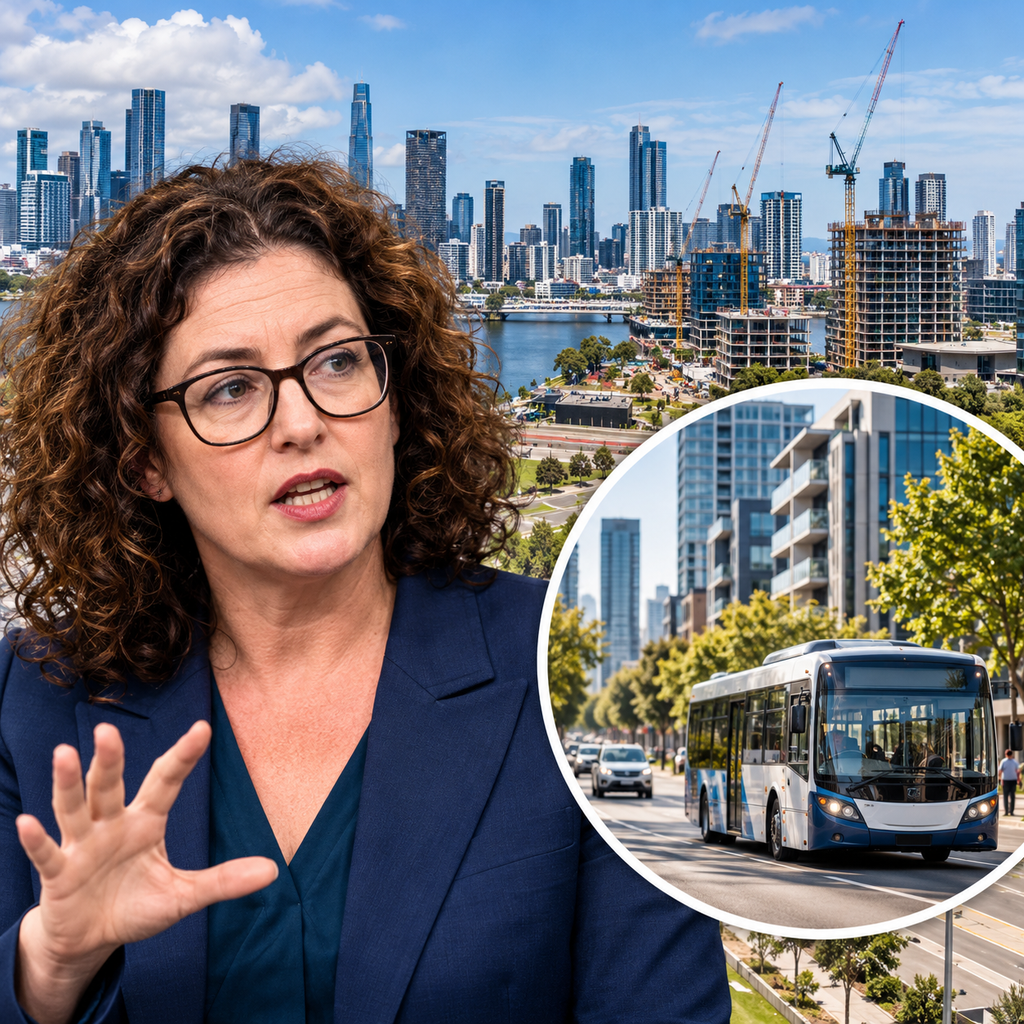
Fishermans Bend covers a substantial area close to Melbourne’s central business district, including parts of Port Melbourne. It has been presented as a major opportunity for housing, employment and urban renewal, with long-term planning aspirations for tens of thousands of residents. Those forecasts describe a possible future, not the current population or housing already delivered.
The challenge has been evident since the precinct was rezoned in 2012, a decision Taylor has criticised for proceeding without sufficient supporting infrastructure planning. Rezoning can change what is legally possible on a site, but it does not automatically create tram tracks, schools, drainage, parks or connections to surrounding streets.
For families considering a move and businesses deciding whether to invest, certainty over delivery matters as much as a vision statement. Infrastructure that arrives decades after new homes are occupied can impose real costs through congestion, longer trips and the difficulty of accessing essential services.
Taylor defended the government’s progress at the local forum and highlighted an approved development contributions plan estimated at $2.7 billion. Such a plan is designed to collect contributions from development towards local infrastructure. It is not proof that $2.7 billion has already been received, spent or committed specifically to a new railway.
Reported priorities for the plan include parks, roads, drainage and community facilities. Those projects are significant for liveability and can support a growing population. Nevertheless, they are not substitutes for the high-capacity public transport connections that candidates and local groups have sought.
Taylor also cited the Metro Tunnel and expanded bus services as evidence of transport progress. The relevant test for Fishermans Bend residents is how those broader improvements connect to their actual journeys: whether services stop where they are needed, how frequently they run and how reliable the transfers are.
At the forum, Greens candidate Sonya Semmens, One Nation candidate Tammy Lindrum and independent Adrian King were among those calling attention to delays and infrastructure gaps. Semmens supported an increase in route 606 bus services. Their approaches to funding and the precise form of new links may differ, but the concern about timeliness has been shared by more than one candidate.
The long-discussed tram connection had once been expected much sooner, while coverage of the latest debate suggests that some major rail proposals could remain years or decades away. Such forward-looking dates should be understood as estimates in political and planning debate, not confirmed opening schedules.
Residents do not have to choose between waiting for a future rail project and demanding improvements now. Frequent buses, safer walking routes, traffic management and reliable connections to existing stations can be assessed on their own merits while larger projects are still being considered.
The consequences are practical. Commuters weigh travel time and reliability against the cost of housing; a household may need to budget for a second vehicle if public transport is inadequate. Businesses depend on staff and customers being able to reach them, while construction and redevelopment can temporarily disrupt local roads.
These effects cannot be reduced to a single dollar amount for every resident. Household costs vary by location, work schedules, childcare arrangements and available transport choices. But planning uncertainty can affect real economic decisions, including whether developers proceed, retailers lease premises and families commit to living in an area.
Concerns at the forum also extended to the condition and safety of existing shopping streets, with candidates discussing reported problems around Bay Street. Those topics are relevant to the election debate but do not establish that a particular party or candidate is responsible for any specific criminal incident.
Development contributions are generally tied to an approved framework for collecting funds as building activity occurs. The headline estimate can sound like an immediately available government budget, but actual receipts depend on development and scheme implementation. Money proposed for a broad list of local infrastructure also cannot all be presented as transport funding.
That distinction is important in election coverage. Voters should be able to compare the dollar figure, the legal and administrative status of the plan, what projects it covers and the timeline for cash to become available. The same standard should apply when challengers make promises about faster trams or greater bus frequency: who will pay and which authority can deliver them?
The pause in a proposed University of Melbourne engineering campus has added to concerns about the precinct’s development momentum. The university’s separate investment decision should not be presented as proof that any individual candidate caused the pause.
The local election will not itself lay tracks or settle every contested development proposal. It can, however, create pressure for clear schedules, accountable spending decisions and realistic links between housing approvals and transport capacity.
Residents could reasonably ask all candidates for a practical programme covering bus services in the near term, design and funding milestones for proposed tram connections, and transparent reporting on the development contributions plan. An answer that identifies the responsible agency and a measurable next step is more useful than an uncosted promise.
Taylor is defending the government’s planning progress, while rivals argue residents have waited too long. With Fishermans Bend still undergoing change, the challenge for whichever politicians hold office is to turn the long-term vision into infrastructure that people can actually use.
Victorian Government information describes the Fishermans Bend Development Contributions Plan as a long-term framework for funding specified projects valued at $2.7 billion. Contributions are to be collected from new development in four residential and mixed-use precincts as building activity progresses. It is not an immediate cash grant paid into a single transport project.
The scheme replaces interim arrangements used since 2014, and it sits alongside an open-space uplift mechanism. The government says it is meant to support roads, parks, drainage, community facilities and transport connections in a coordinated way. The planning amendment implementing the scheme came into operation in early October 2026.
That date is a meaningful administrative milestone, but it does not amount to the opening of a new tram route or rail station. The distinction is important because candidates can reasonably celebrate a completed planning step while residents still ask how soon visible infrastructure will arrive.
Victoria’s official precinct update says 1,500 additional weekly bus services have been introduced on routes connecting Fishermans Bend and the city since 2022. It also describes planning to protect a possible rail alignment and progress on road-safety works. Those details offer more substance than a general claim that the government is doing nothing.
The same update says the longer-term transport vision aims for 80 per cent of movements to be made by public transport, walking or cycling. This is a planning target for the area’s eventual development, not a measured share of existing trips. Achieving it will depend on the quality of connections built as the precinct grows.
The update points to thousands of dwellings built or under construction and a larger pipeline of prospective housing. A pipeline is not a completed supply of homes, however, and projected jobs are not current local employment. Each figure helps explain why future transport demand is expected to rise, provided it is labelled accurately.
The Victorian Auditor-General examined the development of Fishermans Bend in a report tabled in June 2025. The audit provides a separate basis for assessing planning and delivery beyond candidate statements. It also shows why coordination across government, councils and private landowners is central to a project of this size.
Most of the land is privately owned, while infrastructure responsibilities are spread across different public bodies and private developers. That makes delivery harder to communicate: a government may approve planning controls, a council may deliver local facilities, and a transport agency may be responsible for a future connection. Residents still experience the neighbourhood as one place.
An accountable programme therefore needs a shared public schedule and a transparent way to report what has been completed, what remains unfunded and which bodies are responsible. Without that, different candidates can cite different milestones and all appear partly correct while residents remain unsure when their journey to work will improve.