Opposition Leader Angus Taylor has called for Energy Minister Chris Bowen to resign after Snowy Hydro revised the cost and completion forecast for Snowy 2.0, reviving a political argument over who is responsible for one of Australia’s most expensive energy projects. The company’s updated target is $22.2 billion, with an allowance for a cost of up to $25 billion, while commissioning is now expected in late 2029.
The latest assessment is a major test for the Commonwealth-owned company and for governments of both political persuasions. Taylor was energy minister when the project was approved under the Coalition. Bowen, who oversees the project as a shareholder minister under Labor, says the early design and engineering assumptions left a lasting problem. Neither side’s political account changes the figures Australians now need to assess.
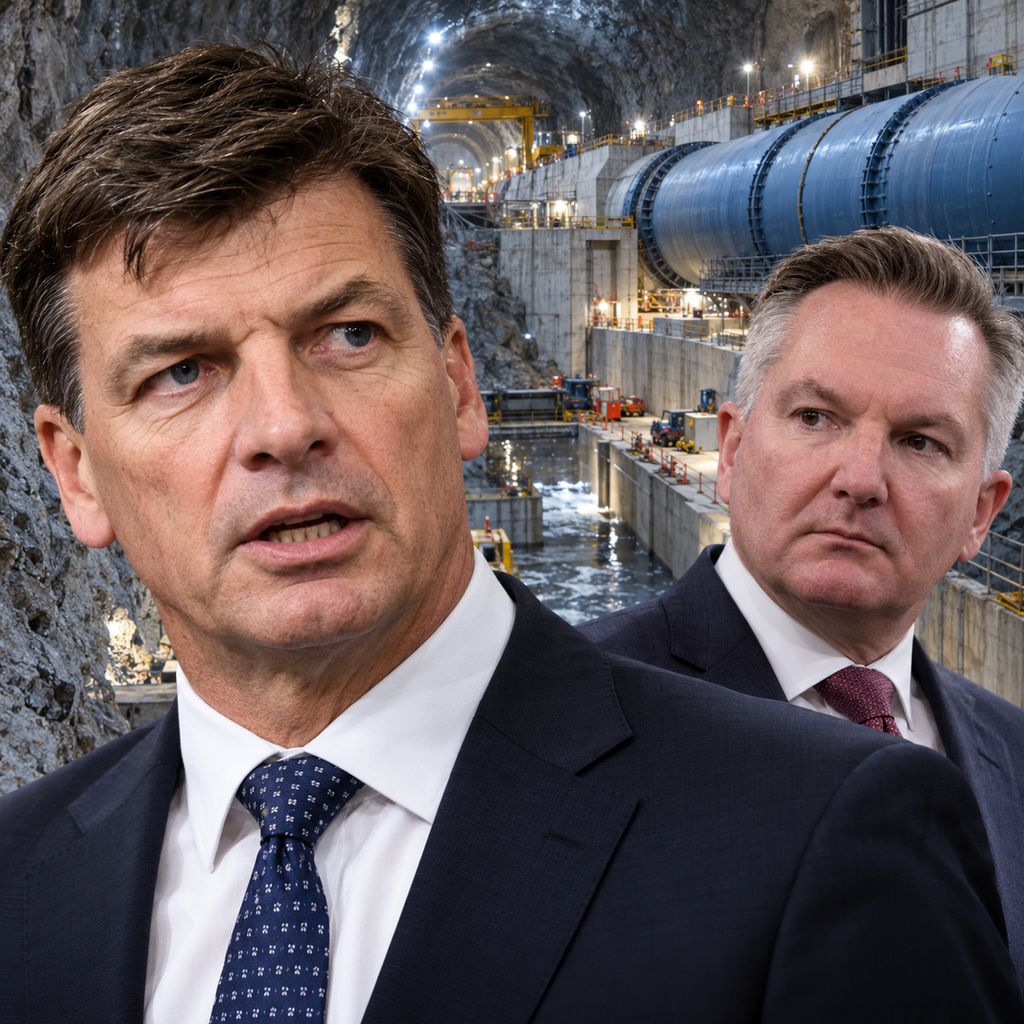
Snowy Hydro’s revised advice distinguishes the target cost-to-complete from an allowance for uncertainty. The $22.2 billion target is not a declaration that every dollar has been spent, and the $25 billion allowance should not be reported as a settled final price. A credible account must keep those concepts separate, just as it must distinguish projected commissioning from actual electricity supplied.
The project’s original public pitch carried an estimate of about $2 billion and an expected 2021 start date. Subsequent reviews, contract changes and difficult construction conditions transformed that outlook. The difference is substantial, but comparing figures from different stages also requires noting changes in the scope of design, what costs were included and the level of detail available at the time. A headline number without that context can mislead in either direction.
The new forecast has also displaced the $12 billion target established during the 2023 project reset. For taxpayers the immediate question is not simply why the project costs more, but what further Commonwealth funding, financing or risk support might be needed before it begins operating.
Taylor told reporters Bowen should lose his job and rejected the suggestion that he himself should take responsibility for increases in the project’s cost. He defended the decisions made when he was energy minister, directing attention to the management of Snowy 2.0 under Labor. That is the opposition leader’s political assessment, not an independent finding about the causes of the overrun.
Bowen has acknowledged the cost increase while accusing the Coalition of overlooking the project’s earlier design weaknesses. He has argued that the engineering and geological problems made construction much more expensive than first anticipated. The government points to design immaturity when the project was initiated, although the 2023 contract reset and subsequent decisions occurred while Labor held office.
Those positions are not mutually exclusive. An initial project can have been approved using inadequate information, and later management decisions can also deserve examination. Responsibility may be distributed across the company, its board, contractors and ministers at different points. Assigning blame accurately requires procurement records, engineering evidence and audit findings, not simply the loudest exchange at a press conference.
Snowy 2.0 is designed to pump water uphill when electricity is plentiful and release it through turbines when the grid needs supply. That makes it storage rather than a new source of fuel. Its value depends on its ability to operate reliably, the price difference between pumping and generating, and the capacity of the surrounding network to move electricity where it is required.
Building a large underground power station through complex geology exposes contractors and owners to conditions that may not be fully understood until excavation progresses. Tunnel productivity, ground support, water management and plant installation have all been central to the public debate about the project’s schedule. Snowy Hydro chief executive Dennis Barnes has said the early complexity was not fully understood and that much of the excavation is now behind the project.
The company says future work is more predictable than earlier tunnelling, while still complex enough to justify contingency. That is a management forecast that should be tested against milestone reporting. It is not a guarantee that there will be no more delays.
In 2023, Snowy Hydro renegotiated arrangements with its principal construction contractor. Instead of relying on the previous fixed-price structure, the parties adopted a model that shared the costs of completing the work. Coalition figures have argued that the change weakened discipline and contributed to higher forecasts. Bowen rejects the suggestion that the revised structure alone caused the blowouts.
A fixed-price contract is not automatically a shield against all cost increases. Where design is incomplete or conditions differ sharply from initial assumptions, the parties can become locked in costly disputes that threaten delivery. Conversely, a shared-cost model can expose the owner to greater variations unless performance incentives, cost verification and oversight are strong. The public-interest question is whether the chosen arrangement reduced total expected loss compared with workable alternatives.
That assessment is harder when the full financial and contractual record is not visible to the public. Parliament, auditors and the company’s shareholder ministers can examine the assumptions behind the revised forecast without pretending commercial sensitivity excuses every gap in accountability.
Government ownership means the financial risk is ultimately a public concern, even if the money does not arrive as an immediate surcharge on household energy bills. Funding decisions can affect public debt, dividends, investment priorities and the resources available for other services. The precise effect on individual power prices, however, cannot be calculated from the construction forecast alone.
Australians should expect clear reporting on the current target and contingency, the delivery milestones that will test the schedule, and the future cost of operating the asset. Independent modelling of system benefits should be examined alongside the capital required to secure them. Claims that Snowy 2.0 will either solve household bills or provide no value at all go beyond what the cost update establishes.
Taylor has made Bowen’s ministerial responsibility the immediate political battleground; Bowen has responded by reaching back to the project’s beginnings. The harder task for both sides is to explain how an asset regarded as strategically valuable can be completed at a credible cost, with measurable oversight and without another surprise for the public.
The Australian National Audit Office examined Snowy 2.0 in a performance audit published in June. It concluded that Snowy Hydro’s management had been partly effective and identified shortcomings in governance, cost forecasting, quality control and performance management. The audit was completed before the latest cost update, so it should be read as an assessment of the systems then in place rather than as a formal audit endorsement of the new figure.
The audit reported project expenditure of $11.1 billion as at 31 March, when the company assessed the project at about 73 per cent complete. Neither number should be confused with the total revised estimate. Expenditure measures money already incurred at a particular date; project completion depends on how progress is measured; the forecast concerns what remains to be done and the risks around finishing it.
Five recommendations were made, and Snowy Hydro agreed with four while partly agreeing with the fifth. The audit also highlighted the need for stronger assurance about contractor forecasts, project scheduling and whether incentive arrangements were achieving their purpose. Those findings provide a more precise basis for assessing management than simply attributing every additional dollar to one minister.
In its fresh announcement, Snowy Hydro said machine tunnelling was 65 per cent complete and excavation of the underground caverns 90 per cent complete. Those are important construction milestones, but neither figure means the whole asset is 65 or 90 per cent ready to generate power. Turbines, electrical systems, connections, commissioning and remaining construction work still matter.
The company also said it was strengthening oversight, project controls and leadership to improve productivity while prioritising safety. These are steps that should be assessed against independently verifiable indicators: progress against a baseline schedule, performance of individual contractors, variation claims and the effective use of contingency.
The longer a megaproject runs, the more complex the distinction between financial and physical progress becomes. Completing a particularly difficult tunnel segment may remove a disproportionate amount of future risk, while comparatively small outstanding works can still delay testing and the commencement of commercial operations. Public reporting should make those differences intelligible.
Snowy Hydro says the completed project will supply long-duration storage equivalent to around 26 million home batteries and that analysis supports substantial economic benefits. The company has also pointed to modelling suggesting wholesale electricity price benefits over the life of the asset. These are forecasts and modelling claims, not realised savings already received by households.
Any assessment of value for money must consider both sides of the ledger: future system benefits and the full cost of delivering and financing the asset. The economic effect can depend on electricity demand, the retirement of ageing generation, transmission capacity, alternative storage options, maintenance and wholesale market conditions.
A significant infrastructure investment can be valuable while still having been approved or managed poorly; conversely, serious budget overruns do not alone prove that a completed asset will provide no useful service. The immediate political challenge is to secure reliable evidence about both issues and allow Parliament and the public to compare them without treating optimistic modelling or partisan criticism as settled fact.