Communications Minister Anika Wells and shadow communications minister Sarah Henderson are arguing over how far Australia should go in making digital platforms responsible for the harm people encounter online. Wells presents the proposed Digital Duty of Care as a way to require technology companies to identify and reduce foreseeable risks. Henderson warns that parts of the scheme remain too broad and could threaten lawful speech. Their disagreement is a genuine clash over the design of public regulation, but the Coalition’s criticism of censorship is a political claim, not proof that the bill has already censored anyone.
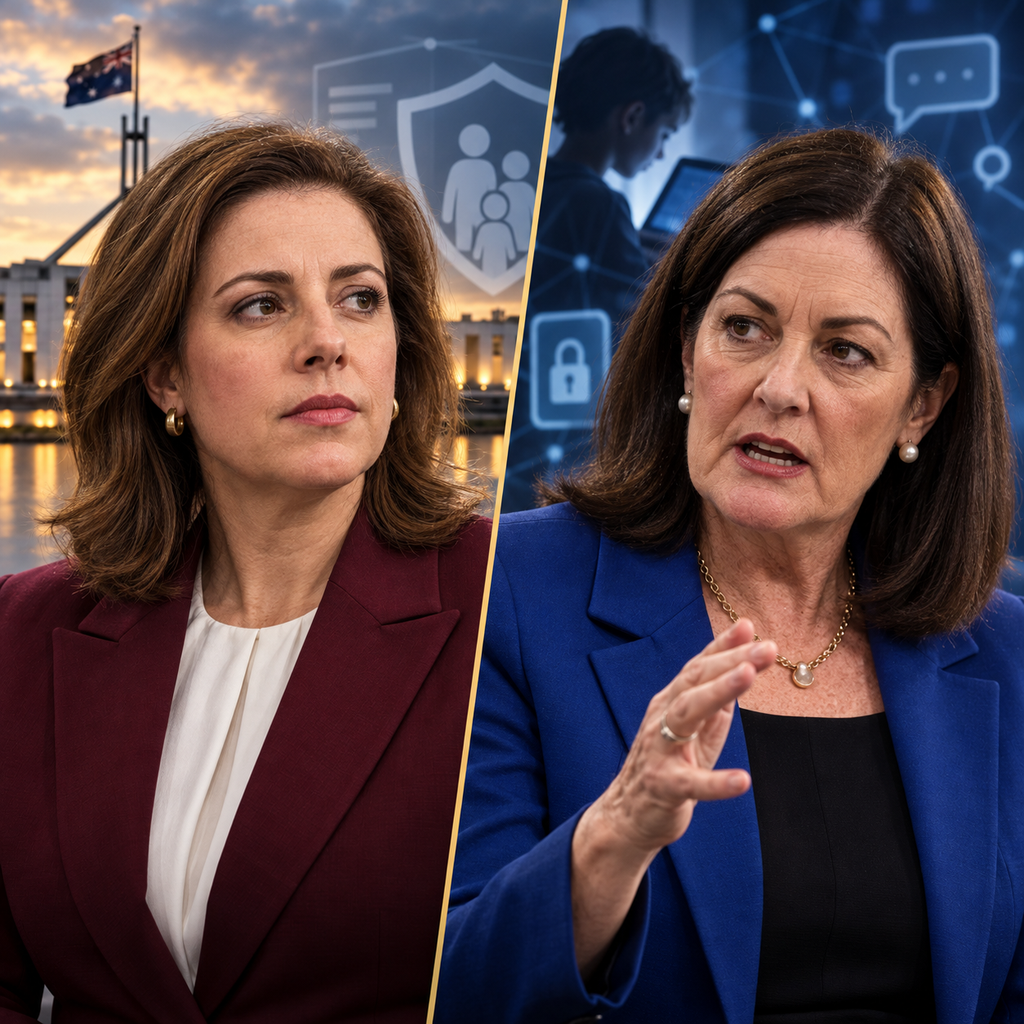
The government has introduced legislation intended to change the responsibilities of online services. Rather than relying entirely on responses after harmful content circulates, its approach would require covered platforms to assess risks and take proportionate preventive measures. The concept draws on a familiar regulatory principle: a company offering a service should consider whether the design and operation of that service can create foreseeable harm. Applying that principle to social media, search, applications and other online spaces is difficult because digital services are diverse and the boundary between harmful conduct and lawful expression can be contested.
Henderson has rejected the government’s assurances that revised wording solves those problems. She has criticised definitions she considers vague, questioned safeguards around research accounts and objected to the possibility of official intervention affecting public debate. Her position is that protecting people online should not give government or regulators an unjustifiably wide role in deciding what can be seen. Those concerns deserve examination on their specific merits. They do not, by themselves, establish that every tool proposed by the legislation would be unlawful or that officials intend to silence political opponents.
Wells has made changes in response to criticism. The government dropped a contentious proposed ministerial power to designate additional categories of online harm and strengthened protections for journalistic material. Those revisions are relevant because an article based on an early exposure draft could exaggerate powers no longer present in the version before Parliament. The Coalition remains opposed despite the concessions, while the Greens have pressed for stronger rights and penalties. The current debate is therefore not simply a choice between leaving the internet untouched and giving a minister unrestricted control.
One major provision would require online services to undertake annual risk assessments. Supporters say this could force companies to think systematically about harms before they become individual crises. Critics ask whether the obligation would be clear, enforceable and proportionate for different types of platforms. A large social network with sophisticated recommendation systems does not have the same risk profile or resources as a small local business with a basic website. The government has said low-risk services should face minimal obligations, but businesses will reasonably want the practical rules explained before they must comply.
The design of recommendation algorithms is central to the argument. Users often receive material selected by platforms rather than chosen directly by them. Campaigners argue that people should be able to turn off personalised recommendations and exercise more control over what fills their feeds. That idea does not necessarily ban algorithms or prevent organisations from publishing lawful material. It changes the degree of choice a user has about automated selection. Its value and workability depend on the precise rights created, how the choices are displayed and whether companies comply in practice.
The proposed use of so-called sock puppet accounts has attracted particular attention. Regulators and accredited researchers could use accounts that do not identify themselves openly to observe what an ordinary user might encounter. Supporters regard that as a practical way to test systems that may behave differently under scrutiny. Henderson and others have questioned the safeguards and the possibility of intrusion. It is important to distinguish accounts used for authorised monitoring from a claim that officials would have unlimited permission to impersonate or harass people. The scope, oversight and restrictions of the power are the material questions.
Another contested issue is the treatment of journalism and material in the public interest. The government says it has improved protection for reporting, while Henderson has asked how broad exemptions would operate and who would decide what qualifies. This is not an incidental drafting matter. News reporting often includes distressing facts, allegations and graphic descriptions that are essential to understanding public events. Regulation that pressures companies to remove lawful reporting could restrict the public’s access to important information. Equally, an exemption that is too loose could become a route for genuinely harmful content to evade oversight. Both risks require careful legislative drafting.
The government is also considering stronger pathways for individuals harmed by online platforms to take legal action. Wells has indicated a willingness to discuss a private right of action, an idea sought by the Greens. That could allow some affected users to pursue remedies rather than relying only on enforcement by a public regulator. It would also raise questions about cost, evidence, legal thresholds and whether ordinary people could realistically use the system. A potential right to sue should not be confused with a right already enacted or with a guarantee that any complaint would succeed.
Penalties form another area of disagreement. The Greens argue that sanctions must be large enough to influence global technology companies. Supporters fear that ordinary fixed penalties may be treated as a manageable business expense by firms with enormous revenue. Critics may ask whether escalating fines create pressure to remove lawful speech out of caution. The answer depends on the particular legal test, review mechanisms and procedural rights, not merely the size of a headline number. A deterrent can be powerful and still require robust protections against error.
The debate is inseparable from the scale of online harm, especially for young people and women. Campaigners have described problems involving image-based abuse, threats and material that exploits vulnerable users. The government argues that platform architecture can amplify those problems. People who have experienced digital abuse may welcome a system that requires companies to anticipate risk, while users concerned about free expression may worry about opaque moderation decisions. These concerns are not mutually exclusive. A law can be judged on whether it improves safety while retaining the transparency and safeguards necessary in a democratic society.
Questions about enforcement go beyond the proposed powers on paper. If duties are broad but the regulator lacks staff, technical expertise or access to information, compliance may become a paperwork exercise. If enforcement is too unpredictable, services may overreact and remove content without meaningful appeal. Transparent guidance, proportionate obligations, public reporting and review rights can therefore matter as much as ambitious legislative language. Both Wells and Henderson should be assessed on the mechanisms they propose to make their preferred balance workable, not only on their warnings about the alternative.
The Senate inquiry is an important part of the process. It provides an opportunity for legal experts, service providers, child protection advocates, journalists and members of the public to test the bill’s wording. The government has already changed elements of its proposal, which demonstrates that the text is not beyond amendment. Parliamentary scrutiny should concentrate on what remains and what the alternative would be if the bill failed. Simply calling the measure a safety law does not prove every clause is proportionate. Calling it censorship does not prove that the revised protections are meaningless.
Henderson’s position carries its own policy test. Opposition to the current proposal leaves open what measures the Coalition believes are sufficient to require technology companies to reduce foreseeable harm. Existing laws and eSafety mechanisms already play a role, but the government’s case is that the current system leaves preventive gaps. An effective alternative would need to identify which risks can be handled under existing powers, where voluntary standards are adequate and what should happen when major platforms repeatedly fail vulnerable users. That is the substantive counterargument the public should be able to evaluate.
Wells faces an equally demanding test. The government needs to show that an obligation framed around prevention can be described clearly enough for companies and courts to apply. It must explain which platforms are covered, how duties change according to risk, what conduct triggers sanctions and how independent oversight works. Promises that no one should fear the bill cannot replace precise legislation. A digital safety rule that succeeds only by encouraging platforms to suppress legitimate debate would carry costs the public has a right to weigh.
For a household using social media every day, the issue can seem abstract until a harmful post spreads or an account is suspended without explanation. The challenge is to build rules that offer recourse in both situations. Someone targeted by abuse wants the platform to respond; someone whose lawful views are removed wants fair treatment and a way to appeal. A well-designed system should not ask the public to choose which of those experiences matters. It should define responsibilities and protections that can be scrutinised when companies or regulators get it wrong.
The parliamentary contest remains unresolved. Wells has narrowed contentious powers and argued for tougher prevention standards. Henderson says the draft still poses unacceptable risks to freedom of expression. Greens demands add another negotiating dimension. The measure is proposed legislation under scrutiny, not an established system whose outcomes can already be measured. The useful question is whether the final text can make online services safer without granting sweeping, poorly checked control over legitimate public discussion. That is the standard on which both the government’s reform and the opposition’s objections should ultimately be judged.






