A Victorian dispute over alleged corruption in major construction projects became intensely personal when Anthony Carbines dismissed the findings of barrister Geoffrey Watson SC as “florid ramblings”, prompting Watson to accuse ministers of attacking him rather than confronting the substance of his concerns. The argument offers a window into a larger accountability problem: how governments should answer damaging allegations without treating every unproven estimate as an established loss to taxpayers.
Carbines was Victoria’s police minister when he made the remarks under then-premier Jacinta Allan. His later move to a different portfolio under Premier Ben Carroll does not change the record of what he said, but it matters when identifying his role. Watson had been examining alleged criminal influence and misconduct associated with the construction division of the CFMEU and major public infrastructure projects. The political row followed publication of highly critical material from that work.
Watson’s report described allegations of intimidation, criminal influence and failures of oversight on major construction projects. It also linked disputed practices to an estimate of about $15 billion in cost blowouts. That number became one of the most contentious parts of the debate. It was not an audited calculation of money stolen, a court finding of corruption worth $15 billion, or proof that a named person had committed a criminal offence.
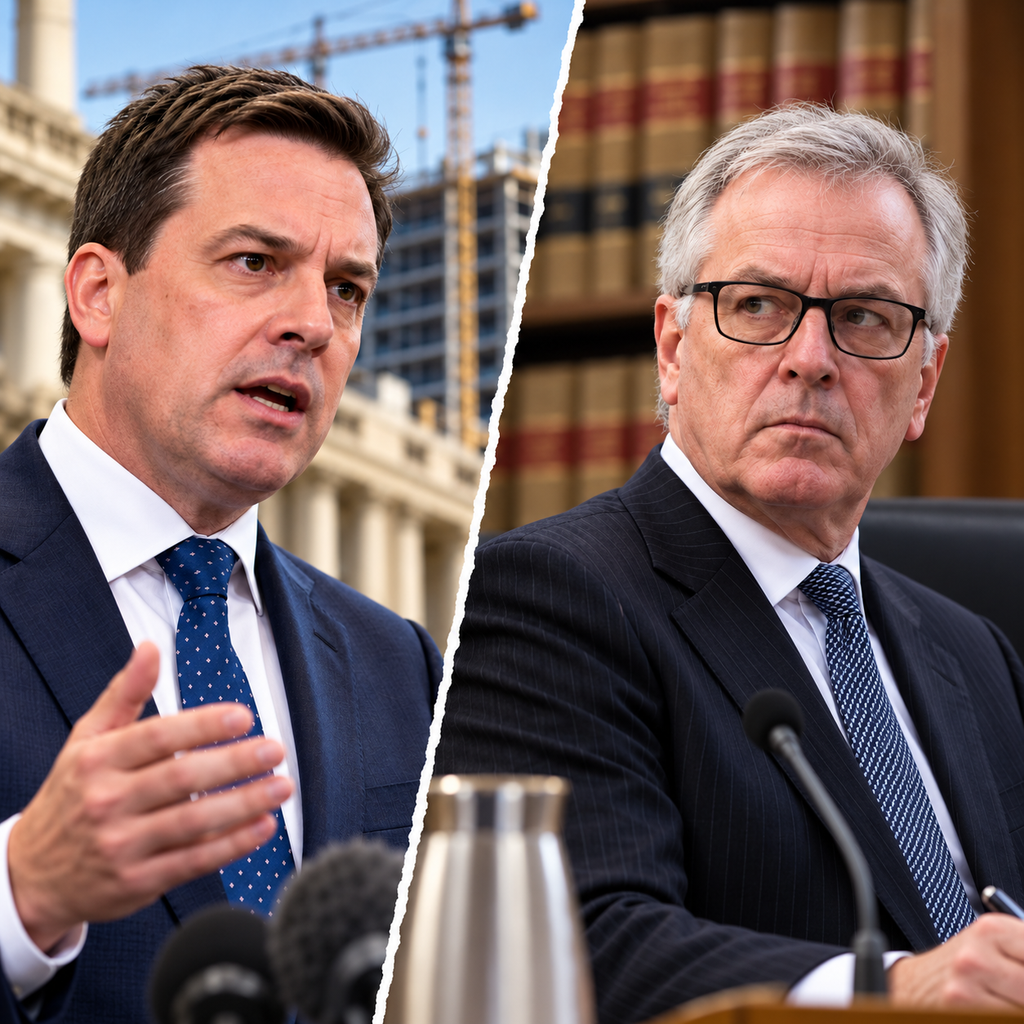
Carbines disputed the strength of Watson’s evidence in unusually personal terms. ‘There’s a lot of florid ramblings from Mr Watson but not a lot of evidence,’ he told reporters, according to AAP. He also said Watson ‘might be good for a quote’ but was not good at producing facts. Those remarks put the barrister’s credibility at the centre of the story and raised the stakes of the government’s challenge to the report.
Watson answered the personal attack directly. He told AAP he was especially disappointed that ministers had used such language without contacting him to ask how the report was prepared or what evidence lay behind it. He said the government appeared more willing to attack him than address the problem he had identified. The exchange was a genuine disagreement between identifiable people, separate from the still-unresolved question of how much alleged misconduct could be substantiated.
The disagreement was especially sensitive because construction spending involves public money on a vast scale. Roads, tunnels, rail projects and other infrastructure can improve productivity and mobility, but their costs are carried by taxpayers. When a significant estimate of possible waste appears, the number attracts understandable attention. It is precisely because the figure is so large that its evidentiary basis needs to be examined carefully rather than accepted or rejected for partisan convenience.
The evidence behind the claims
Independent CFMEU administrator Mark Irving KC expressed doubts about the foundation for elements of Watson’s report, including aspects of the large financial estimates. Parts of the document were redacted, and material was also referred to authorities. That intervention gave the government a substantive reason to press for better evidence. It did not establish that every allegation of improper conduct was unfounded, nor did it establish that the disputed dollar figure was correct.
The competing claims require different answers. A minister can question methodology and the reliability of a large cost estimate. An investigator can demand a response to allegations about procurement and union influence. Courts, regulators and independent inquiries must establish the facts through evidence rather than rhetoric. In this case the public dispute over Watson’s language and Carbines’s response was sharp, while the underlying allegations remained matters for investigation and scrutiny.
Then-premier Allan defended the government’s handling of information concerning potential misconduct. She said allegations brought to her attention had been referred to the Independent Broad-based Anti-corruption Commission, Victoria Police and other relevant bodies. In a separate controversy, questions emerged about whether IBAC’s jurisdiction covered contractors or third parties involved in some of the alleged conduct. A referral and a later jurisdictional barrier are not proof that an allegation was true or that a minister deliberately frustrated scrutiny.
The jurisdiction question deserves attention because major projects can involve many layers of contractors, subcontractors, unions, officials and private businesses. A watchdog may have authority over one category of conduct but not another. Investigators can face practical barriers even when information appears serious. That is an argument for examining the system’s powers and coordination rather than treating the existence of a referral as a complete answer to every concern.
Opposition figures called for stronger independent scrutiny, including a royal commission. Their demands were political proposals, not findings against the government. Supporters of such an inquiry argued that only an extensive investigation with appropriate powers could establish the scale of any misconduct. Critics questioned whether a new inquiry would duplicate existing investigations or confer unwarranted credibility on contested claims. Those competing positions turn on evidence, scope and the powers available to investigators.
The $15 billion estimate deserves particular care. A project running over budget can do so for many reasons, including inflation, changed design, ground conditions, labour costs, delays and procurement choices. Criminality or corruption may be a factor in some circumstances, but the total amount of a cost overrun cannot simply be relabelled as money lost to criminal activity. Establishing a causal link would require detailed evidence about specific contracts, decisions and expenditures.
The minister’s language drew attention precisely because it was more personal than a conventional statement about the report’s methodology. Carbines could dispute Watson’s calculations and evidence without resolving the underlying allegations. Watson’s response turned the focus back to whether public agencies had taken sufficient action. That left Victorians with two questions: what did the material actually prove, and how thoroughly had the responsible institutions tested it?
Watson, for his part, faces the ordinary discipline that should apply to anyone making grave public allegations. It is not enough to say that an issue is too important to ignore. Evidence must be identified, witnesses assessed and competing explanations considered. A report written for public debate may operate differently from a prosecution brief, yet the seriousness of the claims increases the obligation to be precise about what can and cannot be established.
What scrutiny could establish
There are obvious consequences for businesses and workers. Legitimate construction companies need fair access to contracts, employees need safe workplaces, and taxpayers need reasonable assurance that funds are spent for their intended purpose. If intimidation or improper influence affects procurement or site management, it can distort competition. But suggesting such risks exist is not the same as concluding that every union member, contractor or government official is implicated.
The role of independent watchdogs adds another dimension. AAP separately reported concerns from Victorian integrity bodies about opaque budget arrangements and the independence of their funding. Those institutional issues do not prove Watson’s allegations, but they illustrate why public confidence depends on investigators being able to ask difficult questions without needing approval from the subjects of scrutiny. Stable funding and clear jurisdictional rules are part of that confidence.
The state government has since changed leaders and portfolios, so the confrontation belongs to the administration in which Carbines held the police brief. Later developments in construction oversight deserve separate examination. The durable issue is whether credible allegations about public projects can be investigated promptly, whether disputed estimates are corrected openly and whether responsible officials can explain the action taken without making an investigator’s personality the whole story.
A useful test of public accountability is whether institutions can separate three tasks: investigating specific wrongdoing, calculating any financial cost, and deciding whether oversight arrangements should change. Each requires different evidence. Political language can bring attention to all three, but it cannot perform any of them. The truth of an allegation is not settled by a minister’s rejection or an investigator’s insistence.
Procurement controls are a practical place to test whether the state has learned anything from the controversy. Public works contracts commonly involve layers of tendering, subcontracting and variation claims. Each layer can create opportunities for weak oversight if records, conflicts of interest or responsibility are unclear. Auditors can examine whether contracts were competitively awarded, whether variations were justified and whether unusual payments were escalated. Such examination may reveal poor administration without necessarily establishing a criminal offence.
If questionable payments are identified, taxpayers may want to know whether any money can be recovered. The answer would depend on particular contracts, the evidence and the legal remedies available. A disputed estimate of potential waste does not automatically become a recoverable debt. Public agencies may need to review variations, procurement decisions and payment records before deciding whether legal or commercial action is possible.
Leadership and portfolio changes have also altered the political actors responsible for answering questions about Victoria’s construction sector. Carbines’s words can be examined as a recorded intervention by the police minister at that point; later ministers cannot automatically be assumed to endorse his phrasing. Watson’s report, the administrator’s qualifications and any referrals remain distinguishable elements of the same accountability dispute.
Carbines and Watson clashed in public, but neither man’s forceful language can resolve allegations involving contracts, union activities and government oversight. The disputed cost estimate requires its own accounting. Claims of criminal influence require investigation and, where charges result, proper court processes. Victorian taxpayers have a direct interest in both. A credible response depends on evidence that can be tested — not the volume of a political rebuttal.






