Residents and community leaders in Victoria’s Wimmera are calling for a 24-hour mental health facility in Horsham, arguing that people in crisis should not have to travel hours to Ballarat for inpatient care and specialist treatment.
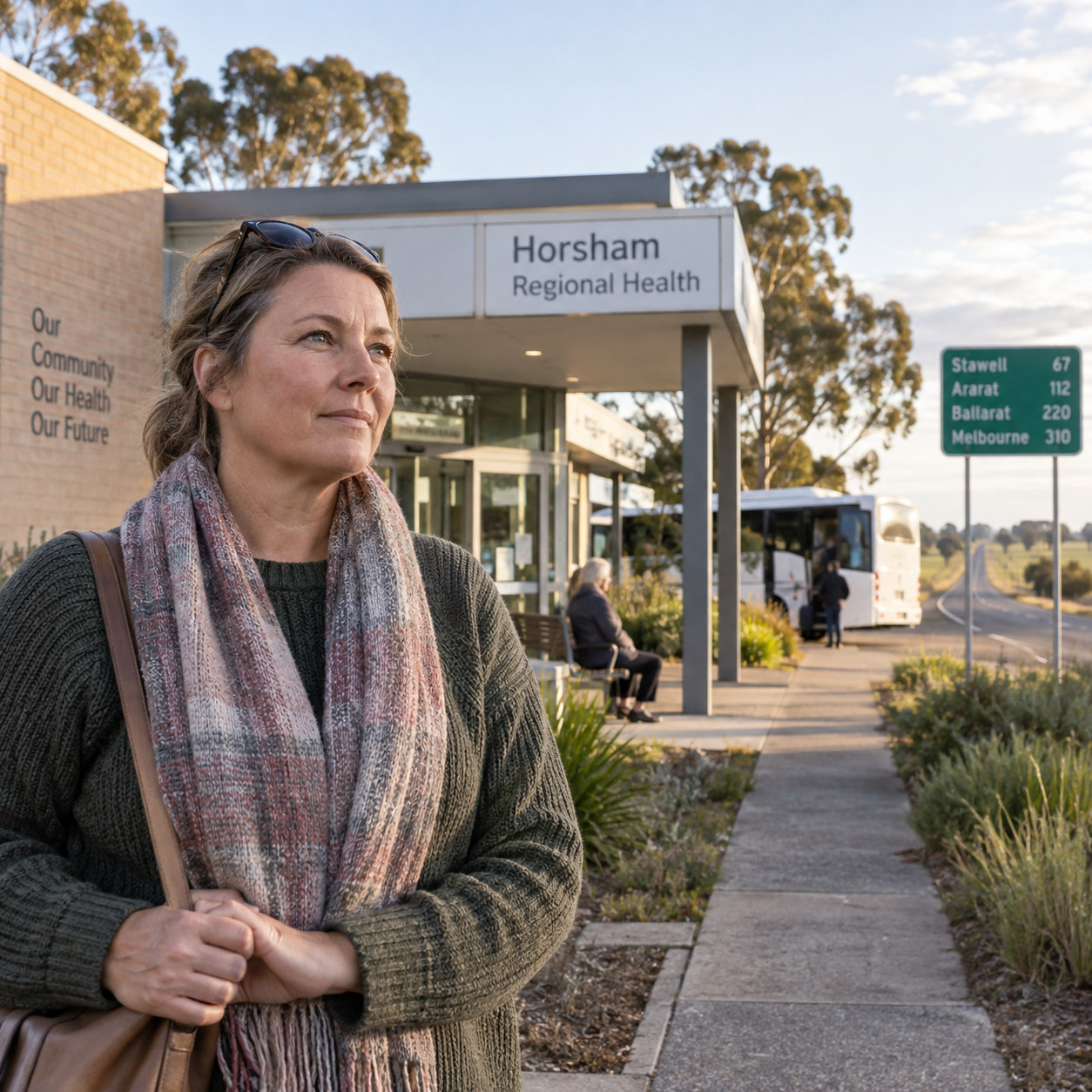
Horsham is the largest population centre and referral hub in the Wimmera, but it does not have a local mental health inpatient unit.
ABC Wimmera reported that some residents regularly make a five-hour round trip by public transport to access treatment in Ballarat.
Grampians Health says there are currently no confirmed plans for a new 24/7 inpatient mental health facility in Horsham.
That makes the story a campaign for expanded local services, not an announcement that a facility has already been approved.
A five-hour trip for treatment
Horsham mother Stacey Kelly told the ABC she has regularly travelled to Ballarat for mental health treatment since 2022.
The trip can take about five hours return on public transport, turning an appointment into an all-day commitment.
Kelly said the treatment she requires is not available in her home region.
She has described the broader cost in practical terms: time away from work, distance from family and friends, travel expenses and the disruption that comes from needing care far from home.
Her experience illustrates a problem that can be hidden by statewide service statistics. A service may technically exist within a health network, but distance and transport can make access much harder for regional patients.
Horsham has no local inpatient unit
The acute mental health inpatient bed base for the region is in Ballarat, about two hours by road from Horsham and farther again for people living in smaller Wimmera communities.
For patients who need admission, that can mean being transported away from their support networks.
Horsham Rural City Council is pushing for a local 24/7 service.
Mayor Brian Klowss told the ABC that about 400 people from the Wimmera are admitted or transported to Ballarat Hospital each year for mental health-related issues.
The council argues that the scale of demand justifies a stronger local response.
After-hours care is a key concern
The gap becomes more visible outside normal business hours.
According to the ABC report, a person presenting to the Wimmera Base Hospital emergency department after hours with a mental health issue may not have a mental health-qualified clinician physically present in the emergency department.
The likely pathway can involve telephone triage based in Ballarat.
Telephone support can be an important part of a regional system, but local advocates argue it is not equivalent to having specialist assessment and inpatient capacity available close to home.
For someone in severe distress, long transport distances can also place pressure on families, ambulance services and hospital staff.
The region’s data adds weight to the campaign
Mental Health Victoria chief executive Phillipa Thomas told the ABC that parts of the Wimmera show particularly high levels of mental health distress and illness compared with the state more broadly.
Data cited from a Western Victoria Primary Health Network report showed emergency department presentations for mental and behavioural disorders in Horsham at 2.15 times the Victorian average.
The ABC also reported that avoidable deaths from suicide and self-inflicted injuries in the Wimmera over the five years to 2021 were significantly higher than the state average.
Those statistics do not prove that one new inpatient unit would solve the region’s mental health challenges.
They do support the argument that service planning should take account of the Wimmera’s specific level of need and its geographic isolation.
Regional access is about more than the number of beds
A mental health system includes community services, crisis assessment, outpatient treatment, inpatient beds, rehabilitation, primary care and support after discharge.
Building an inpatient unit without enough psychiatrists, nurses, allied health workers and community follow-up would not by itself create a complete service.
That is why advocates are calling for broader investment as well as physical infrastructure.
Regional workforce shortages can make service expansion difficult. Health systems may have funding for positions but struggle to recruit and retain specialist staff outside major cities.
Telehealth can extend specialist expertise, but it cannot replace every form of face-to-face assessment, treatment or inpatient care.
What the health service says
Grampians Health has acknowledged continuing demand in the Wimmera but says there are no confirmed plans for a new round-the-clock inpatient facility in Horsham.
The Victorian government says people in the region can access crisis assessment, treatment and other supports through the Grampians Mental Health and Wellbeing service.
Those existing services are important context because the Wimmera is not without mental health support.
The dispute is about whether the current mix and location of services are sufficient for the level of demand and whether people who need inpatient or specialist treatment should have to travel to Ballarat.
There has been discussion of more local capacity before
Regional health planning has previously considered expanding mental health capacity in Horsham.
Earlier Grampians Health planning material discussed options including a small acute mental health service in Horsham alongside stronger community services.
That earlier planning should not be confused with a current construction commitment.
The latest position reported by Grampians Health is that there are no confirmed plans for a new 24/7 inpatient facility.
The difference between a planning concept and a funded, approved project is important for residents who have heard proposals over many years.
Distance changes the real cost of care
For people in metropolitan areas, specialist treatment may involve a short drive or public-transport trip.
In the Wimmera, the same appointment can require hundreds of kilometres of travel.
That creates costs that do not always appear in health budgets: fuel, fares, accommodation, time off work, childcare and the need for relatives or carers to travel.
Patients admitted away from home can also lose day-to-day contact with the people who normally support them.
For some families, those barriers may make it harder to seek help early, increasing the risk that problems become more severe before treatment is accessed.
Why Horsham is the focus
Horsham functions as the Wimmera’s main regional centre.
It already provides a range of health services and is a natural referral point for surrounding towns.
Supporters of a 24/7 mental health facility argue that locating capacity there would reduce the distance many Wimmera residents need to travel and create a stronger local hub for crisis response and inpatient treatment.
It would not eliminate travel for every specialist service, particularly for highly complex cases, but advocates say it could close a major gap between community care and distant inpatient beds.
The case for investment must still answer practical questions
If the state government were to consider a facility, planners would need to determine how many beds are justified, what clinical model should operate, how staffing would be sustained and how the service would connect with Ballarat and local community providers.
They would also need to decide whether a standalone inpatient unit, a smaller short-stay model or an expanded integrated mental health hub would best meet local demand.
Those decisions require detailed clinical and workforce planning as well as capital funding.
The current campaign establishes the need residents and advocates see; it does not settle which service model would be most effective.
A broader rural-health question
The Horsham debate reflects a recurring challenge across regional Australia.
Centralising specialist services can make it easier to maintain experienced teams and a full range of clinical expertise.
But centralisation also shifts the burden of distance onto patients.
When travel times become very long, a service that is efficient at a system level may still be difficult to access in practice.
The policy challenge is finding the point where population size, clinical need and distance justify more local capacity.
What happens next
Horsham Rural City Council, residents and mental health advocates are continuing to push for investment.
There is currently no confirmed commitment for a new 24/7 inpatient facility in Horsham, so any claim that construction is about to begin would be premature.
The next meaningful development would be a formal Victorian government decision, funded health-service plan or announced project that identifies the model, location, staffing and timetable.
Until then, Wimmera residents who require inpatient treatment may continue to depend on services based in Ballarat.
For families making repeated long trips, the debate is not an abstract argument about regional planning. It is about whether specialist mental health care can be available closer to the communities that need it.