Australia has formally launched its campaign for a non-permanent seat on the United Nations Security Council for the 2029–30 term, beginning a diplomatic contest that will be decided by a vote of the UN General Assembly in 2028.
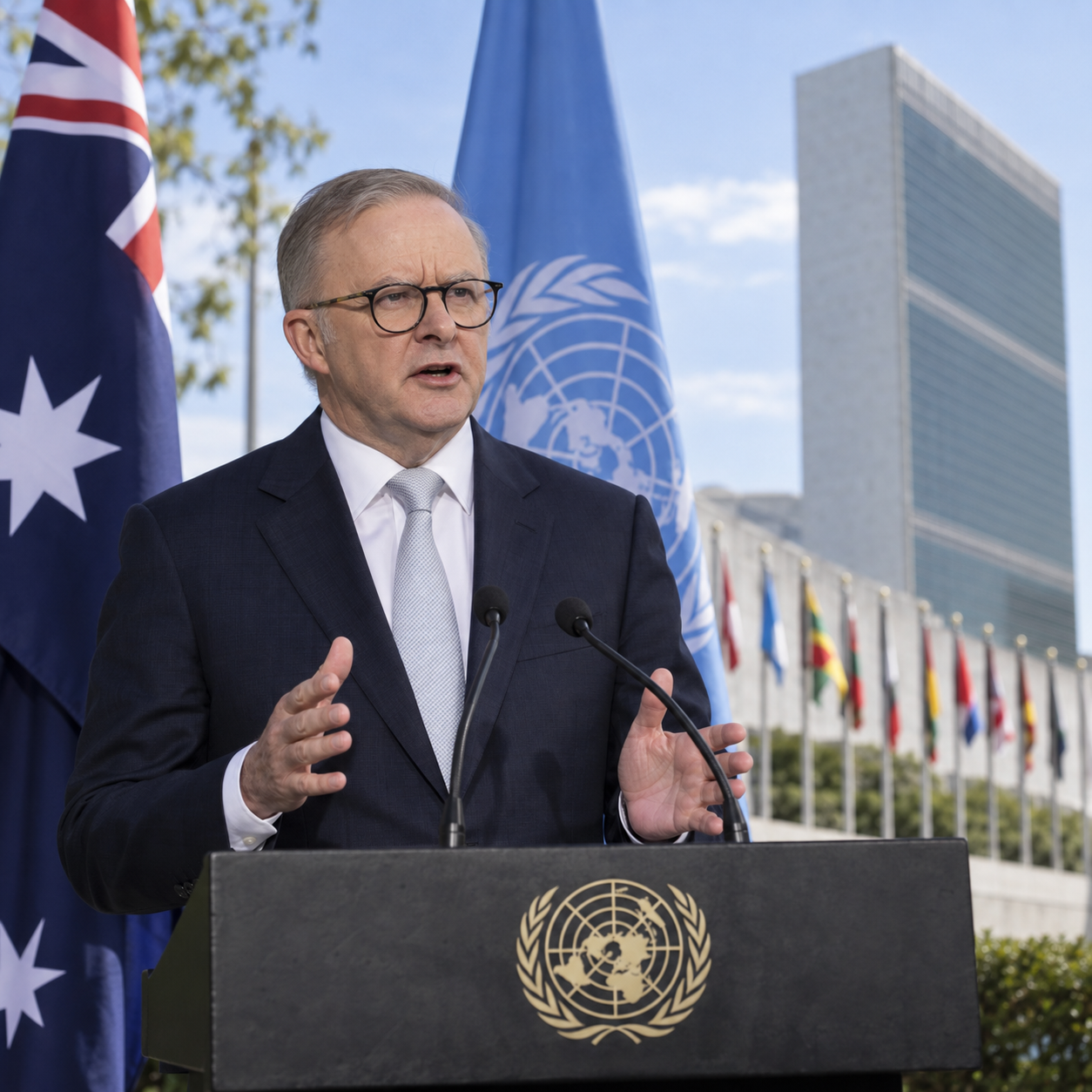
Prime Minister Anthony Albanese announced the campaign in New York on 21 September, saying a Security Council seat would give Australia a larger role in international debates that can affect Australians, including conflict, cybersecurity and the rapid development of artificial intelligence.
The announcement is the start of a bid, not the result of an election. Australia has not yet secured a seat, and the outcome should not be treated as certain.
What Australia is seeking
The Security Council has 15 members. Five — China, France, Russia, the United Kingdom and the United States — are permanent members. The other ten are elected by the General Assembly for two-year terms.
Five non-permanent seats are filled each year.
Australia is seeking one of the two seats allocated to the Western European and Others Group for the 2029–30 term. Finland is also running.
The vote is expected in 2028 and is conducted by secret ballot. Under the UN Charter and General Assembly rules, election to the Security Council requires a two-thirds majority of members present and voting.
That makes campaigning important even when the number of declared candidates appears to match the number of available regional seats. Candidates still need to win the required support in the General Assembly.
Why the Security Council matters
The Security Council has primary responsibility under the UN Charter for international peace and security.
Its powers include establishing peacekeeping and political missions, imposing sanctions, authorising some enforcement measures and making decisions that can be legally binding on UN member states.
Its agenda can include wars, ceasefires, terrorism, nuclear proliferation, sanctions, humanitarian access and threats to international peace.
For a non-permanent member, a seat does not come with the veto held by the five permanent members. It does, however, give the country a vote, a place in negotiations and opportunities to shape resolutions, statements and the Council’s work program.
Non-permanent members can also chair sanctions committees and other subsidiary bodies and can influence compromises between larger powers.
Albanese’s case for the bid
At his New York press conference, Albanese connected the campaign to issues that extend beyond traditional military conflict.
He pointed to the war in Europe, conflict in the Middle East, the experience of COVID, cybersecurity and the challenge of artificial intelligence as examples of how international developments can have domestic consequences.
That framing is consistent with Australia’s official campaign material, which presents the bid around international law, sovereignty, conflict prevention, protection of civilians and a stronger voice for small and mid-sized states.
The government is also arguing that climate, oceans and emerging technology increasingly intersect with security.
Those are the government’s stated campaign priorities. Other UN members will decide how persuasive they are when voting.
Australia has served five previous terms
If elected, 2029–30 would be Australia’s sixth term on the Security Council.
Department of Foreign Affairs and Trade records list previous Australian terms in 1946–47, 1956–57, 1973–74, 1985–86 and 2013–14.
Australia held the Council’s first presidency in 1946.
During its most recent term in 2013–14, DFAT says Australia worked on issues including accountability for the downing of Malaysia Airlines flight MH17, humanitarian access and the Women, Peace and Security agenda.
Those previous terms form part of the government’s argument that Australia has experience operating inside the Council.
Historical service, however, does not give a country an automatic entitlement to return. Each election is decided by General Assembly members under the current geopolitical circumstances.
The campaign will be broader than Europe
Although Australia competes within the Western European and Others Group, its election depends on votes from countries across every UN region.
That means the campaign will involve diplomatic outreach in the Pacific, Southeast Asia, Africa, Latin America, the Caribbean, the Middle East and Europe.
Australia’s official campaign describes the country as a Pacific nation with connections to Southeast Asia, the Indian Ocean and Antarctica, and says it wants to amplify the voices of smaller and mid-sized states.
The government will need to persuade those states that Australian membership would reflect their concerns rather than simply reproduce the priorities of larger Western partners.
That is particularly relevant because debates about Security Council reform often focus on whether the institution adequately represents Africa, Latin America, the Caribbean and the wider Asia-Pacific.
Peacekeeping is part of the pitch
DFAT says Australia has contributed more than 65,000 personnel to more than 60 UN and other multilateral peace and security operations since 1947.
The government is using that history as part of its argument that Australia contributes resources as well as diplomatic positions to international security.
Australia has also supported police peacekeeping training in the Pacific and Timor-Leste, according to DFAT.
Those contributions are relevant under the UN Charter, which says the General Assembly should give due regard to countries’ contributions to international peace and security as well as equitable geographical distribution when electing non-permanent members.
What Australia says it would do on the Council
The government’s campaign material says Australia would support international law and state sovereignty, work to prevent conflict and protect civilians, amplify smaller and mid-sized states and support a more effective and representative United Nations.
It also lists multilateralism, sustainable development, human rights, inclusion and transparency as guiding principles.
Those commitments are campaign positions rather than guarantees of what the Council would achieve.
Security Council outcomes depend on negotiations among 15 members, and any substantive resolution can be blocked by a veto from one of the five permanent members.
A non-permanent member therefore has influence but not unilateral power.
Why technology has entered a traditional security campaign
One feature of the 2029–30 pitch is the emphasis on cyber threats and emerging technology.
Albanese specifically referred to artificial intelligence when launching the bid.
The Security Council has historically focused on armed conflict and state security, but governments increasingly argue that cyber operations, disinformation, autonomous systems and attacks on critical infrastructure can contribute to instability.
How far the Council should go into those areas is contested among UN members. Some states favour a broader security agenda, while others argue that development, technology and climate issues should be dealt with mainly in other UN bodies.
If Australia is elected, those disagreements would shape how much of its stated digital-security agenda can be advanced through the Council.
The campaign has a domestic dimension too
Running for a Security Council seat requires diplomatic resources and sustained ministerial engagement.
Australian governments have traditionally presented such campaigns as a way to increase national influence and protect interests through multilateral institutions.
Critics of international campaigns can question whether diplomatic effort should be concentrated elsewhere, while supporters argue that decisions taken in global bodies have direct consequences for trade, security and regional stability.
Those are legitimate policy arguments. They are separate from the election mechanics, which will ultimately depend on support from other countries.
What happens between now and the 2028 vote
Australia will spend the next two years seeking commitments and building support among UN members.
The government can highlight its peacekeeping record, Pacific relationships, development programs and positions on international law. Other candidates will make their own case.
Because voting is secret, public endorsements do not necessarily translate directly into ballots.
The required two-thirds majority also means a candidate may need several rounds of voting if no one reaches the threshold immediately.
Australia’s campaign therefore begins well before the term itself.
A bid, not a result
The most important distinction at this stage is between candidacy and membership.
Australia has launched a campaign for a 2029–30 non-permanent seat. It has not been elected to that seat.
Finland is also in the contest for the Western European and Others Group places, and other diplomatic dynamics may develop before the 2028 vote.
Until the General Assembly votes, the appropriate way to describe Australia’s position is as a candidate seeking support.
If successful, Australia would return to the Security Council for the first time since 2014 and begin its sixth term in the body. If unsuccessful, the campaign would end without membership.
For now, the launch marks the start of a two-year diplomatic effort rather than a predetermined outcome. The result will depend on the choices of UN member states when the secret ballot is held.