Prime Minister Anthony Albanese has left open the possibility of changing Australia’s copyright framework as the government tries to attract artificial-intelligence investment, while insisting creators should retain control over their work and be paid when copyrighted material is used.
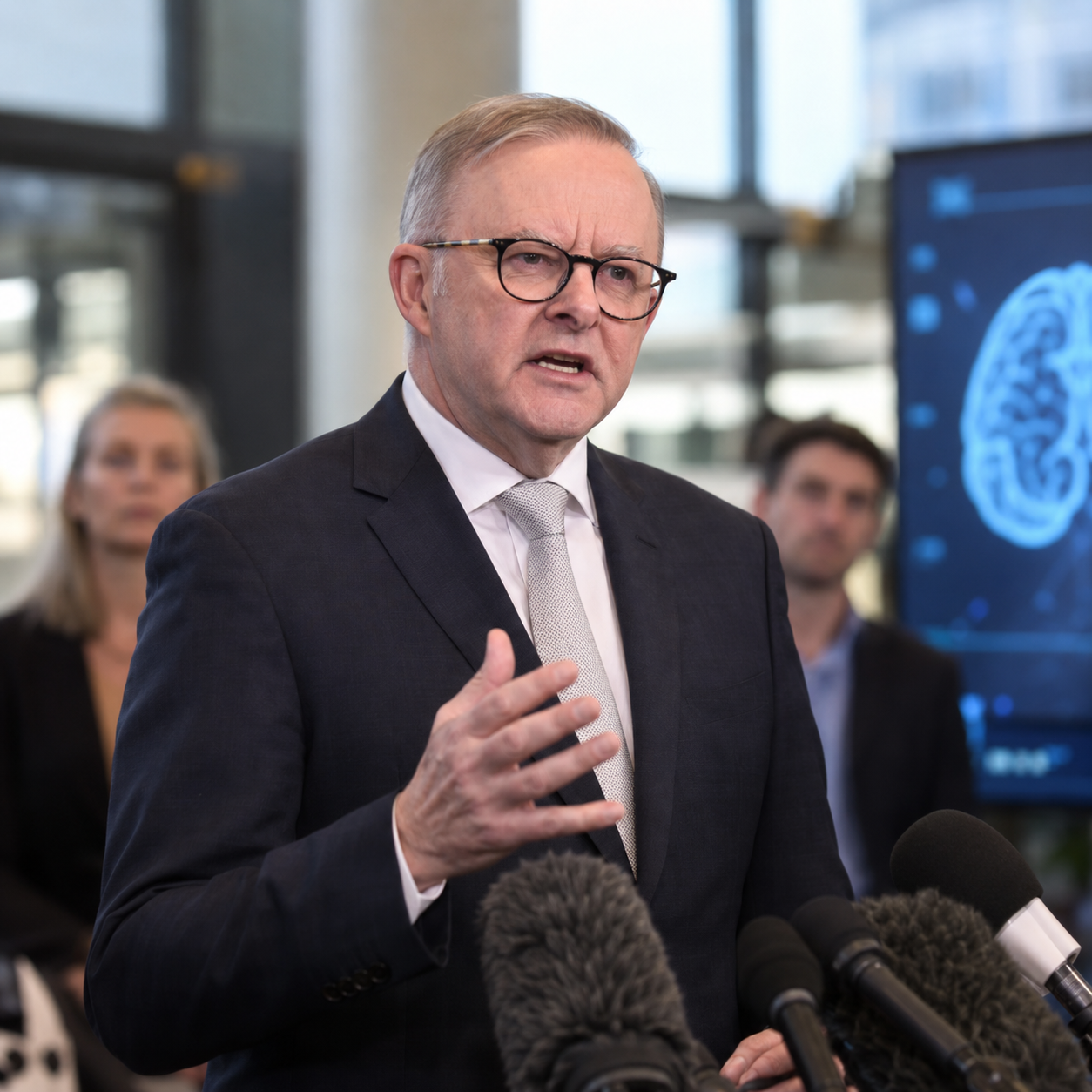
The comments came during a visit to Apple’s headquarters in Cupertino, California, where Mr Albanese met chief executive Tim Cook and was shown new parental-control features partly inspired by Australian online-safety reforms.
The copyright issue is politically and economically sensitive because generative AI systems can be trained on enormous quantities of text, images, music, code and other material, much of it protected by copyright.
Australia has not adopted a broad text-and-data-mining exception that would give AI developers a general right to use copyrighted works for model training without permission.
The Attorney-General’s Department has previously said the government is not considering such a blanket exception.
Instead, officials have been consulting creators, publishers, technology companies, universities, libraries and other stakeholders through the Copyright and Artificial Intelligence Reference Group.
That process has examined licensing, transparency, the legal status of AI-generated material and ways to reduce the cost of enforcing copyright rights.
Mr Albanese’s latest comments do not announce a new law.
He said the government needs to be “forward leaning” as AI investment accelerates globally and indicated that an opt-out model is among the ideas being discussed.
Under a potential opt-out approach, the default legal or commercial position could allow some use of material unless a rights holder takes steps to exclude it. The exact design would matter enormously, and no final Australian model has been announced.
That is different from the present general expectation that a company using protected material needs to operate within existing copyright law and obtain permission or a licence where required.
Mr Albanese also said writers, musicians and other creatives should maintain control over their intellectual property and receive remuneration when their work is used.
Those two positions — supporting AI investment while protecting creators — reveal the policy problem the government is trying to solve.
AI companies argue that access to large, high-quality datasets is important for developing competitive models. Creators and media businesses argue that their work should not become a free input into products that may compete with them or reduce the value of their original content.
The Australian Government has been working through that tension for several years.
The Copyright and Artificial Intelligence Reference Group was established as a standing forum to bring together stakeholders with very different interests.
Its participants include creative-industry bodies, publishers, broadcasters, technology companies, universities, libraries and digital-rights organisations.
The group has no power to make law. Its purpose is to inform government policy and help identify legal uncertainty, practical problems and possible responses.
In 2025, the government identified three copyright-and-AI priorities: encouraging fair and legal licensing arrangements, improving certainty about copyright in AI-generated material and exploring cheaper enforcement options for rights holders.
The Attorney-General’s Department has also consulted on transparency, including questions about what information AI developers should provide about copyrighted material used in training or model development.
For creators, transparency can be as important as the legal rule itself.
A copyright owner cannot easily seek a licence, request removal or enforce rights if they do not know whether their material has been used.
Technology companies, on the other hand, argue that training systems can involve extremely large datasets and that rules requiring item-by-item permission may make development more expensive or push investment toward jurisdictions with more flexible exceptions.
Australia therefore has to decide how much regulatory certainty it wants to offer investors without weakening the economic rights of local creators.
The government’s current position remains more cautious than a general free-use model.
Attorney-General portfolio statements earlier in 2026 stressed that there were no plans to introduce a broad text-and-data-mining exception and said copyright protections should continue to support fair compensation.
Mr Albanese’s comments in California do not contradict that in a simple way, because an opt-out system could be designed through licensing, regulation or other mechanisms without copying the broad exceptions used in some overseas jurisdictions.
But the comments do show that the government is still considering changes to how permission and control might work in practice.
That makes the details of any proposal crucial.
Questions would include which types of material are covered, whether the rule applies only to model training, how a creator registers an opt-out, whether machine-readable signals are recognised, how collective licensing works and what happens when a model has already been trained on protected material.
There would also be enforcement questions.
Individual writers, photographers and musicians often lack the resources to bring expensive court cases against global technology companies. A legal right can have limited practical value if enforcing it is too costly.
That is why the government’s existing consultation has looked at less expensive enforcement pathways as well as the underlying copyright rules.
The debate is also linked to Australia’s broader AI strategy.
Governments around the world are competing for data centres, cloud infrastructure, research investment and technology jobs. Australia has advantages in energy, research institutions, political stability and regional connections, but it competes with larger markets that can offer scale and different regulatory settings.
Mr Albanese’s argument is that Australia should participate in shaping AI rather than simply importing technology developed under rules set elsewhere.
He is expected to raise AI governance with other leaders at the United Nations General Assembly, reflecting the government’s view that some risks cannot be managed by national law alone.
Copyright is one example of that problem because a model can be developed in one country, trained on material hosted in another and used globally.
National laws still matter, but companies can structure data and development across borders.
The Apple visit also highlighted a different technology-policy issue: children’s online safety.
Apple showed Mr Albanese parental-control features that allow parents to restrict apps, content and contacts, set usage limits and detect some sensitive imagery.
The company said aspects of its approach were influenced by Australian reforms aimed at reducing online harms to children.
That gave the government a chance to present Australia as a rule-setter rather than simply a market receiving technology.
The political message is similar on AI: Canberra wants investment but also wants a role in setting the conditions under which that investment operates.
For Australian creators, the immediate practical position has not changed.
Copyright law still applies, the government has not enacted an AI training opt-out regime and there is no general new permission for technology companies to use copyrighted material.
For AI developers, the policy direction remains under consultation rather than settled.
That uncertainty can be frustrating for both sides, but it also reflects the complexity of trying to write rules for technology that is evolving faster than most legislation.
The next meaningful development will be a concrete government proposal, not simply a discussion about possible models.
When that arrives, the key test will be whether the system gives investors enough certainty to build in Australia while giving creators a realistic way to control use of their work and receive payment.
The government’s consultation history also puts the latest comments in context. In late 2025, the Attorney-General’s Department identified licensing, the legal treatment of AI-generated outputs and lower-cost enforcement as priority issues. It explicitly said the government was not considering a general text-and-data-mining exception.
That means the current debate is not simply a choice between “copyright stays unchanged” and “AI companies can use anything”. There are intermediate models: collective licensing, machine-readable reservations of rights, transparency obligations, statutory remuneration arrangements and industry agreements could all change how access works without removing copyright entirely.
An opt-out model would shift some practical burden toward creators because rights holders would need a reliable way to signal that their works cannot be used. Its impact would therefore depend on whether the opt-out is technically simple, legally enforceable and respected across datasets assembled by third parties.
For small creators, that detail is especially important. A large publisher can negotiate licences or monitor commercial use with legal staff. An individual author, photographer or musician may not have the same bargaining power.
Investors are looking for certainty too. AI companies want to know which datasets can be used, what licensing costs apply and whether a model trained lawfully today could face different rules tomorrow. A clear framework can be valuable even when it imposes obligations.
That is why the next stage of policy will matter more than the Prime Minister’s willingness to discuss options. The economic consequences will turn on the precise rules, transition arrangements and enforcement mechanisms that accompany any legislative proposal.
Until then, Mr Albanese’s remarks should be read as a signal that copyright settings remain open for discussion — not as confirmation that Australia has decided to adopt an opt-out model.