A coal mine on a Queensland cattle property has been formally abandoned after the collapse of its former operator, leaving the state government responsible for deciding how the site will be made safe and rehabilitated and renewing scrutiny of the financial safeguards designed to stop mine closures becoming an open-ended public liability.
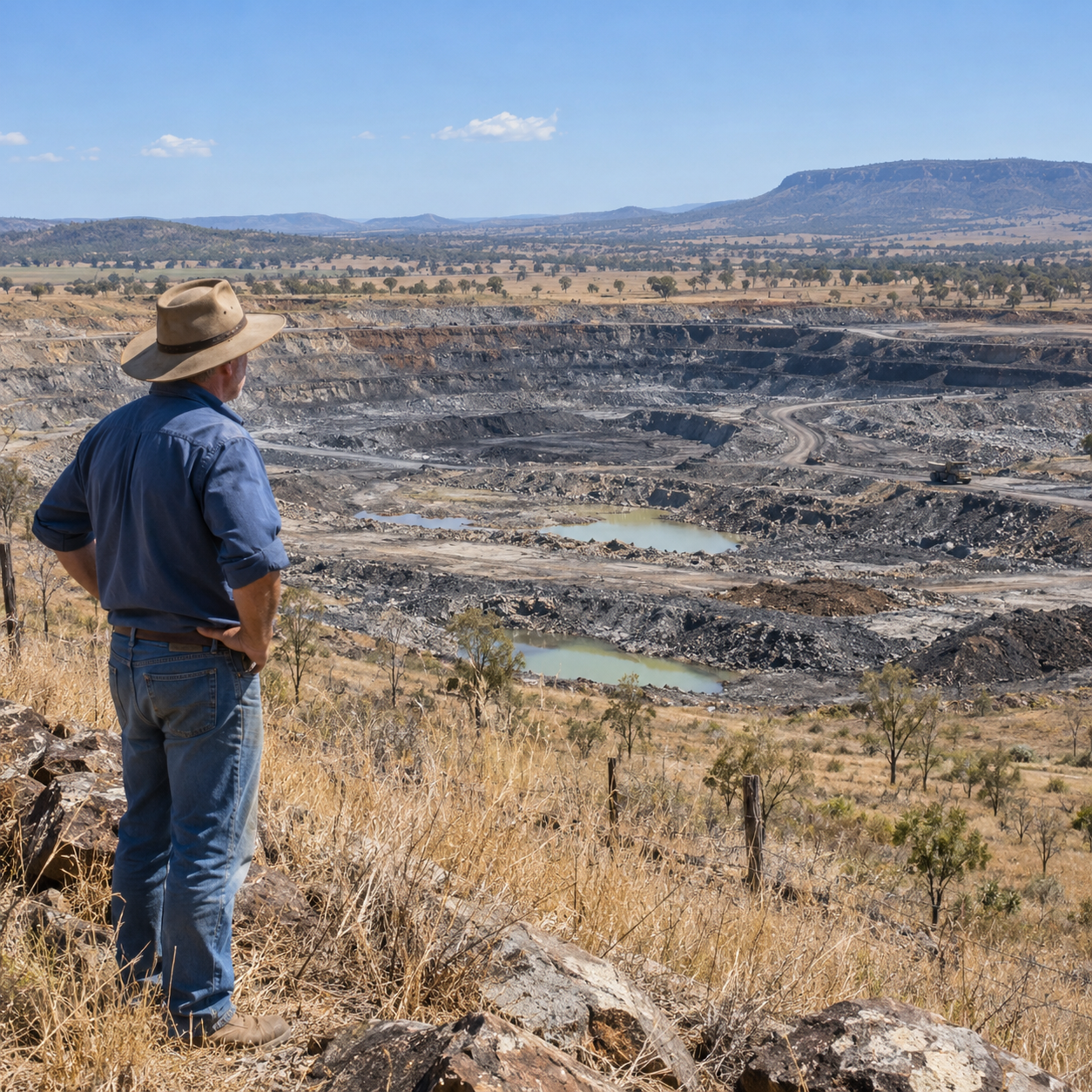
The Bluff Mine, about 20 kilometres east of Blackwater in Central Queensland, sits on a mining lease of roughly 1,100 hectares. The open-cut operation was acquired by Bowen Coking Coal in late 2021, restarted in 2022 and later returned to care and maintenance after weak coal prices and high operating costs made the project uneconomic.
Bowen Coking Coal entered administration and receivership in 2025. The company was subsequently removed from the ASX in July 2026. The Guardian reports that liquidators have now disclaimed the Bluff mining lease and associated permits, meaning the site has effectively become an abandoned mine for the Queensland Government to manage.
That does not automatically mean taxpayers will have to meet the entire rehabilitation bill. Queensland has had a Financial Provisioning Scheme since 2019 specifically to reduce the state’s financial exposure when a resource company fails to meet rehabilitation obligations.
The Department of Environment has reportedly estimated rehabilitation work at Bluff at about $12.3 million. The Guardian also reported that the mine was expected to have financial provisioning of around $10 million, but the amount of surety actually held for this particular site has not been publicly disclosed.
That gap in public information is the central accountability issue. Without confirmation of the Bluff-specific contribution or surety available to the state, it is not yet possible to calculate any final shortfall, or to say with confidence how much rehabilitation will ultimately be funded through company-backed financial assurance, the broader scheme fund or other government resources.
Queensland’s Financial Provisioning Scheme was created under legislation that took effect on 1 April 2019. Its stated purpose is to manage the state’s financial risk when holders of resource environmental authorities fail to meet environmental management and rehabilitation obligations.
The scheme can require companies to provide a surety, contribute to a pooled fund, or both, depending on the estimated rehabilitation cost and the risk category assigned to the operator. The state can also use scheme funding for remediation of abandoned mine sites.
An estimated rehabilitation cost, known as an ERC, is intended to represent the cost of preventing or minimising environmental harm and rehabilitating disturbed land. For larger environmental authorities, the scheme manager uses the ERC and a risk assessment to determine whether an operator must provide surety or make contributions to the fund.
The existence of that system matters because it is designed precisely for situations in which an operator no longer has the capacity or legal responsibility to finish the work itself.
Bluff is a useful test of whether the system can deliver that protection in practice.
The mine had a complicated operational history even before Bowen Coking Coal’s collapse. Production originally began in 2018 under a previous owner. The project was placed into care and maintenance in 2020, later acquired by Bowen and restarted, then again placed on care and maintenance in November 2023.
A 2024 compliance report for the project recorded that the mine operated under a Commonwealth environmental approval covering a project area of 1,088 hectares. The report said environmental monitoring and management obligations continued while the mine was in care and maintenance.
Bowen’s company reporting through 2025 and early 2026 continued to describe Bluff as being maintained rather than producing coal. Equipment had been removed and the company said environmental monitoring continued under the environmental authority.
That distinction is important. A mine in care and maintenance still has an operator responsible for compliance. An abandoned site creates a different problem because the state may need to step in to prevent environmental harm, secure infrastructure and determine a long-term rehabilitation pathway.
Potential risks at a former open-cut coal operation can include erosion, water management, unstable landforms, contaminated runoff, exposed coal or waste materials and, depending on site conditions, gas emissions. The actual risks at Bluff will depend on technical assessments rather than assumptions based on the appearance of the pit.
The mine’s location on and around privately used grazing land also creates a direct issue for landholders.
The Guardian has followed cattle producer Trish Goodwin, whose family property has been affected by the mine and associated infrastructure. Earlier reporting described concerns over access roads, flooding and unfinished commitments while the mine was in care and maintenance. With the lease now disclaimed, questions about access, remediation and compensation remain.
Those landholder concerns are separate from the state’s financial exposure but closely connected to the rehabilitation task. A government response has to consider not only the mine pit itself but also access, drainage, disturbed land and other infrastructure associated with the project.
Queensland already manages a substantial abandoned-mine legacy. Government information says there are about 99 complex abandoned mine sites in the state, with the Abandoned Mine Lands Program managing some of the highest-risk locations and remediating smaller hazards.
Many of those legacy mines pre-date modern rehabilitation rules. Bluff is different because it operated under the newer financial provisioning framework introduced specifically to strengthen protections around modern resource projects.
That makes the site’s financial records particularly important.
If a site-specific surety exists and can be called on, it could meet some or all of the rehabilitation expenditure. If the operator instead contributed to the pooled fund, the funding mechanism may be different. The scheme is designed to spread and manage risk, so a direct comparison between an ERC and a single cash deposit can be misleading.
Queensland Treasury says environmental authorities with larger estimated rehabilitation costs undergo a risk category assessment. Depending on the result, the operator may pay a percentage contribution into the scheme fund or be required to provide surety.
That means a mine with a $12.3 million rehabilitation estimate would not necessarily have exactly $12.3 million sitting in a dedicated account. The relevant question is what financial provisioning decision applied to the Bluff environmental authority at the time and what money or enforceable security remains available now.
Public disclosure of that figure would help clarify whether the scheme has worked as intended in this case.
The state must also determine what rehabilitation standard is required and over what timetable. The first priorities at an abandoned mine may be safety and environmental stabilisation rather than full landscape restoration in one step.
Queensland’s broader rehabilitation policy requires progressive rehabilitation and closure planning for newer mines, with milestones intended to reduce the amount of disturbed land left until the end of a project’s life.
Bluff’s history of shutdowns, ownership changes and financial distress shows why progressive rehabilitation can matter. When rehabilitation is deferred until a company’s finances have deteriorated, governments and financial assurance systems carry more risk.
There is also a wider policy debate about whether the financial provisioning model is calibrated strongly enough for marginal or distressed mines. Queensland is reviewing parts of the scheme in 2026, including settings that determine how risk is assessed and how much financial assurance operators provide.
The Bluff case will likely become part of that discussion because it offers a current example of an operator collapse under the post-2019 system.
For taxpayers, the strongest conclusion at this stage is narrower than some political arguments may suggest. The state now has responsibility for managing the abandoned site, and the reported rehabilitation estimate is about $12.3 million. But the Bluff-specific surety or contribution position has not been publicly confirmed, so a final taxpayer shortfall cannot yet be established.
For the landholder, the practical questions are more immediate: who will secure and repair the site, what happens to damaged or altered access, how quickly environmental risks will be addressed and who will be accountable for the work.
Those questions will ultimately provide the real measure of the financial provisioning system. A scheme designed to protect the public is only as effective as its ability to produce money, responsibility and rehabilitation when an operator disappears.
Another reason the Bluff case deserves close scrutiny is that Queensland’s financial provisioning framework was built after repeated concern that rehabilitation liabilities could remain long after a mine stopped producing. The scheme is meant to make financial risk visible while a project is still operating, not only after an insolvency.
For larger projects, the amount held by the state can differ from the headline ERC because companies may be allocated to different risk categories. Lower-risk operators can contribute a percentage into a pooled fund, while higher-risk operators can be required to provide more direct surety. That structure means the public needs two numbers to understand Bluff properly: the rehabilitation cost estimate and the financial provisioning actually available to the state.
The Queensland Government also has powers beyond financial provisioning. Environmental regulators can pursue compliance action while a responsible entity still exists, and the abandoned-mine program can carry out safety or remediation work after ordinary enforcement avenues have been exhausted.
What is missing publicly is a clear Bluff-specific timetable. Landholders need to know which hazards will be addressed first, how access and drainage issues will be managed and when the government expects to move from temporary site management to longer-term rehabilitation. A published plan would also allow the $12.3 million estimate to be tested against the actual scope of work rather than treated as a stand-alone political number.
The next important step is greater transparency from the Queensland Government about the site’s rehabilitation plan and the financial provisioning available to pay for it. Until those details are released, the $12.3 million estimate should be treated as a rehabilitation estimate — not as a proven bill already passed to taxpayers.