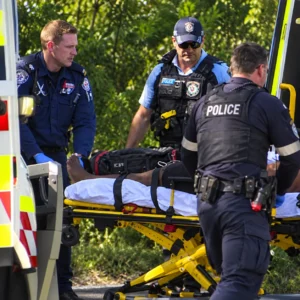
A family of four, including two children, has been winched from a damaged yacht after the vessel struck Elizabeth Reef in the Whitsundays, in a complex offshore rescue that required a helicopter crew to hold a precise hover over the stranded boat.
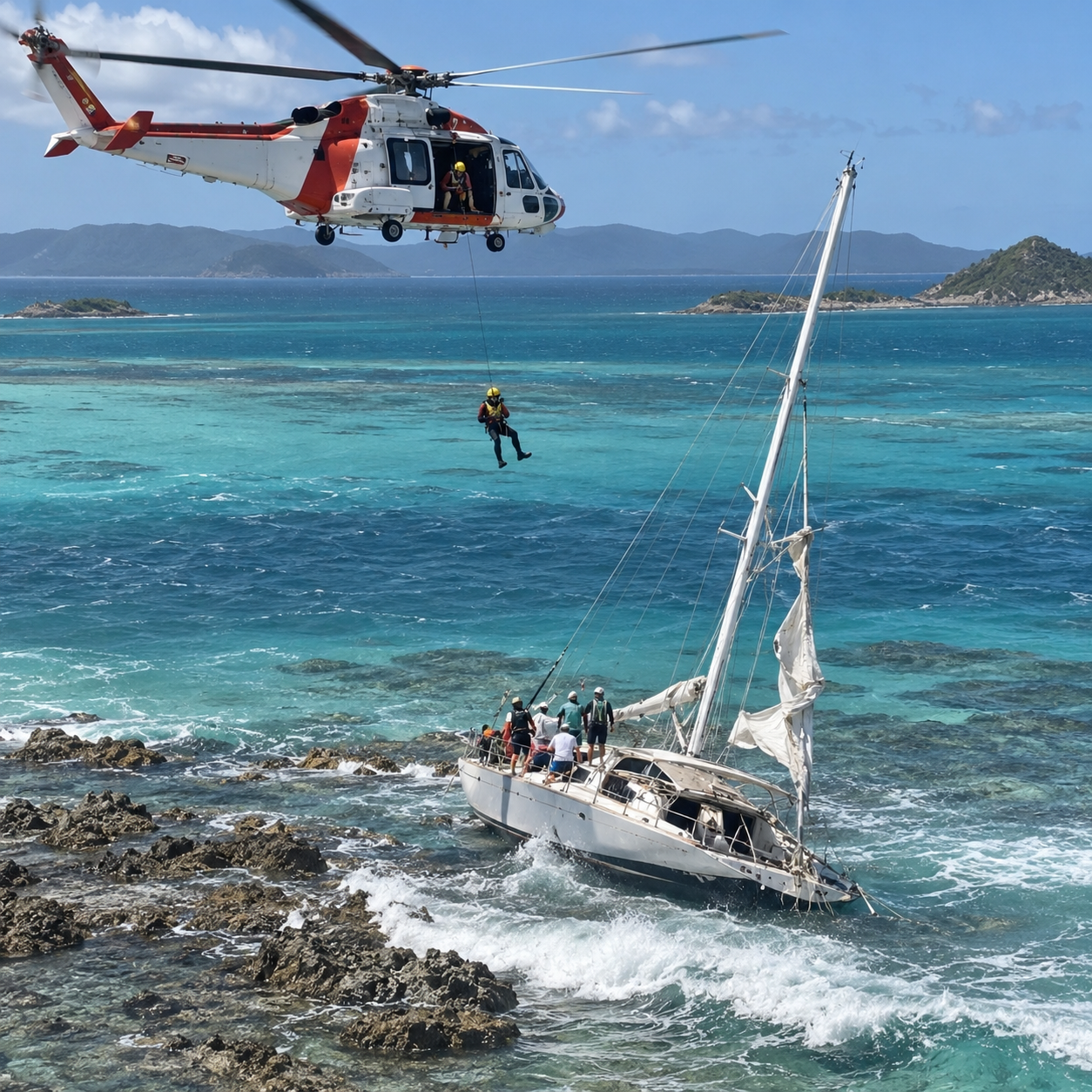
The family — two parents and children aged nine and 12 — had been sailing on a 10-metre yacht about 120 kilometres off the Queensland mainland when the vessel became stuck on the reef at about 4am on Saturday.
They remained aboard the damaged yacht while a CQ Rescue helicopter was dispatched from Mackay. The crew arrived around sunrise and began a winch operation over the reef.
A rescue swimmer was lowered from the helicopter to the yacht and helped secure each family member before they were lifted into the aircraft one at a time.
The four were then flown to Whitsunday Airport. The father was treated on board the helicopter for head injuries and was later taken to Proserpine Hospital for further assessment.
No fatality has been reported, and the ABC says all four family members were successfully removed from the vessel.
The rescue was challenging because of the yacht’s location and the need to operate above a reef rather than a conventional landing area. A helicopter cannot simply land beside a boat in that environment.
Instead, the pilot has to maintain a stable position while the winch operator and rescue swimmer work below. Wind, sea conditions, the movement of the vessel and the proximity of rigging can all affect the operation.
CQ Rescue chief executive Tim Healee described the mission as requiring precision and teamwork. The helicopter crew had to keep the aircraft steady while each person was individually attached to the rescue system and lifted clear.
The incident highlights how quickly a marine problem can become an aviation rescue when a vessel is stranded far from shore.
At roughly 120 kilometres offshore, travel by rescue boat can take much longer than an aircraft response, particularly when the casualty vessel is on a reef rather than in a harbour or near a beach.
Helicopters can provide rapid access, medical treatment and evacuation, but winching people from a yacht introduces hazards that crews have to manage carefully.
Yacht masts, stays and other rigging create obstacles beneath a hovering aircraft. Rotor wash can also affect people on deck and move loose objects, which is why rescue swimmers and winch crews use tightly controlled procedures.
In this case, the family remained on the yacht until the rescue team arrived. The available reporting does not indicate that the vessel sank or that the family had to enter the water.
It would be inappropriate to speculate about the cause of the grounding, the yacht’s navigation equipment or whether any particular safety system was used unless authorities release that information.
Elizabeth Reef is one of many navigational hazards in the broader Whitsundays and Great Barrier Reef region. Reefs can be difficult to see, especially in darkness or poor conditions, and safe navigation depends on accurate charts, positioning, route planning and a proper lookout.
Australian marine-safety guidance emphasises preparation before offshore travel. The Australian Maritime Safety Authority advises boaters to carry reliable communications, tell an emergency contact their trip plan and carry an appropriate registered distress beacon where required.
AMSA says marine radio is an important means of communication and warns against relying on a mobile phone as the only emergency contact method offshore.
Emergency Position Indicating Radio Beacons, or EPIRBs, are designed for marine emergencies and can transmit a vessel’s distress alert and location through satellite systems when activated.
The current Whitsundays report does not state whether an EPIRB was used in this incident, so its role should not be assumed. The general safety guidance is relevant because the family was a long distance from the mainland, where ordinary mobile coverage cannot be relied upon.
Lifejackets, flares, navigation lights, anchors, bilge systems and other safety equipment are also part of offshore boating requirements, with exact rules depending on the vessel and jurisdiction.
Checking weather and sea conditions before departure is another basic precaution. A reef grounding can become more dangerous if waves or wind push a damaged boat further onto rocks or begin breaking the hull apart.
Once a vessel is aground, the safest response depends on the damage, sea state and location. Remaining with the boat can make people easier to locate and can provide more protection than entering the water, but every emergency is different and directions from rescue authorities should take priority.
The presence of children adds another layer for rescuers because harnessing and winching have to account for body size, fear, communication and the need to keep family members separated safely during the sequence.
The ABC report says the nine-year-old and 12-year-old were rescued along with their parents, with no report of serious injury to the children.
The father’s head injury was treated during the flight, showing another advantage of an aeromedical response: crews can begin assessment and care before reaching hospital.
Central Queensland’s rescue-helicopter network regularly performs missions across remote coastal and inland areas. The Mackay-based service responds to medical retrievals, road incidents and offshore emergencies where distance makes conventional ambulance access difficult.
Recent reporting on the region’s rescue services shows how heavily communities rely on them. The combined operating costs of major Central Queensland rescue-helicopter services exceeded $40 million in 2025, with significant Queensland Government support alongside community and industry funding.
That broader funding context is separate from Saturday’s individual mission, but it explains why maintaining aircraft, crews and around-the-clock response capability is expensive. A helicopter rescue service has to be ready before the emergency occurs.
The Whitsundays operation also required coordination between aviation, medical and marine capabilities. The aircraft crew had to locate the yacht, assess the safest hover position, put a rescue swimmer onto the vessel, winch four people and then transfer the family to a location where ground medical care was available.
For recreational sailors, the lesson is not that offshore cruising is inherently unsafe. It is that distance magnifies the consequences of navigation errors, equipment failures and injuries.
Good planning means knowing the route, identifying reefs and other hazards, checking forecasts, carrying the legally required safety equipment and making sure emergency contacts know the trip plan.
It also means understanding how to call for help and having equipment that works beyond mobile-phone range.
Investigators or maritime authorities may later release more information about how the yacht came to strike Elizabeth Reef or what happened to the vessel after the family was removed.
Until then, the confirmed story is the rescue itself: four people were stranded on a damaged yacht far offshore, a helicopter crew reached them around sunrise, and each family member was winched to safety in a technically demanding operation.
Offshore emergency planning is especially important around the Great Barrier Reef because rescue times can be affected by distance, weather and the availability of aircraft or vessels. A yacht 120 kilometres from the mainland is well beyond the kind of response that can rely on ordinary road-based emergency services.
AMSA advises mariners to tell someone their route and expected return time before departure. If a vessel fails to arrive, that contact can raise the alarm even if onboard communications are lost.
Registered distress beacons are another layer of protection. When an EPIRB is activated, its registration can help search-and-rescue authorities identify the vessel and emergency contacts, while GPS-equipped models can provide a more precise location.
Again, there is no public confirmation that an EPIRB triggered Saturday’s Whitsundays response. These are general safety measures relevant to offshore sailing, not facts about the family’s equipment.
Reef navigation also requires attention to charted hazards and tidal conditions. A reef may extend beneath the surface well beyond the visible rocks or breaking water, and the safe route can change with depth and sea state.
After a grounding, skippers also have to consider hull damage, water ingress and whether attempts to refloat the vessel could make the situation worse. Rescue authorities may advise occupants to remain aboard if the yacht is stable enough and entering the water would expose them to greater danger.
The helicopter crew’s ability to reach the family at first light reduced the time they had to remain on the damaged boat, but the operation still required the aircraft to work in a confined and moving environment with no landing option.
The successful outcome does not remove the seriousness of the incident. A stranded yacht on an isolated reef can deteriorate quickly if weather worsens or the hull shifts, which is why early communication and accurate location information are critical in marine emergencies.
The father required further medical treatment, while the rest of the family was reported safely evacuated.