Australia’s renewable-electricity transition has reached a new phase: wind, solar, hydro and other renewable sources now provide close to half of the electricity generated in the National Electricity Market at times, but the federal target of 82 per cent renewable electricity by 2030 still requires a much faster build-out of generation, storage and transmission.
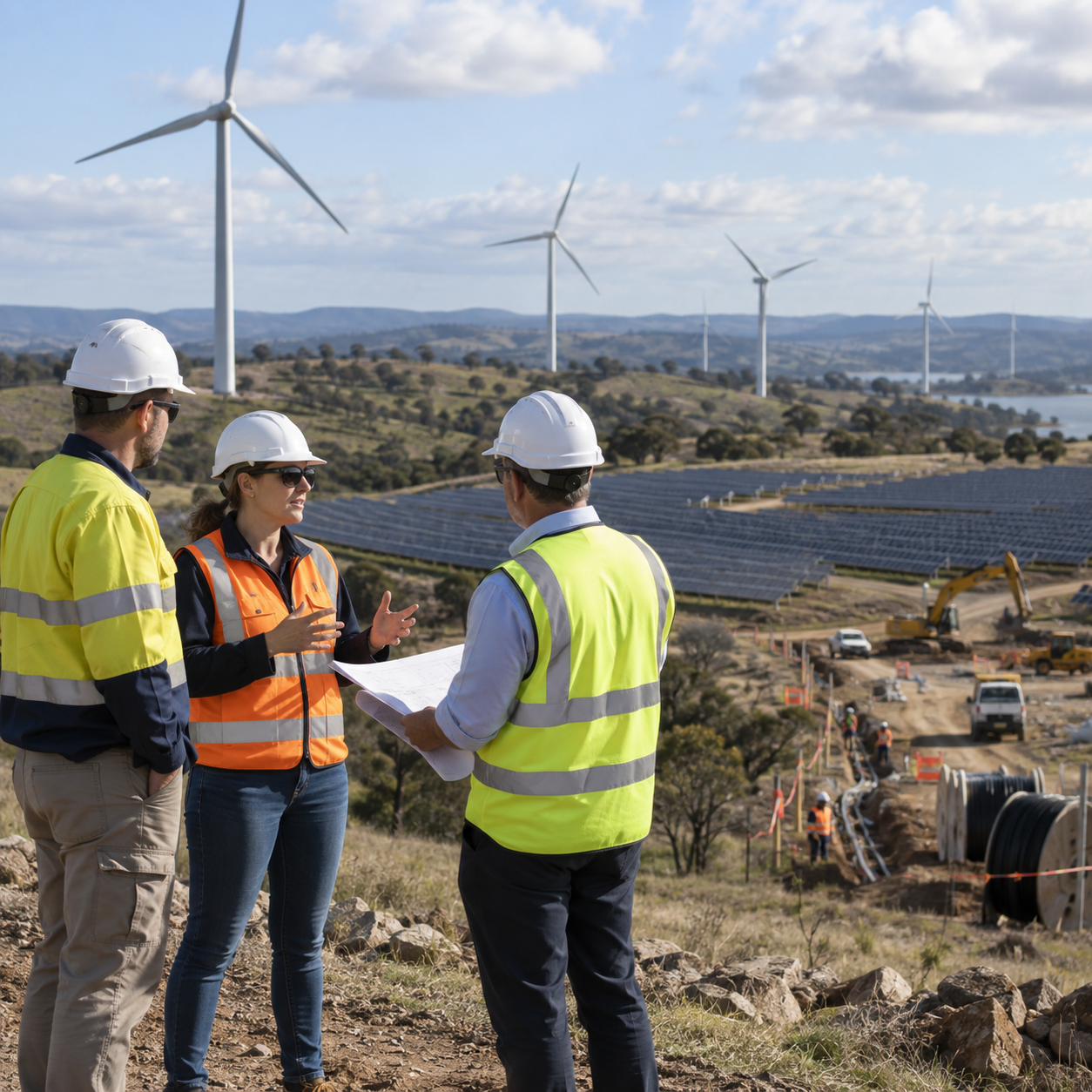
The target is a central part of the Commonwealth’s energy and emissions policy. Government planning documents envisage renewable generation increasing to 82 per cent of on-grid electricity by 2030 as ageing coal-fired power stations retire and more homes, businesses and industries electrify.
Progress is real. The Clean Energy Regulator says Australia added about 6.8 gigawatts of renewable capacity during 2025, including just under 4 gigawatts of large-scale generation and about 2.8 gigawatts of rooftop solar. Renewable energy supplied 43.7 per cent of National Electricity Market generation across 2025 and exceeded 50 per cent in the final quarter for the first time.
AEMO’s first-quarter 2026 data showed the trend continuing, with renewable generation supplying 46.5 per cent of NEM electricity in that quarter. Rooftop solar also helped offset record underlying demand during parts of the period.
Those numbers show the transition is well under way, but they do not mean the remaining gap to 82 per cent is easy to close. The final stages require not only more solar and wind farms but also storage, stronger transmission networks and reliable backup as coal units leave the system.
AEMO’s 2026 Integrated System Plan says the least-cost path to a reliable electricity system involves renewable generation connected by new transmission, firmed with storage and supported by gas as required while coal generation retires.
The phrase “least-cost path” does not mean the transition is cost-free. New networks, batteries, pumped hydro, grid connections and large renewable projects all require capital, planning approvals and construction work. The question is how those costs compare with alternatives, including keeping ageing coal assets operating or replacing them with other technologies.
Project delivery is one of the main pressure points. Australia’s development pipeline is large, but a project can spend years moving from an announcement to environmental approval, a grid connection agreement, financing, construction and final operation.
DCCEEW’s renewable-energy development pathway describes that process as a series of commercial and regulatory stages rather than a single approval. Land tenure, planning and environmental approvals, transmission access, engineering, finance and equipment supply can each become a bottleneck.
The federal government has tried to reduce investment uncertainty through the Capacity Investment Scheme, which provides long-term revenue underwriting for renewable generation and clean dispatchable capacity such as batteries.
The scheme has been expanded to support 26 gigawatts of renewable generation and 14 gigawatts of clean dispatchable capacity. Tenders have selected or are seeking projects across the NEM and Western Australia’s market.
But being selected through a tender does not mean a project is immediately generating electricity. Developers still need to meet contract milestones such as land tenure, planning and environmental approvals, a grid connection offer, financial close, construction and commissioning.
DCCEEW says Capacity Investment Scheme agreements require project owners to report progress against those milestones before a project can operate and access the full benefit of the underwriting arrangement.
That difference between “announced”, “approved”, “financially committed” and “under construction” is crucial when assessing whether the 2030 target is on track. A large headline pipeline can coexist with a smaller volume of physical construction.
The Commonwealth has also created a National Renewable Energy Priority List to speed up environmental decisions for selected projects. The list includes transmission, generation and storage proposals considered important to meeting energy targets.
By July 2026, the priority process had supported 23 projects through a key federal environmental step, including major transmission projects and large wind and solar developments. The broader list could deliver about 20 gigawatts of generation and 10 gigawatts of storage if projects ultimately proceed.
Transmission is especially important because the best renewable resources are often located far from existing high-demand centres. A wind or solar farm can be fully built yet constrained if the network does not have the capacity to move its output to consumers.
Programs such as Rewiring the Nation are intended to finance new or upgraded transmission at concessional rates. Major interconnectors and renewable-energy-zone networks are designed to unlock projects that would otherwise face congestion or connection limits.
Transmission development also creates local controversy. New power lines can cross farms, forests and regional communities, leading to disputes over routes, compensation, environmental impacts and consultation.
That means faster delivery is not simply a matter of removing planning rules. Governments have to balance the need for new infrastructure with landholder rights, environmental assessment and community acceptance.
Finance is another constraint. Renewable projects require long-term certainty about revenue to secure debt and equity. When wholesale prices are volatile, construction costs rise or policy changes affect project economics, investors can delay final investment decisions even when a project has planning approval.
The Clean Energy Regulator’s project data show why that distinction matters. Approved renewable capacity can rise strongly while the amount reaching final investment decision in a particular year is lower.
Storage is becoming increasingly central as renewable penetration rises. Batteries can charge when solar or wind output is high and discharge when demand rises or renewable output falls. Longer-duration storage and flexible gas generation can cover periods when weather conditions reduce renewable supply for longer stretches.
Household rooftop solar also changes the system. Australia has one of the world’s highest rates of rooftop solar adoption, reducing daytime demand from the grid but increasing the need for flexible resources that can respond as solar output drops in the evening.
That is why the 82 per cent target cannot be judged only by the number of wind turbines or solar panels installed. The grid must also be able to balance supply and demand every second, manage voltage and system strength, and keep electricity available through heatwaves, storms and generator outages.
Coal closures add urgency. AEMO expects the existing coal fleet to retire progressively, although actual closure dates can change. Delays to replacement generation or transmission can increase reliability risks, while keeping old plants open longer can require additional maintenance and commercial support.
State policy also matters because planning, transmission and renewable-energy-zone development are shared across federal and state systems. A change in state priorities can affect the timing of projects needed for the national target.
For households, the key outcome is not the renewable percentage by itself but whether electricity remains reliable and affordable through the transition. Wholesale prices, network spending, retail competition and the cost of maintaining backup capacity all feed into bills.
The transition can put downward pressure on wholesale prices when abundant low-marginal-cost renewable energy is available, but new network and storage investment also has to be paid for. The final effect on bills varies by region and over time.
The current evidence therefore supports two conclusions at once. Australia has added renewable generation at a substantial pace and renewables are already supplying a historically high share of electricity. At the same time, moving from roughly half the main-grid supply in strong periods to an annual system around the 82 per cent target requires several years of sustained project delivery.
Whether the target is met will depend on how many projects move from planning into financial close and construction, how quickly transmission becomes available, how storage expands and how coal retirement dates interact with the new build.
The size of the federal investment pipeline shows that policy support is not the only missing ingredient. DCCEEW’s Capacity Investment Scheme now targets 26 gigawatts of renewable generation and 14 gigawatts of clean dispatchable capacity after an expansion announced in 2025.
Recent tenders have selected large volumes of projects, while 2026 rounds continue to seek additional generation and storage. Successful tender status reduces revenue risk, but developers still have to secure approvals, grid access, contracts and construction finance.
Environmental assessment is another stage. The National Renewable Energy Priority List contains dozens of transmission, generation and storage projects, and by mid-2026 more than 20 had cleared a key Commonwealth environmental step.
Those approvals can help projects move toward financial close, but a “green light” under federal environmental law is not the same as construction completion. State approvals, land access and connection studies can still take time.
AEMO’s plan also assumes large amounts of new transmission. Projects such as HumeLink, Marinus Link and renewable-energy-zone networks are intended to move power from areas with strong wind and solar resources to major demand centres.
When transmission arrives later than generation, projects can face congestion and curtailment. When generation arrives later than coal closures, the system may need other dispatchable resources for longer.
This sequencing problem is one reason the 2030 target is difficult even when individual technologies are available and increasingly mature.
The next few annual and quarterly data releases will therefore matter as much as project announcements. Construction starts, financial closes, completed transmission and operating storage will show whether the pipeline is becoming physical capacity at the rate the target requires.
It is a delivery challenge rather than a settled prediction of success or failure. The next few years will show whether Australia’s large project pipeline can be converted into operating infrastructure quickly enough to match the timetable set for 2030.