Victoria Police intelligence has raised concern that some young offenders are hiding knives and other weapons at public transport locations across Melbourne so they can be retrieved later without being carried continuously.
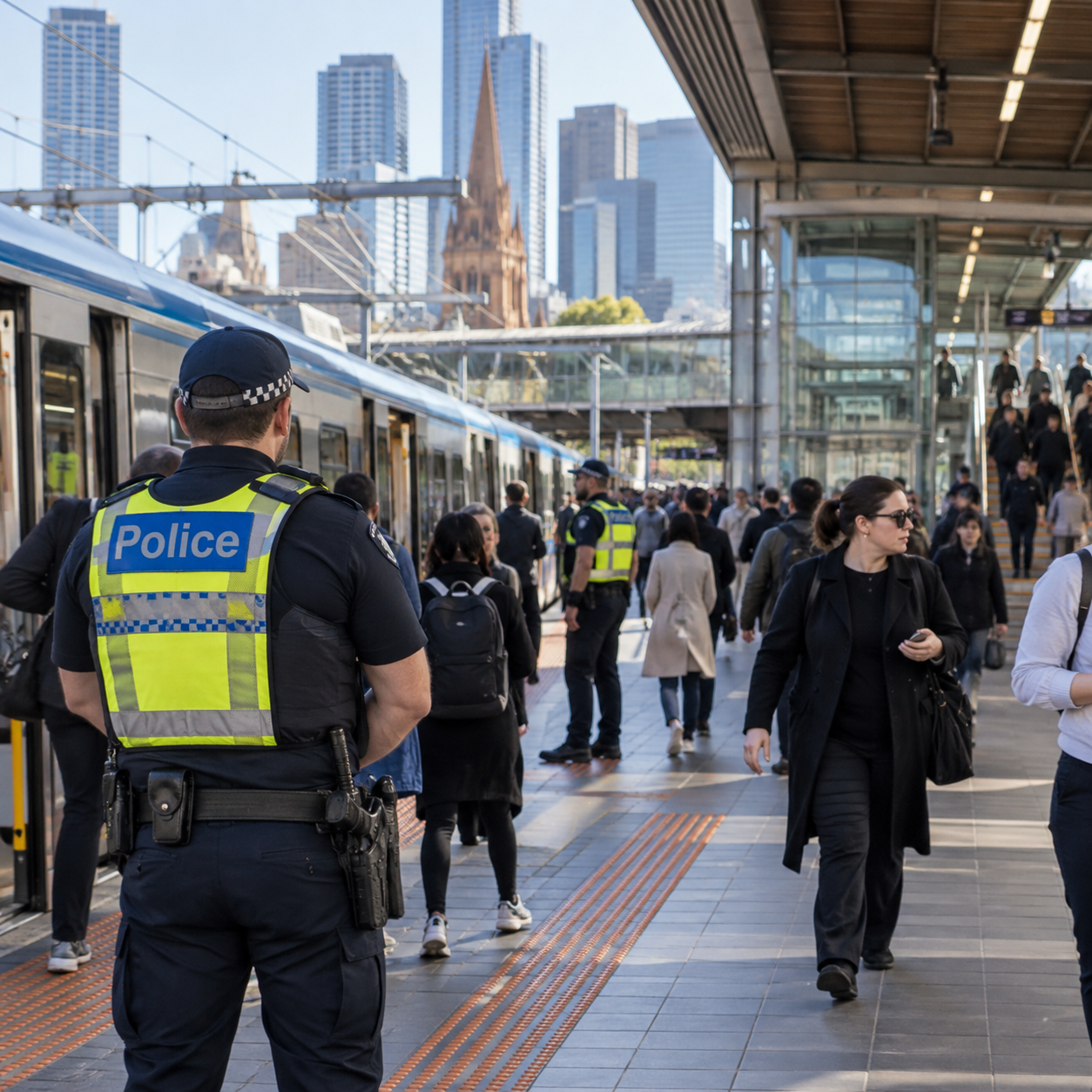
Internal intelligence briefs obtained under freedom-of-information laws describe what police call “communal weapons storage” at major transport precincts. The reports indicate officers believe weapons may be concealed near railway stations and other public places for later use.
The documents do not establish how many hidden weapons exist. Police themselves acknowledge an intelligence gap, which means the scale of the problem cannot currently be measured with confidence.
That uncertainty is important. The intelligence indicates a pattern police consider serious enough to monitor, but it should not be turned into a claim that every station or transport hub contains weapon caches.
Victoria Police estimates more than 15,000 machetes, zombie knives and other knives were seized across the state last year. That figure covers seizures broadly and is not a count of weapons found in communal hiding places.
The issue has become more prominent since Victoria’s machete ban came into effect on 1 September 2025. Under current rules, machetes are prohibited weapons unless a person is covered by an exemption or has formal approval.
Victoria Police says illegal possession of a machete can carry serious penalties, while exemptions exist for limited legitimate uses, including some agricultural, traditional, cultural and historical purposes.
The police intelligence suggests some young offenders may be adapting their behaviour in response to enforcement by avoiding carrying prohibited weapons for long periods and instead relying on shared storage points.
Criminologists say that behaviour, if it is occurring, would make traditional enforcement more difficult because a person may not have a weapon when first approached by police.
Public transport environments add another challenge. Stations and surrounding precincts can have lockers, landscaping, service areas, car parks and other places where objects can be concealed temporarily. High passenger volumes can also make it difficult to distinguish ordinary activity from deliberate weapon storage.
Victoria Police already has search powers in designated weapons-search areas. In those areas, officers and protective services officers can use electronic wands and conduct searches for weapons under the applicable legislation.
The force also publishes notices when particular areas are designated for enhanced search powers, usually for limited periods and specified locations. Those powers are intended to prevent or deter violence or disorder and are subject to legal conditions.
Debate is now focusing on whether those powers should be expanded. Labor and the Coalition have both proposed broader stop-and-search arrangements in the lead-up to Victoria’s November state election, although the details and scope of their proposals differ.
Those political proposals are not yet the same as enacted statewide powers. Any expansion would need to be assessed against the final legislation, operational rules and safeguards that are actually adopted.
Supporters of broader search powers argue police need faster ways to find weapons before violent incidents occur, especially in busy public places. Critics generally raise questions about proportionality, oversight and the risk of searches falling disproportionately on particular groups.
The practical public-safety issue is narrower than the political debate: police want to reduce the availability of weapons in places where large numbers of people gather and move through each day.
For commuters, the current intelligence does not mean people should avoid Melbourne’s rail network. It does mean transport hubs are an active focus for police intelligence and weapons enforcement.
Passengers may also see more visible police activity, wanding operations or designated-area searches where authorities assess a heightened risk. People subject to those searches have legal obligations to comply, while police powers remain constrained by the relevant legislation.
The emergence of hidden communal weapons would also complicate the effect of possession bans. A ban can reduce lawful availability and make carrying a weapon an offence, but enforcement agencies still need intelligence to locate weapons that are deliberately concealed before they are used.
That places greater importance on surveillance, community reporting, intelligence sharing and rapid investigation after violent incidents or suspicious discoveries.
The key fact at this stage is that Victoria Police intelligence identifies communal weapons storage as a growing concern, while also acknowledging that the true number of hidden weapons is unknown.
Any stronger conclusion — such as a precise count of caches, a claim that the practice is widespread across every station, or an assertion that proposed search laws will eliminate the problem — would go beyond the available evidence.
The public-transport setting matters because police data show recorded offending at train stations has risen substantially over time. Crime Statistics Agency figures cited in current reporting show offences at train stations increased from just under 8,000 in 2017 to 12,579 in the year to June 2026.
That total covers many offence types and should not be read as a count of knife incidents. It does, however, explain why railway stations and nearby shopping and transport precincts have become prominent targets for weapons-search operations and intelligence work.
Victoria Police says protective services officers already conduct sweeps around station environments looking for weapons that have been deliberately concealed. The new intelligence suggests those sweeps may be dealing not only with individuals carrying knives but with weapons intended to be shared or retrieved later.
The machete ban creates an additional enforcement layer. Since 1 September 2025, Victoria has classified machetes as prohibited weapons. Victoria Police says it is illegal to own, use, carry, transport, sell or buy a machete without an exemption or valid approval, with unlawful possession carrying penalties of up to two years in prison or a fine of more than $48,000.
Exemptions exist for some legitimate activities, so the ban is not a statement that every machete in Victoria is unlawful. People relying on an exemption must meet its conditions and be able to demonstrate their eligibility if asked.
Police can also declare designated weapons-search areas under existing law. Within those areas, officers and protective services officers can stop people or vehicles and conduct weapons searches, including with electronic wands, without the ordinary requirement for individual suspicion that would apply in many other circumstances.
Victoria Police publishes notices identifying the location and period of each designation. Some declarations can cover transport precincts, shopping areas or other public places where police assess an elevated risk of violence or disorder.
The proposed expansion known as Jack’s Law would go further. Labor has promised broader stop-and-search powers and additional handheld metal-detecting wands if re-elected, while the Coalition has also supported an expansion. Because Victoria has an election in November, the final shape of the policy will depend on legislation and implementation after the political process is complete.
There is disagreement over whether wider suspicionless search powers reduce serious violence. Supporters argue that visibly searching for knives can deter carrying and help police remove weapons before they are used. Civil-liberties groups and some criminologists say evidence of long-term crime reduction is limited and warn that broad powers can increase intrusive encounters without addressing the causes of violent offending.
Concerns about unequal impact are also part of the debate. Data from Queensland’s version of Jack’s Law have been cited by critics who say First Nations people are disproportionately represented among those searched. Victoria Police has said it has zero tolerance for racial profiling.
Existing Victorian powers have also faced legal scrutiny. Earlier this year the Federal Court found that a broad designation covering Melbourne CBD and surrounding areas for six months was invalid and breached the state’s human-rights framework. That judgment is one reason the design and limits of any expanded law will matter.
None of that changes the immediate intelligence issue. A weapon hidden near a station can be available to someone who was not carrying it when police first encountered them, making detection more dependent on searches of places, surveillance, informants and targeted intelligence.
It also means seizure statistics need to be interpreted carefully. The more than 15,000 knives and similar weapons Victoria Police says it seized last year demonstrates the scale of enforcement activity, but it does not tell the public how many people intended to use those weapons, how many were linked to youth offending or how many came from hidden communal stores.
For commuters, practical risk information should continue to come from police and transport authorities rather than viral claims about particular stations. The current documents identify a real policing concern but do not provide a verified list of public transport locations where a hidden knife is known to be present at any given time.
The next steps will include continued police operations, the implementation of existing machete restrictions and a political debate over future search powers. For the public, the safest reading is that authorities have identified a changing pattern of knife-related offending and are adapting their enforcement response, while the scale of the hidden-storage problem is still being established.