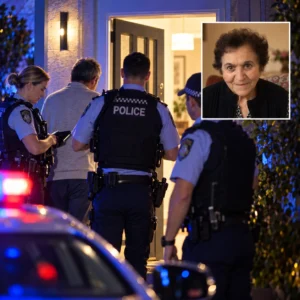
A Sydney woman who killed and dismembered her husband before disposing of his remains in bins across the city’s south-west has been sentenced to six years and three months in prison, with a non-parole period of three years.

Nirmeen Noufl, 55, pleaded guilty to manslaughter after prosecutors accepted that she killed her husband, 62-year-old Mamdouh Noufl, in excessive self-defence during a violent confrontation at their Greenacre home in 2023.
The sentence means Noufl will be eligible to apply for parole in October next year because she has already spent almost two years in custody since her arrest in October 2024. Eligibility for parole does not mean release is automatic.
The distinction between the total sentence and the non-parole period is important. Some commentary has described the outcome as a “three-year sentence”, but NSW Supreme Court Justice Peter Hamill imposed a head sentence of six years and three months. The three-year figure is the minimum period she must serve before becoming eligible for parole.
Noufl had originally been charged with murder. Shortly before a lengthy trial was due to begin, the Crown accepted her plea to the lesser offence of manslaughter on the basis of excessive self-defence.
According to agreed facts reported by the ABC, Noufl told psychiatrists that an argument became physical in May 2023. She said her husband assaulted her, pinned her to the kitchen floor and choked her. She reached for a nearby renovation tool and stabbed him while believing her life was in danger.
Justice Hamill said he was not satisfied beyond reasonable doubt that Noufl intended to kill her husband. The court nevertheless had to sentence her for an unlawful killing and consider what happened afterwards, when Mr Noufl’s body was dismembered and disposed of.
Mr Noufl was reported missing in July 2023. His body has never been recovered.
The agreed facts describe steps taken after the killing to cut up and dispose of his remains. A witness who attended the home in the days that followed saw parts of a large saw that had been dismantled and pieces of plastic, some carrying blood.
Mr Noufl’s remains were placed in garbage bags and disposed of in bins with the assistance of the witness, who cannot be identified for legal reasons.
Justice Hamill described the disposal as a deeply disturbing feature of the offending. He said the conduct after the killing was relevant to the court’s assessment of remorse, rehabilitation and future risk.
The court also considered the history of the couple’s marriage. Evidence before the court described years of dysfunction, controlling behaviour, infidelity and domestic violence. The judge accepted that Noufl had experienced significant violence and that her personal history was relevant to sentence.
Those findings do not erase the seriousness of the conduct after Mr Noufl died, but they help explain why prosecutors accepted excessive self-defence rather than proceeding with the murder charge.
Under Australian criminal law, self-defence can excuse a killing where the accused reasonably believes the conduct is necessary to defend themselves and the response is reasonable in the circumstances as they perceive them. Excessive self-defence applies where a person genuinely believes lethal force is necessary but the response is not legally proportionate, reducing what might otherwise be murder to manslaughter.
The prosecution’s acceptance of the plea meant the court sentenced Noufl on that agreed basis rather than on the allegation that she intentionally murdered her husband for another motive.
Noufl also had a connection to the disability-services sector. The NDIS Quality and Safeguards Commission records a banning order against her under ABN 87 619 333 452.
The order, made in November 2024, prohibits her from engaging in activities related to the provision of services or supports to NDIS participants. It took effect on 26 November 2024 and is due to remain in force for three years across Australia.
That regulatory action is separate from the manslaughter sentence. The Commission’s public register confirms the banning order, but the criminal case before the Supreme Court concerned the death of her husband, not an allegation that she defrauded the NDIS.
Keeping those issues separate is important because public discussion of the case has sometimes combined her former business activities, religion, migration background and the homicide into a single narrative. The sentencing task focused on the evidence surrounding the killing, the history of domestic violence, the disposal of the body and Noufl’s prospects of rehabilitation.
The court’s decision also illustrates why a non-parole period should not be confused with the full punishment imposed. A non-parole period sets the earliest point at which an offender can seek conditional release. The parole authority can consider risk, behaviour in custody, rehabilitation and release arrangements before deciding whether release should occur.
If Noufl is granted parole when first eligible, she would serve the remainder of her sentence in the community under supervision and conditions. If parole is refused, she can remain in custody beyond that date.
For Mr Noufl’s family, the fact that his remains have not been found adds another dimension to the case. The absence of a body has deprived relatives of the ordinary process of burial and has complicated the evidentiary picture since the beginning of the investigation.
The court heard that the exact circumstances of the death could not be reconstructed in every detail. That uncertainty was one reason the agreed facts and psychiatric accounts were important to the resolution of the case.
Justice Hamill’s sentence reflects several competing features: the unlawful killing of a spouse, the severe and calculated concealment that followed, the offender’s history of domestic abuse, the accepted basis of excessive self-defence and the time she has already spent in custody.
The result is neither a finding of innocence nor a three-year total sentence. Noufl stands convicted of manslaughter and has received a six-year-and-three-month prison term. The three-year non-parole period means she may be considered for release next October, but any decision at that point will be made through the parole process.
The case has now moved from determining criminal liability to the administration of that sentence. The lasting unanswered question is where Mr Noufl’s remains are, while his family and the wider community are left with the consequences of a death that the court found arose from a violent and deeply troubled marriage.
The sentencing decision also reflects the way NSW courts separate moral shock from the legal basis of a conviction. The post-death dismemberment was highly disturbing, but Noufl was not sentenced for murder after the Crown accepted that the killing occurred in circumstances of excessive self-defence. The judge could consider the concealment as relevant conduct without rewriting the offence to which she had pleaded guilty.
Domestic violence evidence played a significant role in that legal context. The agreed facts described a marriage affected by controlling behaviour, violence and infidelity. Courts assessing self-defence must consider the circumstances as the accused perceived them, which can include a history of abuse rather than looking only at the final seconds of a confrontation in isolation.
At the same time, excessive self-defence means the response was not fully lawful. The plea accepts criminal responsibility for the death even though Noufl believed she needed to defend herself. That is why the outcome still involved a substantial custodial sentence.
The separate NDIS banning order should also be understood for what it is: a regulatory measure preventing Noufl from working in the provision of NDIS supports for a set period. The public register confirms the order but does not convert the manslaughter case into an NDIS fraud prosecution. Mixing the two can create a misleading impression of what the Supreme Court actually decided.
The same caution applies to references to Noufl’s religion or national background. Those facts may appear in biographical reporting, but they were not elements of the manslaughter offence and were not the basis on which the sentence was imposed. The legally important issues were the killing, the accepted self-defence circumstances, the disposal of the body, her personal history and sentencing principles.