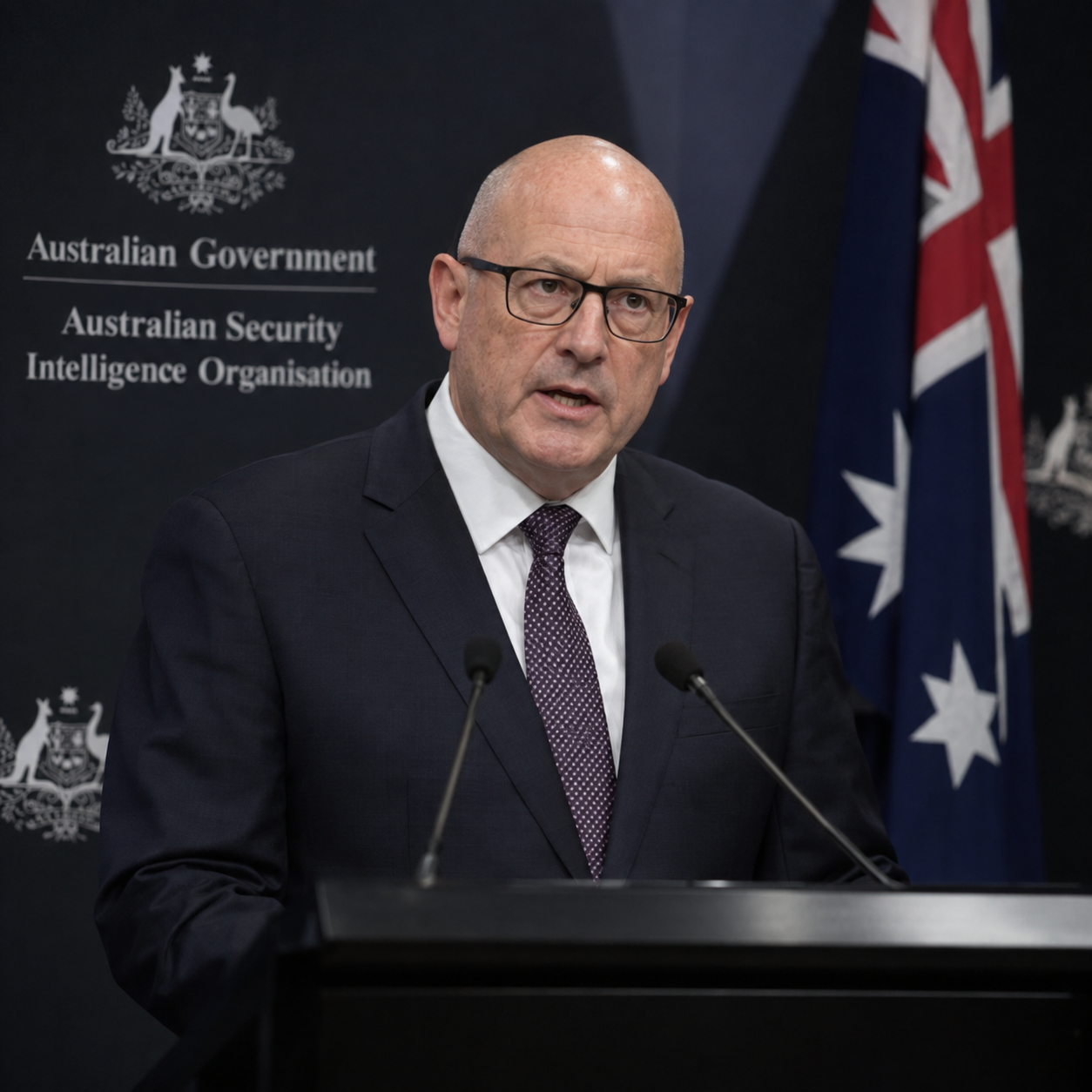
ASIO director-general Mike Burgess says he, political leaders and the media should have done more to call out antisemitism after the October 7 attacks, using a podcast interview to argue that hostile rhetoric can become more dangerous when institutions and public figures fail to challenge it early.
Burgess’ comments were reported by ABC News on Friday and followed a broader 2026 threat assessment in which Australia’s domestic intelligence chief identified antisemitism as a feature appearing across multiple violent extremist cohorts. His remarks are an intelligence and security assessment, not a legal finding about any particular protest, political statement or criticism of the Israeli government.
The distinction matters because public debate over Israel, Gaza and Australian foreign policy is intense and politically contested. Burgess has previously stated that criticism of the government of Israel is not, by itself, antisemitic. At the same time, he has warned that some threatening statements and conduct directed at Jewish people go beyond political protest or commentary.
In the latest interview, Burgess reportedly described the level of antisemitism in Australia as disturbing and said greater action should have been taken earlier by people with public platforms and institutional responsibility. He included himself in that criticism, rather than presenting the problem solely as a failure by politicians or journalists.
That framing is significant because ASIO’s role is narrower than the public political debate. The agency is responsible for identifying and investigating national-security threats including terrorism, espionage and foreign interference. It does not determine the boundaries of ordinary political disagreement, and it is not a general regulator of lawful protest or criticism of foreign governments.
Police, courts, anti-discrimination bodies, employers, universities and other institutions operate under different legal frameworks. Conduct can be offensive without being a national-security threat, and conduct can be a security concern without ASIO publicly disclosing the underlying intelligence. Readers therefore need to separate Burgess’ security assessment from broader arguments over speech and politics.
In his 2026 threat assessment, Burgess argued that contemporary violent extremism is more diverse than the period when agencies could focus heavily on one dominant ideology. He pointed to extremist actors across different ideological backgrounds and said hatred of Jewish people appeared in several of those cohorts.
That does not mean those groups share the same politics or goals. Far-right extremists, religious extremists, anarchist or revolutionary actors can have fundamentally different beliefs. ASIO’s point, as publicly described, is that antisemitic narratives can be adopted across otherwise unrelated movements and can be used to justify threats or violence.
Burgess has also warned against treating Jewish Australians as representatives of the Israeli government. That is an important distinction in a multicultural democracy: Australian citizens and communities should not be held collectively responsible for decisions made by a foreign state simply because of religion, ethnicity or family background.
The reverse distinction also matters. Australians are entitled to criticise Israeli government policy, military conduct, settlements, the war in Gaza or Australia’s diplomatic position. Describing all such criticism as antisemitism would collapse legitimate political debate into a category of racial or religious hatred. Burgess’ earlier public language has explicitly recognised that criticism of Israel is not inherently antisemitic.
The hard cases arise when political language shifts from criticism of a government to threats, harassment or collective blame directed at Jewish people. Different organisations and legal frameworks use different definitions of antisemitism, and there is continuing debate over where particular anti-Zionist or anti-Israel statements fall. Those definitional disputes cannot be resolved simply by citing ASIO.
What ASIO can contribute is its assessment of threat behaviour. If rhetoric is linked to people advocating violence, planning attacks, targeting community sites or acting on behalf of foreign states, it can move into the agency’s security remit. Burgess’ public interventions are therefore focused less on adjudicating political slogans and more on the consequences when hate becomes intimidation or violence.
The latest remarks also sit within a wider security environment in which Burgess has warned about threats from foreign states and cyber actors. Reporting on the same interview highlighted concerns about hostile governments potentially targeting people in Australia and about the vulnerability of modern technology to surveillance and espionage.
Those issues reinforce ASIO’s broader message that domestic social tensions can interact with international conflicts and foreign influence. An overseas war can intensify community divisions in Australia; foreign actors can exploit those divisions; and individuals can be radicalised through online networks that cross national borders.
But the existence of that risk does not make every heated political argument a security matter. Democratic politics depends on people being able to disagree strongly, protest, organise and criticise governments. The security threshold becomes more relevant where conduct involves threats, violence, support for violent extremism or foreign interference.
Burgess’ criticism of the media and politicians is therefore best understood as a call for earlier public challenge to antisemitic hostility, not as an instruction to suppress debate about Israel. Media organisations still have to report opposing views fairly, distinguish verified incidents from claims, and avoid presenting contested political definitions as settled facts.
Politicians face a similar responsibility. They can condemn antisemitic threats while also recognising the rights of people to advocate for Palestinians, criticise Israeli policy or argue for changes to Australian foreign policy. The two positions are not mutually exclusive, even though public debate often treats them as if they are.
There are also competing views about how governments should respond. Jewish organisations and some security analysts have called for stronger action against antisemitic hate and intimidation. Civil-liberties advocates and some academics have warned that broad definitions or security framing can chill legitimate political speech. Those disagreements are part of the policy debate and should be attributed rather than resolved by a news article.
The key factual point in Burgess’ latest intervention is narrower. Australia’s top domestic intelligence official believes antisemitism reached a level after October 7 that should have been challenged more directly and sooner, and he says responsibility for that response was shared across security leadership, politics and media.
His comments will likely feed into continuing debate over social cohesion, hate speech, protest, policing and the role of national-security agencies. They do not decide those debates, but they add the perspective of an agency that is focused on what happens when ideological hostility crosses into threats to life or national security.
For readers, the safest way to interpret the remarks is to keep three categories separate: criticism of the Israeli government, antisemitic hostility toward Jewish people, and violent or national-security threats. They can overlap in particular cases, but they are not automatically the same thing. Burgess’ own public statements have acknowledged that distinction even as he argues Australia responded too slowly to the rise in antisemitic hostility.
ASIO’s intervention also needs to be read in the context of agency accountability. Intelligence services can warn about patterns they see in classified reporting, but much of the underlying evidence cannot be made public. That makes precise language important. When Burgess speaks about antisemitism across extremist cohorts, the public can scrutinise his stated assessment but cannot independently inspect every intelligence file behind it.
That limitation is one reason political leaders and journalists should avoid turning an intelligence warning into a blanket label for people taking part in lawful protest. National-security agencies are most useful when their warnings are tied to behaviour, intent and threat pathways, rather than used as a shortcut for settling political arguments.
Australia’s response also operates through institutions beyond ASIO. Police investigate criminal threats and violence; courts determine guilt; governments set hate-speech and security laws; universities and employers apply their own conduct rules; and civil-society groups debate definitions and community impacts. Burgess’ comments add one perspective to that system rather than replacing the role of those institutions.
The practical test of his argument is whether earlier public challenge to hateful rhetoric can reduce escalation without narrowing legitimate debate. That is ultimately a policy and social question, not one ASIO can answer alone. The agency can identify threat patterns, but elected governments and the wider community decide how to respond while protecting democratic freedoms.