Australian researchers who analysed more than 10,000 pedestrian crashes have found a clear association between larger passenger vehicles and a higher risk of pedestrian death, adding local evidence to a safety debate that has intensified as SUVs, utes and large pick-up trucks take a growing share of the national fleet.
The study linked 10,376 pedestrian crashes involving passenger vehicles in Victoria between 2012 and 2025 with real vehicle-dimension data. After controlling for other factors in the crash records, the researchers found that every additional 100 kilograms of vehicle weight was associated with a 6 per cent increase in the odds of pedestrian death, while every additional 10 centimetres of vehicle height was associated with an 11 per cent increase.
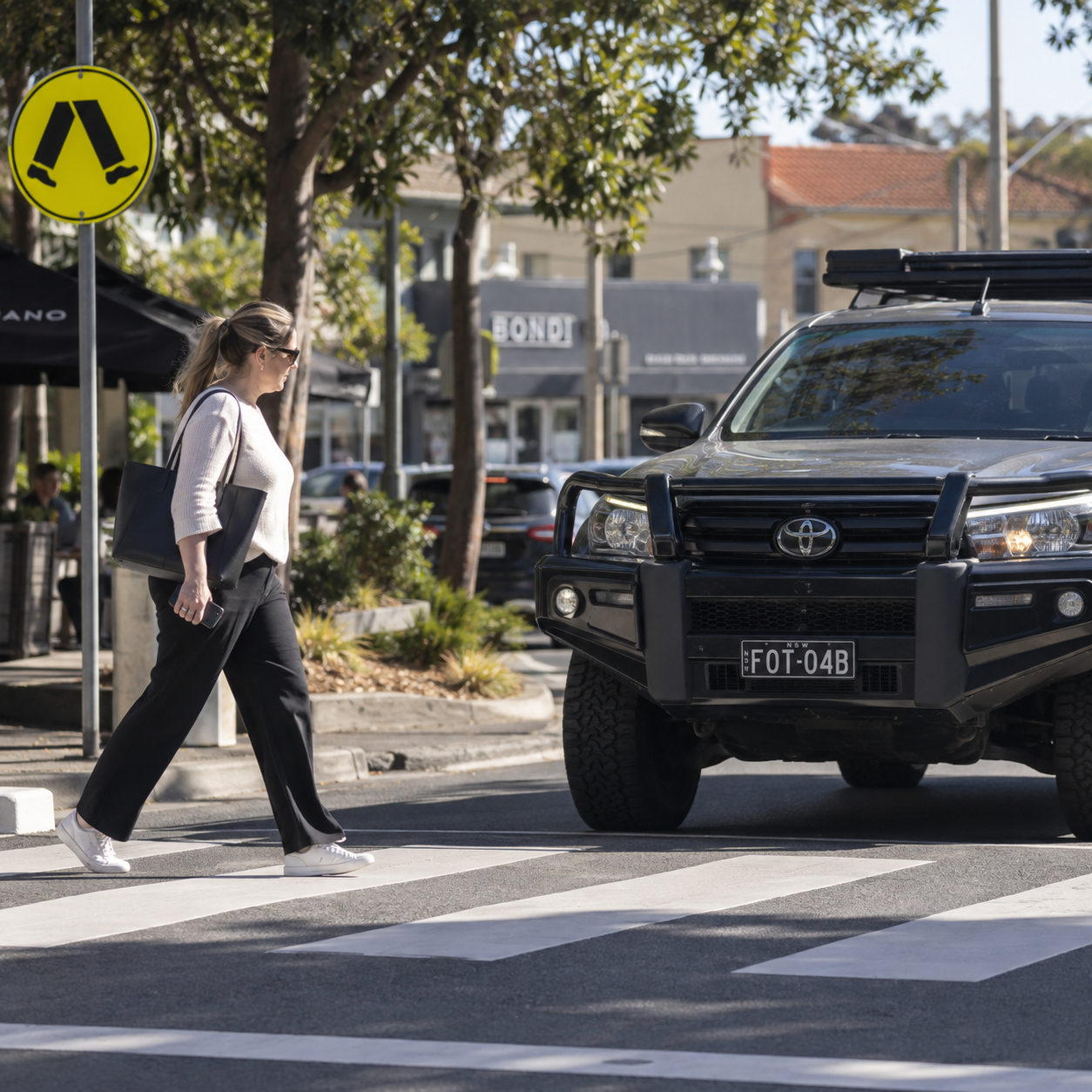
The study, published in Accident Analysis and Prevention and reported by ABC Story Lab, is important because much of the recent debate over large vehicles and pedestrian safety has relied on United States data. Australian vehicle fleets, road design, crash patterns and pedestrian-safety history are not identical to those in the US, so researchers wanted to test whether the same size-related pattern appeared locally.
The answer from the Victorian dataset was yes, but with an important qualification: the research identifies associations, not a simple one-factor cause. A crash outcome can be influenced by impact speed, road environment, lighting, the age and health of the pedestrian, driver behaviour, vehicle design and many other variables. Statistical modelling can account for known factors, but it cannot recreate a controlled experiment on public roads.
The researchers compared vehicle categories as well as dimensions. Relative to passenger cars such as sedans and hatchbacks, station wagons were associated with about 1.2 times the probability of pedestrian death and utility vehicles with about 1.6 times the probability. The dimension-based models then allowed the researchers to look beyond labels and ask whether actual height and weight were associated with outcomes.
The size effects remained after adjustment. The reported 6 per cent increase in fatality odds for each extra 100kg had a 95 per cent confidence interval of roughly 3 to 10 per cent. The 11 per cent increase associated with each additional 10cm of vehicle height had a confidence interval of about 4 to 18 per cent. Those ranges indicate statistical uncertainty around the point estimates, but both associations remained positive in the model.
Odds are not the same thing as a simple percentage-point probability. An 11 per cent increase in odds does not mean that adding 10cm to a vehicle automatically makes every crash 11 percentage points more likely to be fatal. The result describes the relationship found by the model across the observed crashes after accounting for other variables.
The study also found the associations were more evident in crashes at lower speeds. That may sound counter-intuitive because higher speed is a major driver of injury severity, but at very high impact speeds the crash can already be so dangerous that differences in vehicle dimensions become harder to distinguish statistically. At lower speeds, vehicle shape and mass may play a more visible role in whether injuries become fatal.
One mechanism discussed in the broader research is where the vehicle strikes a pedestrian. A lower, more sloping front can make first contact lower on an adult body, while a taller and more vertical front can strike the torso or upper body. The physical consequences can also differ for children because their height places vital areas of the body closer to the front structure of a large vehicle.
The Australian study used overall vehicle height because detailed front-end or bonnet-height data were not available across the Victorian crash sample. That is a limitation. Separate US research has focused directly on front-end height and found strong associations with pedestrian death. The Australian authors note that if equivalent front-end measurements became available locally, they could allow more precise analysis of design rather than overall height.
Weight matters through a different physical pathway. At the same speed, a heavier vehicle carries more kinetic energy. Vehicle mass can also affect how quickly a vehicle can stop and what happens after the first impact. But the study does not suggest weight is more important than speed; rather, it identifies weight as an additional factor within crashes that have already occurred.
The research arrives as Australia’s vehicle market has shifted away from traditional sedans and hatchbacks. Utility vehicles and SUVs now account for a large share of sales, while large US-style pick-up trucks have become more visible. Some buyers choose them for towing, work, rural use or load capacity. The safety question is not whether those uses are legitimate, but whether the external risk to pedestrians is adequately recognised in design standards and consumer information.
Modern vehicles have become much safer for occupants. Stronger passenger cells, airbags, electronic stability systems, automatic emergency braking and other technologies have reduced many risks for people inside cars. Pedestrians and cyclists do not benefit from the same protective structure, so a vehicle can score well on occupant protection while still presenting a different level of risk to someone outside it.
That creates a policy challenge. Regulators could respond through pedestrian-impact standards, vehicle-design rules, safety-rating systems, urban speed management or technology such as automatic emergency braking with pedestrian detection. The study does not identify a single best intervention. It provides evidence that vehicle size deserves a place in the discussion.
The researchers also modelled a hypothetical scenario in which vehicle weight or height was capped at the median levels observed in the sample. Their modelling corresponded to roughly 9 per cent fewer predicted pedestrian fatalities within the analysed crashes. That is not a forecast of what would happen if Australia adopted a legal size cap; it is a modelled comparison showing the potential scale of the association in the dataset.
Any policy built from that result would need to consider trade-offs. Large vehicles can be necessary for some industries and regional tasks, and fleet turnover happens gradually. A regulatory response could focus on front-end design or crash-avoidance performance rather than overall dimensions alone. Consumer ratings could also make external-road-user safety more visible without banning particular categories.
Speed remains one of the most powerful determinants of pedestrian survival, so the study should not be read as an argument that a small car is harmless or that vehicle size replaces the need for safe speeds. A smaller vehicle travelling too fast can still be fatal, while a larger vehicle equipped with effective collision-avoidance systems may avoid some crashes entirely.
The value of the new research is that it adds Australian evidence to a question that had often been dismissed as an American problem. The Victorian data show the local fleet transition is associated with measurable differences in pedestrian outcomes, even after accounting for multiple crash characteristics.
The study also provides a clearer way to talk about risk without turning the issue into a cultural argument over particular vehicle owners. The finding is about population-level crash outcomes and vehicle characteristics, not about the motives or behaviour of every person who buys a ute, SUV or pick-up.
For manufacturers, the results strengthen the case for designing larger vehicles with pedestrian impacts in mind. For regulators, they raise questions about whether current standards sufficiently account for external road users. For consumers, they add another dimension to the meaning of vehicle safety.
The strongest conclusion remains measured: among 10,376 Victorian pedestrian crashes, taller and heavier passenger vehicles were associated with higher fatality odds, and utility vehicles showed a higher probability of death than sedans and hatchbacks. The research does not prove that size alone caused any individual death, but it suggests that as Australia’s fleet grows larger, pedestrian safety cannot be assessed only from inside the cabin.
There is also a design question hidden inside the category labels. Two vehicles can both be sold as SUVs or utes while having very different bonnet geometry, mass and crash-avoidance technology. That is why the authors’ use of real dimension data is useful: it shifts attention from marketing categories to measurable characteristics that can be compared across models.
The study’s findings could eventually influence how safety organisations communicate risk. Consumer ratings traditionally emphasise how well a vehicle protects people inside it. A more complete safety picture could give buyers information about pedestrian protection and collision avoidance as well, allowing people who need a larger vehicle to compare models on external-road-user safety rather than treating all large vehicles as equivalent.
The research also gives policymakers a starting point for Australian-specific follow-up work. Better front-end-height data, national crash datasets and analysis of cyclist outcomes could test whether the Victorian pattern holds across jurisdictions and road users. That additional evidence would help distinguish which aspects of vehicle size matter most before governments consider design or regulatory changes.