A Queensland 18-year-old remains in custody over a large group of alleged online extremist and child-abuse-material offences after an investigation that police say began with information supplied by the FBI. The case started publicly in May, when Australian authorities acted on a report concerning an Australian social-media user allegedly posting material that advocated violence and referred to terrorist attacks.
Police and early ABC reporting said the teenager was charged with 30 offences. A later court report published after the latest mention referred to 29 charges. Because those public accounts are not identical, this article avoids presenting the charge count as settled and instead describes the accused as facing dozens of charges while the current court record is clarified. The allegations have not been tested and there has been no finding of guilt.
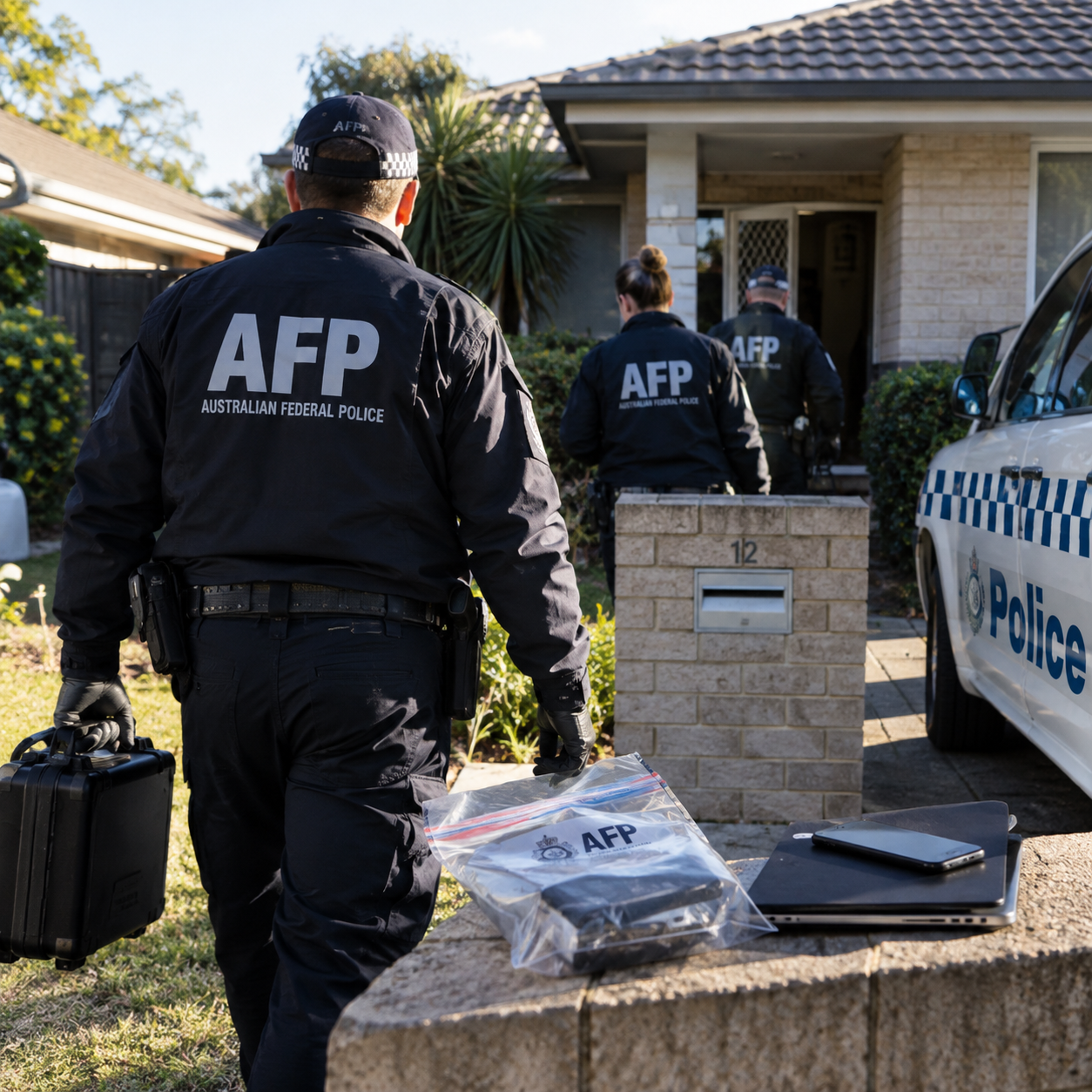
The investigation was conducted by the Queensland Joint Counter Terrorism Team. According to police and reporting based on Australian Federal Police material, the referral from the United States Federal Bureau of Investigation concerned an Australian user allegedly spreading extremist content on an online platform. Investigators then focused on a home in Warner, in Brisbane’s north-west, where officers executed a search warrant on 27 May.
Several electronic devices were seized during the search. Police allege the accused was operating multiple social-media channels that shared extremist material and supported violence against people of Muslim, Jewish and migrant backgrounds. Forensic examination of the seized devices allegedly identified files containing violent extremist material as well as child abuse material.
The charges described publicly include allegations of using a carriage service to transmit violent extremist material, using a carriage service to harass or cause offence, and possessing or controlling child abuse material. Some later reporting also described allegations involving the promotion, solicitation or possession of extremist material. The precise charge sheet, rather than media summaries, will ultimately determine what the prosecution must prove.
The teenager first appeared before a court on 27 May and was remanded in custody. Early Friday reporting said he was expected to reappear in Pine Rivers Magistrates Court on 18 September. A later report said the matter was briefly mentioned, the accused did not appear, no bail application was made and a magistrate ordered a brief of evidence before the matter was adjourned.
That development is important because a brief of evidence is the material prosecutors rely on to set out the case against an accused person. In a matter built around online activity and seized devices, the brief can include forensic material, account records, communications, file data and other evidence said to connect a person to particular accounts or content. The existence of seized devices or disturbing material does not by itself establish who created, uploaded, controlled or intended to distribute it.
The central legal safeguards therefore remain unchanged. Charges are allegations. Remand is not a conviction. The prosecution bears the burden of proving each offence to the required criminal standard, while the accused has the right to challenge whether the evidence establishes control of accounts, knowledge of material, intent and the other elements of any specific charge.
Australian Federal Police Detective Superintendent Anthony Conway said, in comments carried by AAP and other outlets, that police treat information about people allegedly promoting or encouraging violence online as a national-security priority. He also linked the investigation to broader efforts to reduce radicalisation risks among vulnerable young people.
That wider concern has become increasingly visible in Australian security debates. Law-enforcement and intelligence agencies have repeatedly warned that radicalisation can occur online, sometimes through mainstream social platforms, gaming environments or encrypted channels. The Warner case should not be treated as proof of any broader trend on its own, but it illustrates the cross-border nature of online investigations: an account can be visible overseas, a platform can be based in another jurisdiction, and the person alleged to control it can be in Australia.
The FBI referral is significant for that reason. Australian agencies routinely cooperate with overseas partners where information may involve an Australian user or a potential threat. In practical terms, that can mean foreign agencies identify material first, pass relevant information to Australian counterparts, and local investigators then decide whether there are grounds for warrants, device seizures or charges under Australian law.
Police have not publicly released the complete digital evidence behind the prosecution. Nor has the court made findings about whether the accused created every item allegedly located, controlled the channels described by police or intended the consequences alleged by investigators. Those questions remain for the criminal process.
The reported mix of extremist-content allegations and child-abuse-material allegations also needs to be kept legally distinct. They are different categories of alleged offending, with different evidentiary issues. The public fact that both categories were described after the same device examination does not mean every device contained both, or that every charge depends on the same file, post or account.
The case also carries a risk of overstatement because the alleged content is inflammatory. Police say the channels supported violence against Muslims, Jewish people and migrants. That is a serious allegation, but reporting should not convert an allegation about advocacy or material into a proven plan for a physical attack unless prosecutors establish that separately. The public material currently available describes alleged online conduct and alleged possession or transmission of prohibited content; it does not establish a completed violent attack by the accused.
Similarly, the investigation being handled by a counter-terrorism team does not automatically mean every charge is a terrorism offence. Joint counter-terrorism teams investigate a range of conduct connected to violent extremism and national security. The legal character of each offence depends on the actual charge and the facts alleged to support it.
The latest court step means attention now shifts away from the initial arrest narrative and toward the evidence. If a brief is served, defence lawyers can assess the prosecution case in detail, including the basis for linking accounts and devices to the accused, the nature of the material, and whether the elements of each offence are made out.
Further hearings will also clarify whether the prosecution’s current charge count is 29 or 30. Police and ABC material released on Friday used the figure 30, while later court reporting used 29. Until a court list, prosecution document or updated agency statement resolves that discrepancy, the safest description is that the 18-year-old faces dozens of charges arising from the investigation.
What is confirmed is narrower but still significant: the investigation began after an FBI report, the Queensland Joint Counter Terrorism Team searched a Warner home on 27 May, electronic devices were seized, police allege extremist and child abuse material was found during forensic examination, and the accused remains before the courts. Everything beyond those established procedural facts — including responsibility for the alleged accounts and material — remains to be determined through the legal process.
One further issue is the way online offences can produce different public charge totals as a case develops. Police may initially announce a set of charges laid at arrest, while prosecutors can later withdraw, amend, consolidate or add charges before a matter progresses. That is one possible explanation for the 30-versus-29 discrepancy in current reporting, but it should not be assumed without the updated charge sheet. Until that document is public, reporting the accused as facing dozens of charges is more accurate than choosing one number and presenting it as undisputed.
The next court steps are likely to be procedural rather than a determination of guilt. A brief of evidence can be followed by further mentions, legal submissions and decisions about which charges proceed. If any offences are indictable, the matter may later move beyond the Magistrates Court. None of those stages should be described as proof that the allegations occurred; they are part of the process for testing whether the prosecution has a case to answer.
The investigation also demonstrates why cross-border referrals require careful attribution. The FBI is reported to have supplied information that prompted the Australian investigation, but the Australian charges are being prosecuted under Australian law by Australian authorities. The FBI referral does not amount to a foreign finding of guilt, and it does not replace the need for admissible evidence in an Australian court.